Introduction
Qualitative research is a major research method in sociology used to understand meanings, experiences, social relationships, beliefs and everyday interactions. Unlike approaches that primarily measure social phenomena through numerical data, qualitative research seeks to understand how people interpret and experience their social world.
For UPSC Sociology Optional, qualitative research is important because it connects sociological theory with lived social reality. Thinkers such as Max Weber emphasised Verstehen, or interpretive understanding, while Erving Goffman examined everyday interaction through close observation. Indian sociologists such as M.N. Srinivas and Andre Beteille also demonstrated the value of intensive fieldwork in understanding Indian society.
Qualitative research therefore helps sociologists move beyond statistics to ask an important question: What does a social phenomenon mean to the people who experience it?
What is Qualitative Research?
Qualitative research is a systematic approach to studying social life through non-numerical data such as interviews, observations, field notes, life histories, documents and narratives.
Its primary objective is not simply to measure behaviour but to understand its meaning, context and social processes.
For example, a quantitative study may examine the percentage of women participating in the labour force. A qualitative study may ask why some women enter paid employment, how families perceive their employment, and how women negotiate household expectations.
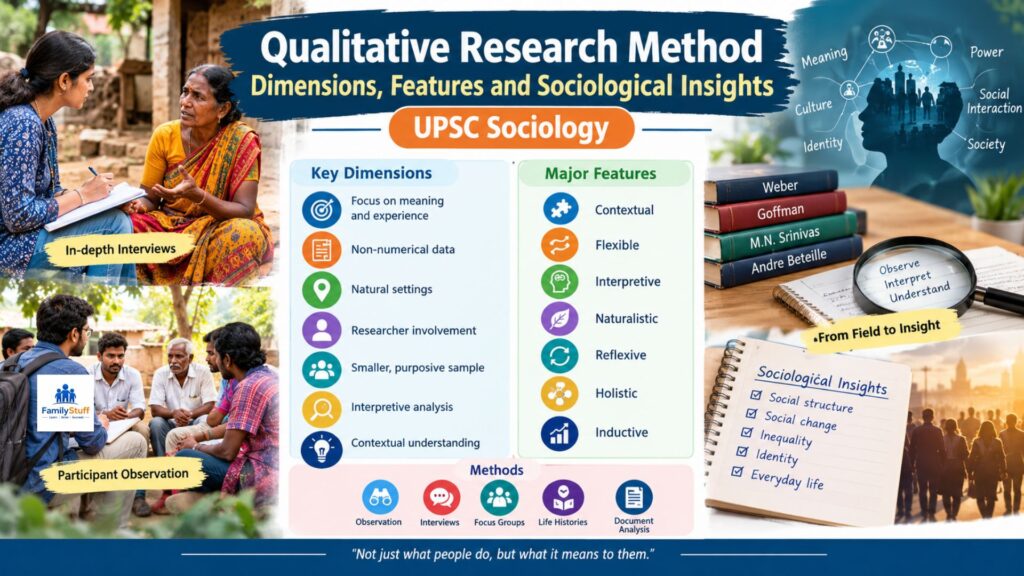
Key Dimensions of Qualitative Research
| Dimension | Qualitative Approach |
|---|---|
| Main concern | Meaning, experience and social processes |
| Data | Words, narratives, observations and documents |
| Setting | Often natural or real-life settings |
| Approach | Interpretive and contextual |
| Researcher | Actively involved in data collection and interpretation |
| Sample | Usually smaller and purposively selected |
| Analysis | Thematic, narrative or interpretive |
| Outcome | Rich and contextual understanding |
Thus, qualitative research attempts to understand social reality from the perspective of social actors.
Theoretical Foundations of Qualitative Research
Max Weber and Verstehen
Max Weber provides one of the strongest theoretical foundations for qualitative sociology.
His concept of Verstehen refers to interpretive understanding of social action. Weber argued that sociology must understand the meanings actors attach to their actions.
For example, two people may participate in the same religious ceremony, but their personal motivations may differ. Understanding these meanings requires more than simply counting participants.
Symbolic Interactionism
Symbolic interactionists such as George Herbert Mead and Herbert Blumer emphasised that social reality develops through interaction and shared meanings.
Qualitative methods are particularly useful for studying:
- Identity
- Self and society
- Everyday interaction
- Symbols
- Social roles
- Meaning-making
Erving Goffman
Goffman’s study of everyday interaction demonstrates how detailed observation can reveal social rules and performances.
His dramaturgical perspective compares social interaction with theatrical performance. Concepts such as front stage, back stage and impression management can be explored effectively through qualitative observation.
Interpretive Sociology
Interpretive sociology focuses on how individuals understand their social situations.
Therefore, qualitative research is particularly valuable when researchers want to study subjective meanings rather than only observable behaviour.
Major Methods of Qualitative Research
1. Participant Observation
The researcher observes social life while participating, to varying degrees, in the community being studied.
Participant observation helps researchers understand:
- Everyday practices
- Informal social norms
- Group relationships
- Rituals
- Power relations
It is especially useful when people may find it difficult to explain their behaviour through formal interviews.
2. In-depth Interviews
In-depth interviews allow researchers to explore individual experiences, perceptions and meanings.
Unlike highly structured questionnaires, qualitative interviews can be flexible. The researcher can ask follow-up questions when new themes emerge.
3. Focus Group Discussions
A focus group brings several participants together to discuss a particular topic.
The interaction between participants itself becomes valuable data. Agreement, disagreement and negotiation can reveal collective perceptions.
4. Life Histories and Narratives
Life-history research examines an individual’s experiences over time.
It can help sociologists understand how wider structures such as class, caste, gender, education and migration shape individual biographies.
5. Document and Content Analysis
Researchers may examine:
- Diaries
- Letters
- Newspapers
- Government documents
- Social media content
- Autobiographies
- Institutional records
These sources can reveal changing social values and cultural meanings.
Qualitative Research and Indian Sociology
Qualitative research has played an important role in studying Indian society.
M.N. Srinivas
M.N. Srinivas used intensive fieldwork to study caste, village life and social change. His concepts of Sanskritization, Westernization and dominant caste emerged from close engagement with Indian social realities.
His work demonstrates how field-based research can generate concepts that explain social change.
Andre Beteille
Andre Beteille’s work on caste, class and power in rural India demonstrated the importance of studying social institutions within their concrete social contexts.
His village studies showed that caste cannot always be understood independently of class and power relations.
G.S. Ghurye
G.S. Ghurye combined textual, historical and empirical approaches in studying caste and tribal communities. His work illustrates that qualitative understanding can be strengthened by connecting field realities with historical and cultural evidence.
Features of Qualitative Research
The major features can be summarised as follows:
| Feature | Sociological Significance |
|---|---|
| Contextual | Studies behaviour within its social setting |
| Flexible | Research questions may evolve during fieldwork |
| Interpretive | Focuses on meanings attached to actions |
| Naturalistic | Often studies people in real-life settings |
| Reflexive | Recognises the researcher’s influence |
| Holistic | Connects individual experiences with wider structures |
| Inductive | Concepts may emerge from empirical observations |
Qualitative research therefore treats social reality as complex, contextual and meaning-oriented.
Qualitative Research: Theory and Application
A major strength of qualitative research is its ability to connect abstract concepts with lived experiences.
For example, the concept of social exclusion can be studied through interviews with marginalised communities. Researchers can examine how exclusion is experienced in schools, workplaces, housing and public institutions.
Similarly, gender inequality can be explored by examining women’s everyday experiences of unpaid work, mobility restrictions and workplace expectations.
This demonstrates an important distinction:
Theory provides concepts for understanding society, while qualitative research helps reveal how those concepts operate in everyday life.
Qualitative and Quantitative Research: A Comparison
| Basis | Qualitative Research | Quantitative Research |
|---|---|---|
| Focus | Meaning and experience | Measurement and patterns |
| Data | Words and observations | Numerical data |
| Sample | Usually smaller | Often larger |
| Method | Interviews, observation, narratives | Surveys, statistical analysis |
| Strength | Depth and context | Generalisation and measurement |
| Research logic | Often inductive | Often deductive |
| Main limitation | Limited generalisability | May overlook meanings and context |
The distinction should not be treated as absolute. Contemporary social research increasingly uses mixed-method approaches, combining qualitative depth with quantitative measurement.
Criticism and Limitations of Qualitative Research
Qualitative research has several limitations.
Limited Generalisation
Studies involving small or purposively selected groups may not represent an entire population.
Researcher Subjectivity
The researcher’s interpretation can influence data collection and analysis.
Reflexivity Challenge
Researchers must examine their own assumptions, social position and relationship with participants.
Time and Resource Intensive
Ethnographic fieldwork and repeated interviews can require considerable time.
Access and Ethical Issues
Sensitive research may involve problems related to privacy, informed consent and confidentiality.
Difficulty of Replication
Because social contexts and researcher-participant relationships vary, another researcher may not reproduce exactly the same findings.
However, these limitations do not make qualitative research inferior. They highlight the need for methodological transparency, reflexivity and ethical research practices.
Contemporary Relevance of Qualitative Research
Qualitative methods remain highly relevant in contemporary society.
Researchers can use interviews and digital ethnography to study:
- Online communities
- Social media identities
- Platform-based work
- Migration experiences
- Youth culture
- Gender relations
- Changing family structures
- Caste and social exclusion
For example, understanding why young people construct particular identities on social media requires more than counting posts or followers. Researchers must examine symbols, narratives, peer influence and identity construction.
Thus, qualitative research remains valuable even as society becomes increasingly data-driven.
Why This Topic Matters for UPSC Sociology
Qualitative research is important for Sociology Optional Paper I, particularly questions related to sociological research methodology and methods.
It helps aspirants understand:
- Research methods
- Interpretive sociology
- Fieldwork
- Participant observation
- Objectivity and subjectivity
- Reflexivity
- Qualitative versus quantitative approaches
- Relationship between theory and empirical research
Its relevance also extends to Paper II, because Indian sociologists used field studies to understand caste, tribes, villages, family and social change.
For UPSC Mains, candidates can strengthen answers by connecting methodology with thinkers such as Weber, Goffman, Srinivas and Beteille.
UPSC Mains Answer Writing Approach
For a 10-Mark Question
Use a compact structure:
- Introduction – Define qualitative research.
- Core concept – Explain meaning, context and interpretation.
- Thinker – Use Weber’s Verstehen.
- Methods – Mention interviews, observation and life histories.
- Example – Give an Indian sociological example.
- Conclusion – Highlight its contribution to understanding social reality.
For a 15/20-Mark Question
Use a broader analytical structure:
Introduction → Definition → Theoretical foundations → Dimensions and methods → Thinkers → Indian examples → Comparison with quantitative research → Criticism → Contemporary relevance → Conclusion
A strong answer should distinguish between interpretation and measurement, while showing that both can complement each other.
5 Likely UPSC Sociology Questions
- Discuss the significance of qualitative research in understanding social action and social reality.
- Examine the relationship between Max Weber’s concept of Verstehen and qualitative research methods.
- Critically examine the strengths and limitations of qualitative research in sociological enquiry.
- Analyse the contribution of fieldwork and qualitative methods to the study of Indian society.
- “Qualitative research provides depth, while quantitative research provides breadth.” Discuss with suitable sociological examples.
FAQs on Qualitative Research Method
1. What is qualitative research in sociology?
Qualitative research is a method of studying social life through non-numerical data such as interviews, observations, narratives and documents, with emphasis on meaning and context.
2. Why is qualitative research important in sociology?
It helps sociologists understand people’s experiences, interpretations, relationships and everyday social practices that numerical data alone may not fully capture.
3. Which sociologist is associated with interpretive understanding?
Max Weber is strongly associated with Verstehen, or interpretive understanding of social action.
4. What are the main methods of qualitative research?
Major methods include participant observation, in-depth interviews, focus groups, life histories, narrative research and qualitative document analysis.
5. Is qualitative research better than quantitative research?
Neither method is universally superior. Qualitative research provides depth and contextual understanding, while quantitative research provides measurement and broader patterns. Mixed methods can combine their strengths.
Conclusion
Qualitative research provides sociology with a powerful way to understand meaning, experience, interaction and social context. Its foundations in Weberian interpretive sociology and symbolic interactionism show why social action cannot always be understood through measurement alone.
In India, field-oriented scholars such as M.N. Srinivas and Andre Beteille demonstrated how close engagement with communities can reveal the operation of caste, class, power and social change.
At the same time, qualitative research requires methodological discipline. Issues of subjectivity, generalisation, researcher influence and ethics must be addressed through reflexivity and transparency.
For Sociology Optional, the key insight is clear: qualitative research does not merely collect people’s stories; it systematically interprets those experiences to understand wider social structures and processes.