Introduction
The Neolithic period in India marks an important stage in the transition from hunting and gathering to food production, settled life and village-based communities. Archaeological evidence from different parts of the Indian subcontinent shows that this transition did not occur everywhere at the same time or in the same way.
For UPSC, Neolithic sites are important for both Prelims and Mains. Prelims questions may ask you to identify a site, region, archaeological feature or crop. In Mains, map-based knowledge can strengthen answers on Neolithic cultures, the beginning of agriculture, pastoralism, settlement patterns and regional variations in early Indian history.
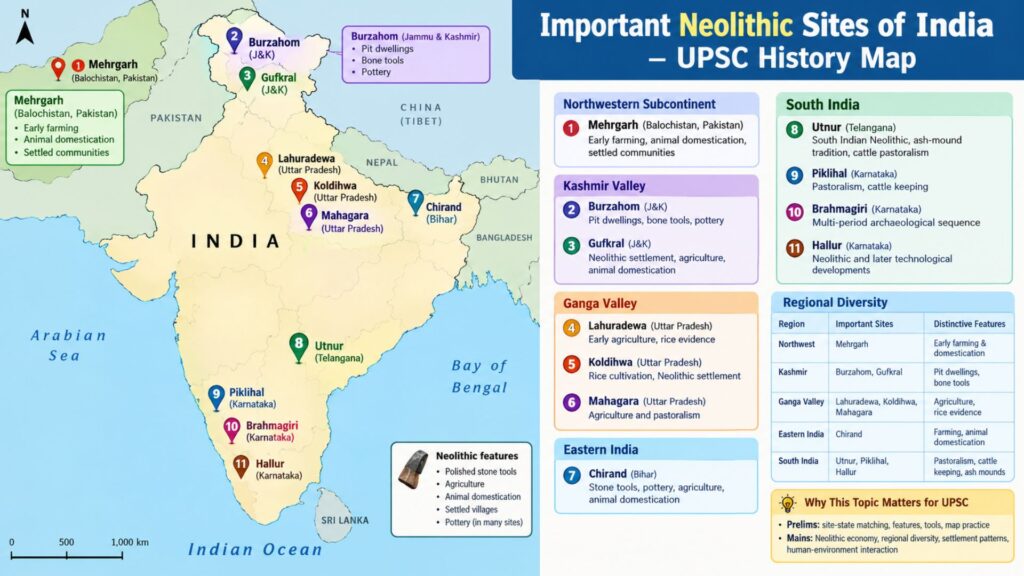
The most useful approach is to learn Neolithic sites region-wise on the Indian map, rather than memorising an isolated list of names.
What Was the Neolithic Period?
The term Neolithic means the “New Stone Age.” It broadly refers to communities that used polished stone tools and increasingly depended on agriculture, animal domestication and settled or semi-settled life.
However, the Neolithic was not simply a sudden shift from stone tools to agriculture. Different regions followed different trajectories.
Important features include:
- Ground and polished stone tools
- Beginning or expansion of agriculture
- Domestication of animals
- More permanent settlements
- Pottery in many communities
- Storage facilities
- Changing food habits
- Development of village communities
- Increasing regional cultural diversity
The chronology also varied considerably. Therefore, UPSC aspirants should avoid presenting the Indian Neolithic as a single uniform phase.
Major Neolithic Sites of India
1. Mehrgarh: The Northwestern Context
Mehrgarh, located in present-day Balochistan, is one of the most important archaeological sites for understanding the early development of agriculture and settled communities in the northwestern subcontinent.
It lies in present-day Pakistan, near the Bolan Pass.
Archaeological evidence from Mehrgarh includes:
- Early farming
- Animal domestication
- Mud-brick structures
- Burials
- Pottery in later phases
- Evidence of craft activities
Mehrgarh is especially important because it provides evidence for very early food-producing communities in South Asia.
UPSC Map Point
Remember:
Mehrgarh → Balochistan → Northwestern South Asia
It should not be confused with Indian Neolithic sites farther east or south.
2. Burzahom: Kashmir Valley
Burzahom, near Srinagar in Jammu and Kashmir, represents an important Neolithic tradition of the Kashmir Valley.
One of its most distinctive features is the presence of pit dwellings.
People excavated pits into the ground and used them as dwelling spaces, particularly during the earlier phases of occupation.
Archaeological evidence includes:
- Pit dwellings
- Ground and polished stone tools
- Bone tools
- Pottery
- Animal remains
- Evidence of hunting and farming
Burzahom is particularly useful for understanding how communities adapted their settlement practices to the environmental conditions of the Kashmir Valley.
UPSC Map Point
Burzahom → Kashmir Valley → Pit dwellings
This association is highly useful for Prelims.
3. Gufkral: Another Kashmir Neolithic Site
Gufkral, also located in Kashmir, provides additional evidence for the Neolithic cultural traditions of the region.
The site contains evidence associated with:
- Neolithic settlement
- Agriculture
- Animal domestication
- Stone tools
- Pottery
Together, Burzahom and Gufkral demonstrate that the Kashmir Valley had a distinctive Neolithic cultural tradition.
Map Memory
Kashmir → Burzahom + Gufkral
Neolithic Sites of the Ganga Valley
4. Lahuradewa: Uttar Pradesh
Lahuradewa, located in present-day Uttar Pradesh, is important in discussions concerning early agriculture in the Ganga plain.
Archaeological investigations have provided evidence relevant to early plant cultivation, including rice.
The site is particularly significant because it contributes to debates about the emergence of agriculture in the Ganga Valley rather than simply treating agriculture as an external development introduced from another region.
Why It Matters
Lahuradewa helps UPSC aspirants understand that agricultural development in the Indian subcontinent involved multiple regional processes.
5. Koldihwa: Uttar Pradesh
Koldihwa, in the Belan Valley of Uttar Pradesh, is another important site associated with Neolithic culture.
The site has been discussed in relation to:
- Early agriculture
- Rice cultivation
- Polished stone tools
- Pottery
- Settled communities
The Belan Valley is important for understanding prehistoric developments in the Ganga region.
Map Association
Koldihwa → Belan Valley → Uttar Pradesh
6. Mahagara: Uttar Pradesh
Mahagara, also situated in the Belan Valley, provides evidence of early farming and pastoral activities.
The site is particularly relevant to the study of:
- Agriculture
- Cattle keeping
- Village settlement
- Neolithic material culture
Koldihwa and Mahagara should therefore be remembered together.
Neolithic Sites of Eastern India
7. Chirand: Bihar
Chirand, located in Bihar near the Ganga, is one of the important Neolithic sites of eastern India.
Archaeological evidence indicates a settled community with:
- Bone tools
- Stone tools
- Pottery
- Agriculture
- Animal domestication
The site’s location is important for understanding the spread and regional development of Neolithic communities in the eastern Ganga plains.
UPSC Map Memory
Chirand → Bihar → Ganga region
Neolithic Sites of South India
South Indian Neolithic cultures are especially important for UPSC because they show distinctive patterns of pastoralism, cattle keeping, ash mounds and settlement.
8. Utnur: Telangana
Utnur, in present-day Telangana, is associated with the South Indian Neolithic tradition.
The South Indian Neolithic is known for its strong association with cattle pastoralism.
Some sites also contain ash-mound deposits, which are among the most distinctive archaeological features of the region.
9. Piklihal: Karnataka
Piklihal, in Karnataka, is another major South Indian Neolithic site.
It is associated with pastoral communities and provides evidence for cattle-based subsistence.
The site is useful for understanding how Neolithic communities in the Deccan developed forms of economic life different from those found in the Kashmir or Ganga regions.
10. Brahmagiri: Karnataka
Brahmagiri, in Karnataka, is an important archaeological site with evidence from several cultural phases.
It is especially valuable because it helps demonstrate the long-term cultural sequence in southern India, including prehistoric and later phases.
For UPSC, remember Brahmagiri as an important archaeological site of Karnataka rather than treating it exclusively as a Neolithic settlement.
11. Hallur: Karnataka
Hallur, in Karnataka, is associated with the South Indian Neolithic and later cultural developments.
The site provides evidence relevant to:
- Agriculture
- Animal domestication
- Pottery
- Stone tools
- Early metal use in later phases
Hallur is useful for understanding the transition from Neolithic communities towards later technological and cultural developments.
Important Neolithic Sites: Quick Revision Table
| Site | Region/State | Major Significance |
|---|---|---|
| Mehrgarh | Balochistan, Pakistan | Early farming and settled communities |
| Burzahom | Jammu & Kashmir | Pit dwellings, bone tools |
| Gufkral | Jammu & Kashmir | Kashmir Neolithic tradition |
| Lahuradewa | Uttar Pradesh | Early agriculture, rice evidence |
| Koldihwa | Uttar Pradesh | Rice cultivation and Neolithic settlement |
| Mahagara | Uttar Pradesh | Agriculture and pastoralism |
| Chirand | Bihar | Neolithic settlement, bone tools |
| Utnur | Telangana | South Indian Neolithic, ash-mound tradition |
| Piklihal | Karnataka | Pastoralism and cattle keeping |
| Brahmagiri | Karnataka | Multi-period archaeological sequence |
| Hallur | Karnataka | Neolithic and later technological developments |
Regional Diversity of the Indian Neolithic
One of the most important analytical points for UPSC is that the Indian Neolithic was regionally diverse.
| Region | Important Sites | Distinctive Features |
|---|---|---|
| Northwest | Mehrgarh | Early farming and domestication |
| Kashmir | Burzahom, Gufkral | Pit dwellings, bone tools |
| Ganga Valley | Lahuradewa, Koldihwa, Mahagara | Agriculture and rice-related evidence |
| Eastern India | Chirand | Farming, animal domestication, bone tools |
| South India | Utnur, Piklihal, Hallur | Pastoralism, cattle keeping, ash mounds |
This comparison is more useful than memorising dates alone.
The evidence suggests that food production, settlement and technological change developed through different regional pathways.
Why Were Ash Mounds Important in South India?
Ash mounds are one of the distinctive features associated with the South Indian Neolithic.
They consist of large deposits of burnt or vitrified cattle dung and other organic material. Their exact function and formation have been debated by archaeologists.
They are commonly associated with sites connected to pastoral communities and cattle management.
For UPSC, the safest approach is:
South Indian Neolithic → cattle pastoralism → ash-mound tradition
Avoid assuming that every ash mound represents exactly the same activity. Archaeological interpretation requires caution.
Neolithic Economy: Agriculture and Pastoralism
The Neolithic economy cannot be reduced to agriculture alone.
Different communities combined:
- Crop cultivation
- Cattle keeping
- Sheep and goat herding
- Hunting
- Fishing
- Gathering
- Local craft production
The relative importance of each activity varied by ecological region.
For example, the South Indian Neolithic is particularly notable for pastoral practices, while sites in the Ganga region contribute important evidence to discussions about early agriculture and rice cultivation.
Thus, the Indian Neolithic demonstrates the interaction between environment, subsistence and settlement patterns.
Why This Topic Matters for UPSC
For Prelims
UPSC can test:
- Site-state matching
- Archaeological features
- Neolithic tools
- Early agriculture
- Rice cultivation
- Pit dwellings
- Ash mounds
- Regional cultural traditions
- Chronological relationships
- Map-based identification
For Mains
The topic can support answers on:
- Origins of agriculture
- Neolithic revolution
- Regional diversity in prehistoric India
- Pastoralism
- Settlement patterns
- Human-environment interaction
- Archaeological methods
- Transition from hunting-gathering to food production
Map Practice
On an outline map of India, locate:
Burzahom → Kashmir
Lahuradewa → Uttar Pradesh
Koldihwa → Uttar Pradesh
Mahagara → Uttar Pradesh
Chirand → Bihar
Utnur → Telangana
Piklihal → Karnataka
Hallur → Karnataka
Then add Mehrgarh separately as a northwestern subcontinental site in present-day Pakistan.
UPSC Mains Answer Writing Approach
For a 10-Mark Answer
Question:
Discuss the regional diversity of Neolithic cultures in the Indian subcontinent.
Suggested Structure
Introduction:
Define the Neolithic and mention agriculture, domestication and settled life.
Body:
- Kashmir — pit dwellings and bone tools
- Ganga Valley — agricultural and rice-related evidence
- South India — pastoralism and ash mounds
- Northwest — early farming traditions represented by Mehrgarh
Conclusion:
Emphasise that the Indian Neolithic developed through diverse regional pathways.
For a 15/20-Mark Answer
Use a more analytical structure:
Introduction
Define the Neolithic and explain that it was a gradual and regionally varied process.
Body
1. Regional distribution
- Northwest
- Kashmir
- Ganga Valley
- Eastern India
- Deccan and South India
2. Economic differences
- Agriculture
- Pastoralism
- Hunting and gathering
- Mixed subsistence
3. Settlement differences
- Pit dwellings
- Village settlements
- Pastoral camps
4. Technological evidence
- Ground stone tools
- Bone tools
- Pottery
- Later metal objects
5. Environmental adaptation
Explain how communities adapted to mountains, river valleys, forests and Deccan environments.
Conclusion
State that the Indian Neolithic should be understood as a plurality of regional traditions rather than a single uniform cultural stage.
5 Likely UPSC-Style Questions
1. Prelims
Consider the following pairs:
| Site | Feature |
|---|---|
| Burzahom | Pit dwellings |
| Chirand | Neolithic settlement |
| Piklihal | South Indian Neolithic |
| Koldihwa | Ganga Valley Neolithic |
Which of the above pairs are correctly matched?
2. Prelims
With reference to the Neolithic period in India, consider the following statements:
- Neolithic cultures developed uniformly across the Indian subcontinent.
- South Indian Neolithic cultures show evidence of cattle pastoralism.
- Kashmir Neolithic sites include evidence of pit dwellings.
Which statements are correct?
3. Mains — 10 Marks
Discuss the significance of archaeological sites in reconstructing the Neolithic economy of India.
4. Mains — 15 Marks
The Indian Neolithic represents multiple regional trajectories rather than a single uniform cultural transformation. Discuss with suitable examples.
5. Mains — 20 Marks
How did environment influence subsistence, settlement and material culture during the Neolithic period in the Indian subcontinent? Discuss with reference to Kashmir, the Ganga Valley and South India.
FAQs
1. Which is the most important Neolithic site for UPSC?
There is no single most important site. Burzahom, Koldihwa, Lahuradewa, Chirand, Piklihal, Utnur and Hallur are useful for different regional traditions.
2. Which Neolithic site is famous for pit dwellings?
Burzahom in Kashmir is particularly famous for its pit dwellings.
3. Which Neolithic sites are associated with rice cultivation?
Koldihwa and Lahuradewa are important in discussions of early rice cultivation and agriculture in the Ganga region.
4. What are South Indian Neolithic sites known for?
South Indian Neolithic sites are particularly associated with cattle pastoralism, settled communities and ash-mound traditions.
5. Why is Mehrgarh important in prehistoric Indian history?
Mehrgarh provides important evidence for early farming, animal domestication and settled communities in the northwestern part of the South Asian subcontinent.
Conclusion
The Neolithic period in the Indian subcontinent was not a uniform transformation that occurred everywhere at the same time. Archaeological sites reveal distinct regional combinations of agriculture, pastoralism, hunting, settlement and technology.
For UPSC preparation, aspirants should combine map practice with archaeological features. Remembering Burzahom with pit dwellings, the Ganga Valley sites with early agricultural evidence, and South Indian sites with pastoralism and ash mounds creates a strong conceptual framework for both Prelims and Mains.
The key lesson is that the Indian Neolithic represents regional diversity within a broader transition towards food production, settled life and increasingly complex human-environment relationships.