Introduction
Social research seeks to understand how social phenomena are related, how they change, and why particular outcomes occur. To study these relationships systematically, sociologists often use variables—measurable characteristics that can take different values among individuals, groups, institutions, or societies.
For example, a researcher studying educational inequality may examine family income, parental education, caste, gender, school quality and educational achievement. These characteristics can vary across individuals and may have different relationships with one another.
The concept of variables is particularly important in UPSC Sociology Optional Paper I, especially in questions related to research methodology, scientific method, hypothesis, research design and quantitative methods. Understanding variables also helps aspirants connect sociological theory with empirical research.
What Is a Variable in Social Research?
A variable is a characteristic or attribute that can assume different values or categories among the units being studied.
For example:
- Age can vary from one person to another.
- Income can differ between households.
- Education can range from primary schooling to postgraduate education.
- Political participation can vary in frequency and intensity.
- Social class can differ among individuals.
A variable differs from a constant, which remains unchanged within a particular study.
Concept, Variable and Indicator
These terms should not be confused.
| Term | Meaning | Example |
|---|---|---|
| Concept | Abstract sociological idea | Social class |
| Variable | Measurable characteristic that varies | Household income |
| Indicator | Observable measure used to represent a concept | Monthly income, occupation |
| Value | Particular category or measurement | ₹40,000 monthly income |
For instance, social status is a broad concept. A researcher may use education, occupation and income as indicators to operationalise it.
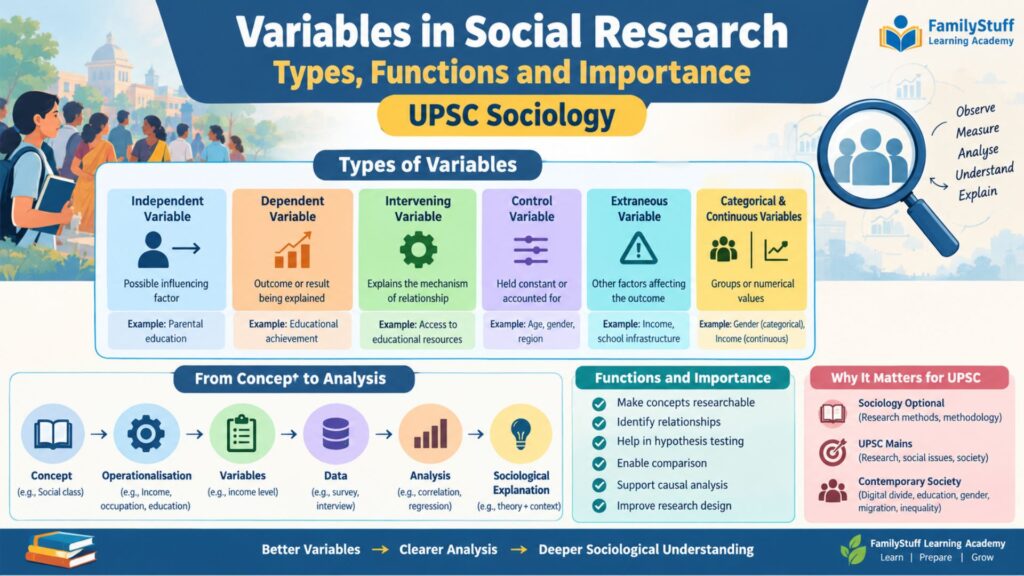
Types of Variables in Social Research
1. Independent Variable
An independent variable is considered a possible influencing factor in a research relationship.
For example, a study may examine whether parental education influences children’s educational achievement.
Here:
Parental education → Educational achievement
Parental education is the independent variable.
However, sociological research must avoid assuming that every observed association represents a simple causal relationship.
2. Dependent Variable
The dependent variable is the outcome or phenomenon that the researcher seeks to explain.
In the above example:
Educational achievement is the dependent variable.
The researcher asks whether changes in parental education are associated with differences in educational achievement.
3. Intervening Variable
An intervening variable helps explain the mechanism through which an independent variable may influence a dependent variable.
For example:
Parental education → Educational resources → Educational achievement
Here, access to educational resources can function as an intervening variable.
This is sociologically important because social relationships are rarely explained adequately by a simple cause-and-effect model.
4. Control Variable
A control variable is a factor that researchers hold constant or statistically account for so that the relationship between two variables can be examined more carefully.
Suppose a researcher studies:
Education → Income
Age, gender, region or work experience may also influence income. The researcher may therefore control for some of these factors.
Control variables help reduce the possibility of attributing an observed relationship to the wrong factor.
5. Extraneous Variable
An extraneous variable is a factor other than the principal variables under investigation that may influence the research outcome.
For example, in a study of educational performance, parental income, school infrastructure and access to digital devices may affect student performance even if the research primarily focuses on teaching methods.
Researchers must identify such factors because they can complicate interpretation.
6. Categorical and Continuous Variables
Variables can also be classified according to the form of their values.
Categorical variables represent groups or categories.
Examples include:
- Gender
- Religion
- Occupation
- Rural/urban residence
- Type of family
Continuous variables can take a range of numerical values.
Examples include:
- Age
- Household income
- Hours of work
- Years of schooling
This distinction becomes important when selecting appropriate methods of data collection and analysis.
Variables and Hypothesis Formation
Variables are closely connected with the hypothesis.
A hypothesis proposes a relationship that can be empirically examined.
For example:
“Higher levels of parental education are associated with higher educational achievement among children.”
This hypothesis identifies:
- Independent variable: parental education
- Dependent variable: educational achievement
A good hypothesis should be sufficiently clear and capable of empirical investigation.
However, sociological research does not always begin with a hypothesis. Exploratory and qualitative research may begin with broader questions and allow concepts and relationships to emerge during fieldwork.
This distinction is important when comparing quantitative and qualitative approaches
Variables and Operationalisation
One of the major challenges in social research is converting abstract sociological concepts into measurable forms.
This process is called operationalisation.
For example:
Concept: Social mobility
Possible indicators:
- Change in occupational status
- Change in income
- Educational attainment
- Intergenerational occupational mobility
Similarly:
Concept: Social participation
Possible indicators:
- Membership in associations
- Participation in community organisations
- Attendance at public meetings
- Participation in voluntary activities
Operationalisation improves clarity, but it can also simplify complex social realities.
A person’s social mobility, for instance, cannot always be captured completely through income or occupation alone.
Variables Through Major Sociological Perspectives
Different sociological approaches may conceptualise social variables differently.
Positivist Perspective
The positivist tradition associated with Émile Durkheim emphasised systematic observation and the study of social facts.
Quantitative variables can help researchers identify patterns across populations.
For example, Durkheim’s study of suicide demonstrated how individual acts could be analysed in relation to broader social conditions.
Interpretive Perspective
Max Weber emphasised verstehen and the importance of understanding the meanings actors attach to their actions.
An interpretive sociologist may therefore be cautious about reducing complex social behaviour to measurable variables alone.
For example, religious participation cannot necessarily be understood only through frequency of attendance. The meanings individuals attach to religious practices may also matter.
Merton and Middle-Range Theory
Robert K. Merton’s idea of middle-range theory is particularly relevant to empirical sociology.
Rather than attempting to explain all social life through a single universal theory, researchers can develop propositions concerning specific relationships.
Variables therefore become useful tools for connecting theoretical concepts with empirical investigation.
Variables in Indian Social Research
Variables are particularly useful when studying the complexity of Indian society.
For example, research on educational inequality may examine:
| Variable | Possible dimensions |
|---|---|
| Caste | Social category, discrimination, access |
| Gender | Gender differences in participation |
| Income | Household economic position |
| Education | Years and level of schooling |
| Region | Rural/urban and regional differences |
| Digital access | Device and internet availability |
Indian sociologists such as M.N. Srinivas and Andre Beteille demonstrated the importance of studying social structure through empirical investigation.
Concepts such as Sanskritisation, dominant caste, caste, class and power cannot be understood adequately through numerical variables alone. Fieldwork, historical context and interpretation are also necessary.
This illustrates the importance of combining measurement with sociological understanding.
Functions and Importance of Variables
Variables perform several important functions in social research.
1. They make concepts researchable
Abstract concepts can be converted into observable dimensions.
2. They help identify relationships
Researchers can examine associations between social characteristics.
3. They assist hypothesis testing
Variables make it possible to formulate empirically testable propositions.
4. They improve comparison
Researchers can compare groups, regions and time periods systematically.
5. They support causal analysis
When research design is appropriate, variables can help investigate possible causal relationships.
6. They improve research design
Identifying relevant variables helps researchers select suitable methods, samples and analytical techniques.
Theory and Application: A Necessary Distinction
Variables should not be treated as theories themselves.
A theory provides a broader explanatory framework.
A variable is a research tool used to represent a characteristic that can vary.
For example:
- Marx’s theory of class conflict is theoretical.
- Class position can be operationalised as a variable in an empirical study.
Similarly, Bourdieu’s concepts of economic, social and cultural capital provide theoretical tools for analysing inequality. Researchers may operationalise particular dimensions of capital through measurable indicators.
Thus:
Theory → Concept → Operationalisation → Variable/Indicator → Data → Analysis
This sequence helps connect sociological theory with empirical research.
Limitations of Using Variables in Social Research
Despite their usefulness, variables have important limitations.
Reductionism
Complex social phenomena may be reduced to a few measurable characteristics.
Difficulty of Measurement
Concepts such as identity, power, culture and social exclusion are difficult to measure precisely.
Contextual Variation
The meaning of a variable can differ across societies and social groups.
Correlation Is Not Causation
A statistical association between two variables does not automatically prove that one causes the other.
Value and Interpretation
Data collection itself may involve choices concerning definitions, categories and measurement.
Qualitative Dimensions
Variables may fail to capture meanings, emotions, experiences and everyday interactions that qualitative methods reveal.
Therefore, variables should complement sociological interpretation rather than replace it.
Why This Topic Matters for UPSC Sociology
Sociology Optional
Variables are directly relevant to Paper I, particularly the section on research methods and methodology.
They help aspirants understand:
- Scientific method
- Hypothesis
- Research design
- Quantitative methods
- Measurement
- Operationalisation
- Empirical research
UPSC Mains
The concept can strengthen answers on research methodology, social research and sociological perspectives.
It can also support Paper II answers when discussing empirical studies of caste, class, education, gender, migration and inequality.
Contemporary Society
Variables are increasingly important in studying:
- Digital inequality
- Educational access
- Migration
- Employment
- Gender inequality
- Urbanisation
- Social mobility
The key is to combine measurable evidence with sociological interpretation.
UPSC Mains Answer Writing Approach
For a 10-mark answer
Use a compact structure:
Introduction: Define variable.
Body:
- Explain independent and dependent variables.
- Mention intervening and control variables.
- Give one sociological example.
- Briefly mention operationalisation.
Conclusion: Explain their role in systematic social research.
For a 15-mark answer
Add:
- Positivist and interpretive perspectives
- Hypothesis and operationalisation
- Indian society example
- Limitations of measurement
For a 20-mark answer
Use a broader analytical framework:
Introduction → Definition → Classification → Functions → Thinkers → Theory-application relationship → Indian examples → Limitations → Contemporary relevance → Conclusion
A useful answer-writing distinction is:
Variables help measure social reality, but sociological explanation requires context, theory and interpretation.
Likely UPSC Sociology Questions
- Discuss the role of variables in sociological research. Illustrate with suitable examples.
- Examine the distinction between independent, dependent and intervening variables in social research.
- Analyze the importance and limitations of operationalisation in sociological research.
- “Measurement of social reality cannot be separated from theoretical assumptions.” Critically examine.
- Evaluate the usefulness of variables in understanding complex social phenomena in Indian society.
Frequently Asked Questions
1. What is a variable in sociology?
A variable is a characteristic or attribute that can take different values among individuals, groups or other units of social research.
2. What are the main types of variables?
Important types include independent, dependent, intervening, control and extraneous variables. Researchers may also distinguish categorical and continuous variables.
3. What is the difference between a concept and a variable?
A concept is an abstract sociological idea, while a variable represents a characteristic that can take different measurable values in a study.
4.Why is operationalisation important in social research?
Operationalisation converts abstract concepts into observable indicators, making empirical investigation possible.
5. Are variables sufficient for understanding society?
No. Variables are useful for measurement and comparison, but complex social phenomena also require theory, context, interpretation and qualitative understanding.
Conclusion
Variables provide an important bridge between sociological concepts and empirical research. They help researchers formulate hypotheses, identify relationships, organise data and compare social groups.
However, society cannot be reduced entirely to measurable characteristics. The interpretive meanings of social action, historical context, institutional structures and lived experiences also matter.
For UPSC Sociology aspirants, the key is therefore to understand variables not merely as statistical tools but as part of a broader research process:
Conceptualisation → Operationalisation → Variables → Data → Analysis → Sociological Explanation
A strong sociological approach combines systematic measurement with theoretical reasoning and contextual interpretation. This balance makes social research both empirically useful and sociologically meaningful.