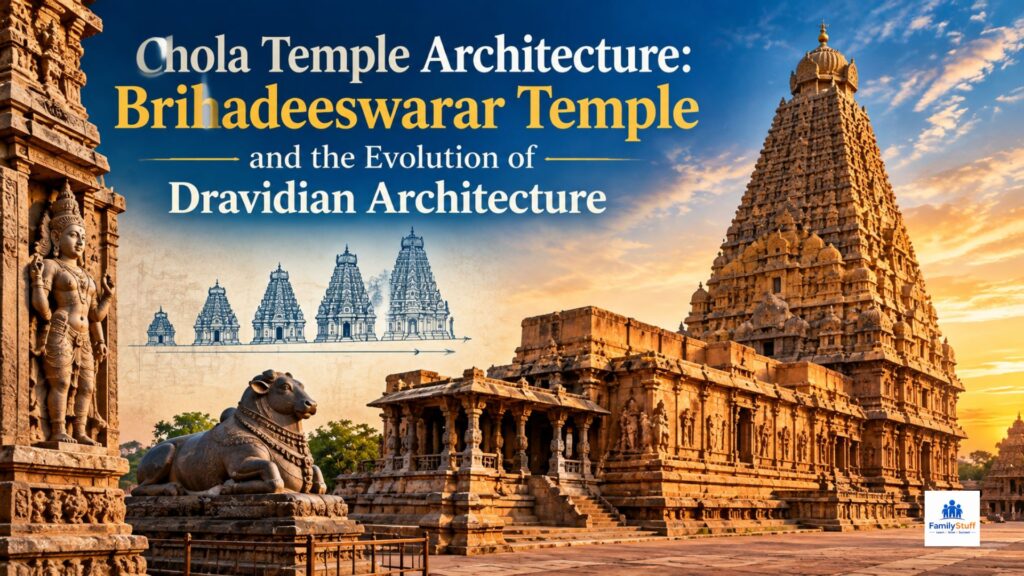
Introduction: Why Chola Temple Architecture Matters for UPSC
Chola temple architecture represents one of the most important stages in the development of Dravidian architecture in South India. The Cholas transformed temples from primarily religious spaces into major centres of ritual, administration, art, economic activity and cultural expression.
The architectural achievements of the Cholas are particularly important for UPSC Prelims and Mains because they connect several areas of the syllabus: ancient and medieval Indian architecture, religion, sculpture, inscriptions, Chola administration, economy and South Indian history.
The temples at Thanjavur, Gangaikondacholapuram and Darasuram demonstrate how Chola rulers used architecture to express royal authority while supporting Shaivism, artistic traditions and institutional life.
The evolution of Chola temple architecture can therefore be understood not simply as a history of buildings, but as a study of political power, religious patronage, technological skill and social organisation.
1. Historical Background of Chola Temple Architecture
The imperial Cholas rose to prominence in the 9th century CE and established a powerful state in the Kaveri delta.
Important rulers associated with the expansion of Chola power include:
- Vijayalaya Chola
- Aditya I
- Parantaka I
- Rajaraja I
- Rajendra I
- Kulottunga I
The early Cholas inherited architectural traditions from earlier South Indian dynasties, particularly the Pallavas.
The Pallavas had already experimented with:
- rock-cut temples,
- monolithic architecture,
- structural temples,
- sculptural decoration,
- and the development of the Dravidian temple form.
The Cholas refined these traditions and increasingly favoured large structural temples constructed primarily from stone.
From experimentation to monumental architecture
The development can broadly be understood as:
Pallava foundations → Early Chola development → Imperial Chola monumentalism → Later Chola refinement
This evolution is important because Chola architecture was not an isolated invention. It represented the continuation, expansion and refinement of earlier South Indian architectural traditions.
2. Major Features of Chola Temple Architecture
Chola temples display several characteristic features of the Dravidian style.
2.1 Vimana
The vimana is the superstructure built above the sanctum or garbhagriha.
In major Chola temples, the vimana became exceptionally prominent.
The Brihadeeswarar Temple at Thanjavur is particularly famous for its monumental vimana.
2.2 Garbhagriha
The garbhagriha, or sanctum, housed the principal deity.
In large Shaiva temples, the central shrine contained the Shiva linga.
The architectural emphasis placed the sacred centre within a carefully organised temple complex.
2.3 Mandapas
Mandapas were pillared halls used for different religious and ceremonial purposes.
Their development contributed to the increasing complexity of temple plans.
2.4 Gopurams
Gopurams are monumental gateway towers.
An important point for UPSC aspirants is that the enormous dominance of gopurams characteristic of many later South Indian temples developed particularly strongly in the post-Chola and later medieval periods.
Therefore, it is misleading to assume that Chola architecture was defined primarily by enormous gateway towers.
2.5 Temple Enclosures
Large temples were organised within enclosed spaces.
These complexes could include:
- subsidiary shrines,
- halls,
- circumambulatory passages,
- water facilities,
- administrative spaces,
- inscriptions,
- and sculptural programmes.
Thus, the temple functioned as much more than a single shrine.
3. Evolution of Chola Temple Architecture
The Chola architectural tradition developed over several centuries.
| Phase | General Features | Important Examples |
|---|---|---|
| Early Chola | Smaller structural temples; Pallava influence | Early Chola temples in Tamil Nadu |
| Imperial Chola | Monumental scale and highly developed vimanas | Brihadeeswarar Temple, Thanjavur |
| Rajendra Chola period | Continuation with architectural refinement | Gangaikondacholapuram |
| Later Chola | Increasing decorative and sculptural sophistication | Airavatesvara Temple, Darasuram |
This evolution demonstrates a movement from relatively modest structural temples towards large, highly organised monumental complexes.
4. Brihadeeswarar Temple at Thanjavur
The Brihadeeswarar Temple, also known as Rajarajesvaram, is the most celebrated example of Imperial Chola architecture.
It was commissioned by Rajaraja Chola I and associated with his reign in the early 11th century.
The temple is dedicated to Shiva.
Major architectural features
The temple is notable for:
- its massive scale,
- tall vimana,
- axial planning,
- stone construction,
- sculptural decoration,
- inscriptions,
- subsidiary shrines,
- and carefully organised temple complex.
The vimana became a powerful visual symbol of royal authority and religious patronage.
Why is Thanjavur significant?
The temple illustrates the relationship between religion and kingship.
Rajaraja’s patronage of the temple demonstrated his devotion to Shiva while simultaneously presenting the Chola state as wealthy, organised and capable of mobilising considerable resources.
The temple inscriptions are particularly valuable because they provide information about:
- land donations,
- temple administration,
- personnel,
- gifts,
- ritual activities,
- and economic arrangements.
Therefore, the temple itself becomes a historical source.
5. Gangaikondacholapuram: Continuity and Refinement
Rajendra Chola I established Gangaikondacholapuram as his imperial capital.
Its great Shiva temple continued the monumental architectural tradition established under Rajaraja I.
However, the temple’s architectural treatment displays differences from Thanjavur.
The vimana is generally regarded as having a somewhat more curvilinear and refined profile, creating a different visual effect from the strongly pyramidal appearance of the Thanjavur temple.
This demonstrates that Chola architecture did not simply repeat earlier designs.
Instead, architects modified established forms according to changing aesthetic preferences.
Historical significance
The temple also reflected Rajendra Chola’s imperial achievements.
The establishment of Gangaikondacholapuram followed his northern campaigns and expansion of Chola influence.
Architecture therefore operated simultaneously as:
religious monument + imperial symbol + urban centre
6. Airavatesvara Temple at Darasuram
The Airavatesvara Temple at Darasuram belongs to the later Chola architectural tradition and is associated with Rajaraja Chola II.
Compared with the enormous scale of the Brihadeeswarar Temple, Darasuram is especially notable for its intricate sculptural and architectural detailing.
Its features include:
- elaborately carved pillars,
- detailed sculptures,
- sophisticated architectural forms,
- ornamental treatment,
- and a distinctive chariot-like design associated with parts of the temple structure.
The temple demonstrates how the later Chola tradition increasingly emphasised refinement and intricate craftsmanship, rather than simply increasing monumental scale.
7. The “Great Living Chola Temples”
Three major Chola temples are especially important:
- Brihadeeswarar Temple, Thanjavur
- Brihadisvara Temple, Gangaikondacholapuram
- Airavatesvara Temple, Darasuram
Together, they are recognised by UNESCO as the Great Living Chola Temples.
Their significance lies not only in their architecture but also in the continuing ritual and cultural traditions associated with them.
Comparative understanding
| Feature | Thanjavur | Gangaikondacholapuram | Darasuram |
|---|---|---|---|
| Major ruler | Rajaraja I | Rajendra I | Rajaraja II |
| Period | Early 11th century | 11th century | 12th century |
| Main deity | Shiva | Shiva | Shiva |
| Architectural emphasis | Monumentality | Refinement of monumental form | Sculptural intricacy |
| Historical role | Royal and religious centre | Imperial capital temple | Later Chola artistic achievement |
For UPSC, remembering this ruler–temple–feature relationship is useful for both Prelims and Mains.
8. Temples as Economic and Administrative Institutions
One of the most important analytical aspects of Chola temples is their economic role.
Temples received:
- land grants,
- gold,
- livestock,
- agricultural produce,
- lamps and ritual materials,
- and other endowments.
Inscriptions recorded many such donations.
The temple therefore became connected with the wider agrarian economy.
Temple and local society
Temple institutions could employ:
- priests,
- musicians,
- dancers,
- accountants,
- guards,
- artisans,
- cooks,
- gardeners,
- and other workers.
This demonstrates the extensive institutional network surrounding major temples.
However, temples should not be treated as completely independent economic units. Their functioning was closely connected with royal patronage, local elites, landholding structures and agrarian production.
9. Chola Temples and Inscriptions
Inscriptions are among the most valuable sources for studying Chola history.
Temple inscriptions provide evidence about:
- royal donations,
- taxation,
- land transactions,
- temple personnel,
- irrigation-related resources,
- religious endowments,
- and administrative arrangements.
For example, inscriptions at major Chola temples help historians reconstruct aspects of the temple economy and social organisation.
Why inscriptions matter for UPSC
A strong Mains answer should not merely state that Chola temples were “centres of culture.”
It should provide evidence.
A useful analytical chain is:
Temple construction → land and resource mobilisation → institutional expansion → employment and redistribution → social and cultural influence
This transforms a descriptive answer into an analytical one.
10. Chola Architecture and Bronze Sculpture
Chola cultural achievement was not limited to stone architecture.
The period is also famous for bronze sculpture, particularly images associated with Shaiva traditions.
The iconic image of Nataraja, Shiva as the cosmic dancer, became one of the finest expressions of South Indian bronze artistry.
The relationship between temple architecture and sculpture was significant.
Temples provided spaces in which sculpture, ritual, music, dance and religious narratives interacted.
Thus, Chola temples should be studied as integrated cultural institutions, rather than merely as architectural structures.
11. Chola Architecture and the Dravidian Tradition
Chola temples are a major stage in the development of the Dravidian architectural tradition.
However, Dravidian architecture did not begin with the Cholas.
The Pallavas had already developed important structural and rock-cut architectural forms.
The Cholas expanded these traditions through:
- greater monumental scale,
- sophisticated stone construction,
- elaborate sculptural programmes,
- extensive inscriptions,
- temple-centred institutions,
- and large-scale royal patronage.
Later South Indian dynasties further developed the tradition, especially through increasingly elaborate gopurams and temple complexes.
This continuity is important in UPSC answers because it avoids presenting Indian architecture as a series of disconnected dynastic styles.
Why This Topic Matters for UPSC
UPSC Prelims
Focus on:
- Rajaraja Chola I – Brihadeeswarar Temple at Thanjavur
- Rajendra Chola I – Gangaikondacholapuram
- Rajaraja Chola II – Airavatesvara Temple
- Dravidian architectural tradition
- Vimana and gopuram
- Chola inscriptions
- Great Living Chola Temples
- Chola bronze sculpture
UPSC Mains
The topic can be connected with:
- temple architecture,
- state formation,
- religion and kingship,
- agrarian economy,
- inscriptions,
- art and culture,
- urbanisation,
- social institutions,
- and regional identities.
A high-quality answer should explain why monumental temples emerged and what functions they performed, rather than simply listing architectural features.
UPSC Mains Answer Writing Approach
For a 10-Mark Answer
Use a simple structure:
Introduction:
Define Chola temple architecture as a mature stage of the Dravidian architectural tradition.
Body:
Mention 4–5 major features:
- monumental vimana,
- structural stone construction,
- mandapas,
- sculpture,
- inscriptions.
Give Thanjavur as the main example.
Conclusion:
Mention the synthesis of religion, kingship, art and institutional life.
For a 15-Mark Answer
Use three dimensions:
Architectural
- vimana
- sanctum
- mandapas
- sculptural decoration
- temple planning
Political
- royal patronage
- imperial symbolism
- capitals and political authority
Socio-economic
- land grants
- temple employment
- inscriptions
- redistribution of resources
End with a balanced assessment of temples as both religious and socio-economic institutions.
For a 20-Mark Answer
Use a comparative and chronological framework.
Introduction → Historical background → Evolution → Architectural features → Three major temples → Economic and social functions → Inscriptions → Cultural significance → Comparison with Pallava/later traditions → Conclusion
A useful concluding argument is:
Chola architecture represents not merely the construction of monumental temples but the institutional integration of religion, political authority, economic resources and artistic traditions.
5 Likely UPSC-Style Questions
1.
Discuss the evolution of Chola temple architecture from the early Chola period to the later Chola period.
2.
The Brihadeeswarar Temple represents the convergence of religion, political authority and architectural innovation. Discuss.
3.
How do Chola temple inscriptions help historians understand the economic and social organisation of medieval South India?
4.
Compare the architectural significance of the temples at Thanjavur, Gangaikondacholapuram and Darasuram.
5.
Chola temple architecture was a continuation as well as a refinement of earlier South Indian architectural traditions. Examine with reference to the Pallavas and later developments.
5 Frequently Asked Questions
1. What is Chola temple architecture?
Chola temple architecture refers to the temple-building tradition developed under the Chola rulers of South India, particularly from the early medieval period onward. It is an important stage in the development of Dravidian architecture.
2. Which is the most famous Chola temple?
The Brihadeeswarar Temple at Thanjavur, commissioned by Rajaraja Chola I, is the most famous example of Imperial Chola temple architecture.
3. What are the three Great Living Chola Temples?
They are:
- Brihadeeswarar Temple, Thanjavur
- Brihadisvara Temple, Gangaikondacholapuram
- Airavatesvara Temple, Darasuram
4. What is the difference between a vimana and a gopuram?
The vimana is the superstructure over the main sanctum, while a gopuram is a monumental gateway tower. In major Chola temples, the vimana received particularly strong architectural emphasis.
5. Why are Chola temple inscriptions important?
They provide evidence about land grants, donations, temple administration, personnel, economic resources and aspects of social organisation, making them important primary sources for Chola history.
Conclusion
Chola temple architecture represents a major stage in the evolution of South Indian Dravidian architecture. Beginning with earlier traditions and reaching monumental expression under the Imperial Cholas, it combined structural innovation with sculpture, inscriptions and religious practice.
The temples of Thanjavur, Gangaikondacholapuram and Darasuram demonstrate different stages of this development—from monumental scale to greater architectural and sculptural refinement.
Their historical importance extends beyond aesthetics. Chola temples were connected with kingship, landholding, economic activity, social organisation and cultural production. Studying them therefore provides a broader understanding of medieval South Indian society and the relationship between architecture and state formation.
For UPSC aspirants, the key is to move beyond memorising temple names and identify the political, economic, religious and cultural processes represented by Chola architecture.