Introduction
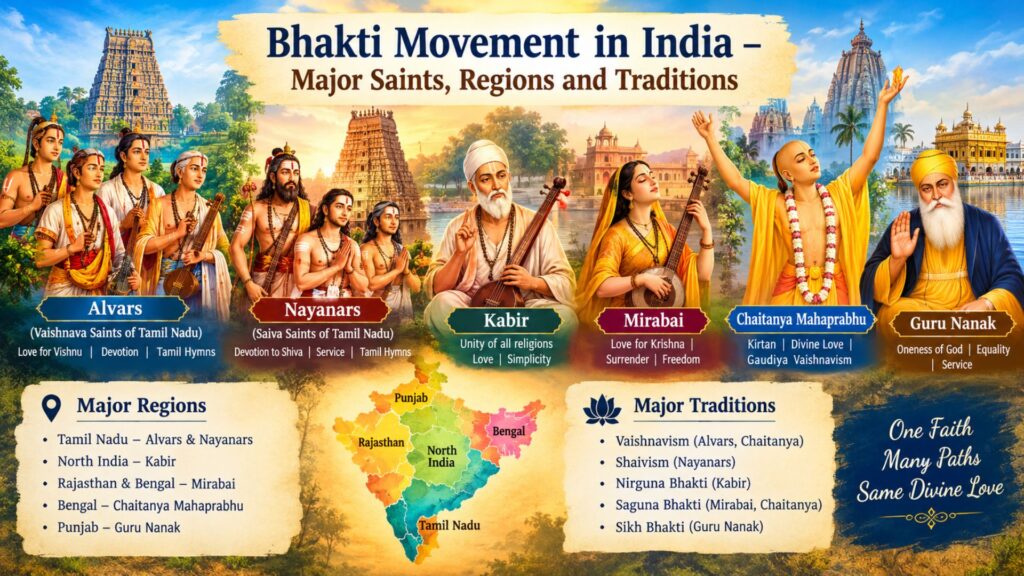
The Bhakti Movement in India was a broad and diverse set of devotional traditions that developed over several centuries. It emphasised personal devotion to a chosen deity and offered different paths to spiritual liberation. The movement cannot be treated as a single, centrally organised movement. Instead, it included many regional traditions, saints, philosophical schools, literary traditions, and forms of worship.
For UPSC Civil Services Examination, the Bhakti tradition is important because it connects medieval Indian history with religion, society, literature, language, art and regional cultures. Questions can test the chronology of Bhakti traditions, the teachings of individual saints, the role of vernacular languages, social criticism, and the relationship between Bhakti and Sufi traditions.
The earliest major regional developments are associated with the Alvars and Nayanars of South India between the seventh and ninth centuries. Later, devotional traditions developed across Maharashtra, Karnataka, North India, Bengal, Assam, Punjab and other regions. NCERT identifies saints and traditions across these regions, including Basavanna, Ramanuja, Jnaneshwar, Namdev, Kabir, Ravidas, Mirabai, Chaitanya, Guru Nanak, Shankaradeva and others.
What Was the Bhakti Movement?
The word Bhakti broadly refers to devotion or intense attachment to a chosen deity.
The tradition developed around the idea that a devotee could establish a direct emotional and spiritual relationship with the divine. Depending on the tradition, the object of devotion could be Shiva, Vishnu, Krishna, Rama, Devi, or a formless conception of God.
Bhakti traditions differed considerably. Some emphasised temple worship and devotional images, while others rejected elaborate ritualism and stressed devotion to a formless God.
Therefore, it is more accurate to speak of Bhakti traditions rather than assuming that all Bhakti saints shared identical beliefs.
Historical Background of Bhakti Traditions
Bhakti had important precedents in earlier Indian religious literature.
The Bhagavad Gita presented devotion as one of the important spiritual paths. The Puranic traditions further developed forms of devotion towards major deities.
Over time, devotional traditions became closely connected with regional societies.
The seventh to ninth centuries witnessed the emergence of the Nayanars, devoted primarily to Shiva, and the Alvars, devoted primarily to Vishnu, in South India. They composed devotional poetry in Tamil and travelled between sacred centres. Importantly, these saints came from different social backgrounds.
This southern devotional tradition later interacted with philosophical developments associated with thinkers such as Ramanuja.
Major Features and Tenets of the Bhakti Movement
1. Personal Devotion
The central feature was intense personal devotion to the divine.
The devotee sought a direct relationship with God rather than depending exclusively on formal religious institutions.
Different traditions expressed this relationship through love, surrender, service and remembrance.
2. Importance of Divine Grace
Many Bhakti traditions emphasised that divine grace could help the devotee attain spiritual liberation.
This made devotion an important alternative to approaches that placed greater emphasis on ritual knowledge or philosophical speculation.
3. Devotion Through Different Forms
Bhakti did not follow one theological model.
Some traditions worshipped God through a particular form or incarnation.
Others emphasised a formless God.
This produced two broad analytical categories often used in UPSC preparation:
| Tradition | General Character | Examples |
|---|---|---|
| Saguna Bhakti | Devotion to God with attributes and form | Rama, Krishna, Shiva traditions |
| Nirguna Bhakti | Devotion to a formless, attributeless God | Kabir, Ravidas and related traditions |
This distinction should not be treated as absolute because individual traditions could contain diverse ideas.
4. Vernacular Languages
One of the most important consequences of Bhakti was the growth of devotional literature in regional languages.
Tamil, Kannada, Marathi, Hindi-related literary languages, Bengali, Assamese, Punjabi and other languages became important vehicles for religious expression.
The use of vernacular languages allowed devotional ideas to circulate beyond elite Sanskritic learning.
5. Music and Collective Devotion
Songs, poetry, recitation and congregational practices played a major role.
The Alvars and Nayanars composed devotional poems and set them to music.
Later traditions developed practices such as kirtan, bhajan and communal recitation.
6. Critique of Social Hierarchy
Several Bhakti saints criticised social exclusion and religious practices based purely on birth or ritual status.
Saints such as Kabir and Ravidas are especially important in this context.
However, it would be historically inaccurate to claim that the entire Bhakti movement completely abolished caste distinctions. Bhakti traditions varied greatly in their relationship with existing social structures.
Spread of the Bhakti Movement in India
1. South India: Alvars and Nayanars
The Alvars were devoted to Vishnu, while the Nayanars were devoted to Shiva.
They flourished mainly between the seventh and ninth centuries.
Their devotional poetry was deeply connected with Tamil sacred geography. They visited temples and sacred centres and composed hymns praising their chosen deities.
Their social backgrounds were diverse, including communities regarded as socially marginalised at the time.
Important South Indian Developments
| Region | Tradition / Figure | Major Association |
|---|---|---|
| Tamil Nadu | Alvars | Vishnu devotion |
| Tamil Nadu | Nayanars | Shiva devotion |
| Karnataka | Basavanna | Virashaiva/Lingayat tradition |
| Tamil Nadu | Ramanuja | Vishishtadvaita |
| Tamil Nadu | Nammalvar | Vaishnava devotional tradition |
2. Karnataka: Basavanna and the Virashaiva Tradition
The 12th century witnessed the activities of Basavanna and the Virashaiva or Lingayat tradition in Karnataka.
The tradition emphasised devotion to Shiva and developed distinctive religious and social practices.
The Vachanas, composed in Kannada, became an important form of devotional and ethical expression.
For UPSC, Basavanna is particularly relevant for understanding the relationship between religious devotion, social criticism and regional-language literature.
3. Maharashtra: Varkari Tradition
Maharashtra developed a strong devotional tradition centred on Vithoba of Pandharpur.
Important figures included:
- Jnaneshwar
- Namdev
- Eknath
- Tukaram
The Varkari tradition combined pilgrimage, devotional singing and community participation.
Jnaneshwar’s Marathi interpretation of the Bhagavad Gita, commonly known as the Jnaneshwari, was particularly significant for Marathi literary and religious history.
4. North India: Nirguna and Saguna Traditions
From the late medieval period, North India witnessed several important devotional traditions.
Kabir
Kabir strongly criticised religious formalism and emphasised devotion to a formless divine reality.
His verses questioned both Hindu and Muslim religious orthodoxies.
His teachings are important for understanding:
- Nirguna Bhakti
- criticism of ritualism
- social criticism
- vernacular religious poetry
- interaction between different religious communities
Ravidas
Ravidas emphasised devotion and spiritual equality.
His background and teachings make him important for understanding how Bhakti traditions could challenge social exclusion.
Mirabai
Mirabai became one of the most prominent female voices of Krishna devotion.
Her devotional poetry expressed an intense personal relationship with Krishna.
Her example is important for studying gender, devotion, literary expression and social conventions in medieval India.
Tulsidas
Tulsidas was an important figure in the Rama devotional tradition.
His Ramcharitmanas, composed in Awadhi, played a major role in the development and popularisation of Rama-centred devotional culture in North India.
Surdas
Surdas is associated particularly with Krishna devotion.
His compositions contributed significantly to the devotional literary tradition surrounding Krishna. NCERT associates him with works such as Sursagara, Surasaravali and Sahitya Lahari.
5. Bengal and Eastern India
Chaitanya
Chaitanya played a major role in the Krishna devotional tradition of Bengal and eastern India.
His tradition emphasised intense emotional devotion, singing and collective religious participation.
Shankaradeva
In Assam, Shankaradeva developed a Vaishnava devotional tradition.
He emphasised devotion to Vishnu and used Assamese poetry, drama and performance traditions to communicate religious ideas.
He also encouraged namghars, or houses of prayer and recitation, and satras, which became important institutional centres.
6. Punjab: Guru Nanak
Guru Nanak developed a distinctive devotional tradition in the Punjab region during the late 15th and early 16th centuries.
His teachings emphasised devotion to one God, ethical living, remembrance of the divine name and rejection of empty ritualism.
The emergence of the Sikh tradition represents an important development within the wider religious and cultural environment of medieval North India.
Important Bhakti Saints and Their Contributions
| Saint / Tradition | Region | Broad Orientation | Important Contribution |
|---|---|---|---|
| Alvars | Tamil Nadu | Vaishnava | Tamil devotional hymns |
| Nayanars | Tamil Nadu | Shaiva | Shiva devotional poetry |
| Basavanna | Karnataka | Shaiva/Lingayat | Vachana literature and social critique |
| Ramanuja | South India | Vaishnava | Vishishtadvaita philosophy |
| Jnaneshwar | Maharashtra | Varkari | Marathi devotional-philosophical literature |
| Namdev | Maharashtra | Bhakti | Devotional poetry |
| Kabir | North India | Nirguna | Critique of ritualism and sectarianism |
| Ravidas | North India | Nirguna | Devotion and social equality |
| Mirabai | Rajasthan/North India | Krishna Bhakti | Female devotional voice |
| Tulsidas | North India | Rama Bhakti | Ramcharitmanas |
| Chaitanya | Bengal | Krishna Bhakti | Kirtan and ecstatic devotion |
| Shankaradeva | Assam | Vaishnava | Assamese literature, namghars and satras |
| Guru Nanak | Punjab | Devotional monotheism | Ethical devotion and community |
The geographical spread of these traditions shows why the Bhakti phenomenon should be understood as a network of regional traditions rather than a single centrally directed movement. NCERT’s map of Bhakti saints itself demonstrates this wide regional distribution.
Impact of the Bhakti Movement
1. Growth of Regional Literature
Bhakti significantly strengthened regional literary traditions.
Tamil devotional hymns, Kannada Vachanas, Marathi devotional literature, Hindi devotional poetry, Bengali Vaishnava literature and Assamese devotional works illustrate this development.
Religion thus became an important force in the growth of regional literary cultures.
2. Development of Vernacular Languages
Bhakti poets communicated complex religious ideas through languages understood by wider sections of society.
This helped strengthen the literary status of several regional languages.
3. Social Criticism
Some Bhakti traditions questioned caste hierarchy, ritual privilege and social exclusion.
However, their social impact varied across regions.
Therefore, an answer should avoid the simplistic statement that “Bhakti ended the caste system.”
A better argument is that Bhakti created important spaces for questioning ritual and social hierarchies, while caste structures continued in many parts of Indian society.
4. Religious Transformation
Bhakti encouraged new forms of worship based on:
- personal devotion
- singing
- pilgrimage
- temple-centred traditions
- collective recitation
- devotional poetry
It also contributed to the wider development of sectarian traditions such as Vaishnavism, Shaivism and regional devotional schools.
5. Cultural Integration
Bhakti traditions crossed regional and linguistic boundaries.
Devotional stories, pilgrimage networks, music and literature connected different communities.
However, this should not be interpreted as complete social or religious unity. Medieval India continued to experience religious differences, competition and conflict alongside cultural interaction.
6. Interaction with Sufi Traditions
Bhakti and Sufi traditions developed within the same broad medieval social environment.
Both included traditions of personal devotion, spiritual discipline, music and the importance of a relationship between the individual and the divine.
Yet they emerged from different theological and institutional contexts.
Therefore, UPSC answers should discuss similarities without treating Bhakti and Sufism as identical movements.
Bhakti Movement: Major Features at a Glance
| Aspect | Bhakti Tradition |
|---|
| Core idea | Personal devotion to the divine |
| Period | Major regional developments from early medieval period onward |
| Early major regional centres | South India |
| Major early groups | Alvars and Nayanars |
| Languages | Tamil and many later regional languages |
| Forms of devotion | Saguna and Nirguna |
| Methods | Prayer, singing, poetry, pilgrimage, remembrance |
| Social dimension | Criticism of ritual and, in some traditions, caste hierarchy |
| Literary impact | Growth of vernacular devotional literature |
| Geographical spread | South, West, North, East and Northeast India |
| Related theme | Interaction with Sufi traditions |
Why This Topic Matters for UPSC
The Bhakti Movement is important for both UPSC Prelims and Mains.
For UPSC Prelims
Focus on:
- Alvars and Nayanars
- Saguna and Nirguna Bhakti
- Basavanna
- Ramanuja
- Jnaneshwar
- Namdev
- Kabir
- Ravidas
- Mirabai
- Tulsidas
- Surdas
- Chaitanya
- Shankaradeva
- Guru Nanak
- Vachanas
- Namghars
- Satras
- Ramcharitmanas
- regional languages
For UPSC Mains
Prepare themes such as:
- Bhakti and social change
- Bhakti and vernacular literature
- Bhakti and caste
- Bhakti and women
- Bhakti and regional identities
- Saguna versus Nirguna traditions
- Bhakti and Sufism
- religious movements and medieval society
The topic also fits into Indian culture, medieval history, social history and literature, making it useful for GS Paper I.
UPSC Mains Answer Writing Approach
For a 10-Mark Question
Use a simple three-part structure:
Introduction:
Define Bhakti and mention its long chronological and regional development.
Body:
Explain 3–4 major features such as personal devotion, vernacular languages, devotional poetry and criticism of ritualism. Add two or three examples.
Conclusion:
Mention its contribution to religious expression and regional cultural development.
For a 15-Mark Question
Use:
Introduction → Historical background → Major features → Regional spread → Social and cultural impact → Conclusion
Add a small table or examples to improve factual density.
For example, compare:
- Alvars – Tamil Nadu – Vishnu
- Nayanars – Tamil Nadu – Shiva
- Kabir – North India – Nirguna
- Chaitanya – Bengal – Krishna
- Shankaradeva – Assam – Vaishnava
For a 20-Mark Question
A high-quality answer should demonstrate chronology, regional diversity and analysis.
Suggested structure:
- Definition and historical context
- Early South Indian traditions
- Philosophical developments
- Regional spread
- Saguna and Nirguna traditions
- Social implications
- Literary and linguistic impact
- Bhakti-Sufi interaction
- Limitations and historical complexity
- Balanced conclusion
A strong conclusion could state that Bhakti transformed the ways in which devotion was expressed and helped shape regional languages and cultures, while its social consequences differed significantly across regions and communities.
5 Likely UPSC-Style Questions
1.
“The Bhakti tradition was not a single movement but a collection of diverse regional devotional traditions.” Discuss.
2.
Examine the contribution of the Alvars and Nayanars to the development of Bhakti traditions in South India.
3.
Compare the Saguna and Nirguna traditions of Bhakti with suitable examples.
4.
Discuss the role of Bhakti saints in the growth of regional languages and literature in medieval India.
5.
“Bhakti traditions questioned social and religious hierarchies, but their impact on the caste system was uneven.” Analyse.
5 Frequently Asked Questions
1. What was the Bhakti Movement in India?
The Bhakti Movement refers to diverse devotional traditions that emphasised a personal relationship between the devotee and the divine. These traditions developed across different regions over several centuries.
2. Who were the Alvars and Nayanars?
The Alvars were Tamil devotional saints associated primarily with Vishnu, while the Nayanars were devoted primarily to Shiva. They flourished especially between the seventh and ninth centuries.
3. What is the difference between Saguna and Nirguna Bhakti?
Saguna Bhakti focuses on devotion to God with a particular form or attributes, while Nirguna Bhakti emphasises devotion to a formless or attributeless divine reality.
4. Did the Bhakti Movement abolish the caste system?
No. Some Bhakti saints criticised caste hierarchy and ritual privilege, but caste structures continued in medieval Indian society. Its social impact varied across regions and traditions.
5. What was the impact of the Bhakti Movement?
Its major impacts included the growth of vernacular literature, expansion of devotional practices, development of regional religious traditions, new forms of religious expression and criticism of certain social and ritual hierarchies.
Conclusion
The Bhakti Movement in India was a long and diverse historical process rather than a single organised movement. From the Alvars and Nayanars of South India to Kabir, Mirabai, Chaitanya, Shankaradeva, Guru Nanak and numerous regional traditions, Bhakti reshaped religious expression across medieval India.
Its significance extended beyond theology. Bhakti contributed to regional literature, vernacular languages, music, pilgrimage networks and new forms of community participation. Some traditions also questioned caste-based exclusion and excessive ritualism.
At the same time, a balanced historical assessment requires recognising that Bhakti did not produce uniform social transformation. Its relationship with caste, ritual, institutions and political power differed across regions.
For UPSC, the central lesson is therefore to understand Bhakti through diversity, regional context, social change, literary development and continuity, rather than presenting it as a single movement with one uniform ideology.