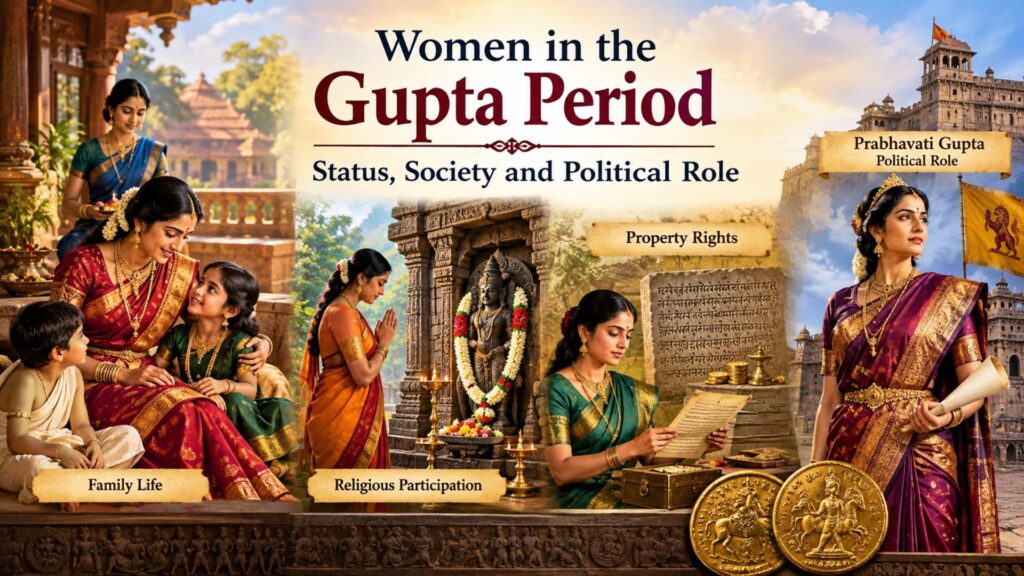
The status of women in the Gupta period is an important topic for UPSC History because it connects political history with social structure, religion, law and economic change. The Gupta period, broadly covering the 4th to 6th centuries CE, is often associated with major achievements in art, literature, science and political consolidation. However, social conditions were not uniformly progressive.
The position of women needs to be studied through multiple sources, including Dharmashastra literature, inscriptions, copper-plate grants, religious texts, art and accounts of foreign travellers. These sources suggest a complex picture. Patriarchal control over women’s lives remained strong, while some elite women exercised considerable influence in political, religious and cultural spheres.
A comparison with the pre-Gupta period is therefore more useful than simply describing Gupta society as either “progressive” or “regressive.”
Historical Background: Women Before the Gupta Period
The status of women had already undergone significant changes before the rise of the Guptas.
In the early Vedic period, women appear in sources such as the Rigveda as participants in religious and intellectual life. Some women are associated with Vedic hymns, while marriage generally took place at a relatively mature age.
However, during the later Vedic and post-Vedic periods, patriarchal social institutions became stronger. The importance of patrilineal descent, inheritance through male members and control of women’s sexuality increased.
The emergence of Dharmashastra traditions further emphasized women’s dependence within the patriarchal household.
At the same time, the rise of Buddhism and Jainism created alternative religious spaces. Women could enter Buddhist and Jain monastic institutions, although these traditions also developed hierarchical rules governing female monastics.
Thus, the Gupta period inherited a social structure that had already experienced a long-term shift away from the relatively wider religious and intellectual participation associated with some early Vedic contexts.
Status of Women in the Gupta Period
1. Family and Patriarchal Structure
Gupta society was predominantly patriarchal.
The family remained the principal institution through which women’s social identity was defined. Marriage, motherhood and domestic responsibilities were highly valued.
The increasing influence of Brahmanical social ideals reinforced distinctions based on caste, gender and family lineage. NIOS’s historical account notes that the position of women continued to decline in the Gupta period and emphasizes their economic dependence on men.
However, this should not be interpreted as meaning that every woman experienced identical restrictions.
The social position of a woman could vary according to:
- caste
- economic status
- family background
- marital status
- religious affiliation
- location
- membership in a royal or elite household
Therefore, historians should avoid treating “women” as a single homogeneous category.
2. Marriage and Women’s Autonomy
Marriage was central to women’s social position.
Brahmanical norms increasingly emphasized marriage within socially approved groups and the importance of family lineage. Women’s sexuality was closely regulated because inheritance and lineage were primarily organized through male descent.
The ideal of the chaste and devoted wife became increasingly important in normative literature.
At the same time, literary and artistic evidence shows that women were visible in social and cultural life. The existence of such representations does not necessarily prove social equality, but it demonstrates that women participated in a wider range of social activities than a simple household-versus-public-life model might suggest.
3. Property Rights and Stridhana
One of the most important issues in understanding women’s status is property ownership.
The concept of stridhana refers broadly to property that belonged to a woman, particularly gifts received in connection with marriage and other personal gifts.
The evidence indicates that women could exercise rights over their stridhana, even though broader inheritance rights were considerably more restricted than those of men.
NIOS notes that women were generally excluded from inheriting property but possessed rights over stridhana, particularly gifts received at marriage.
This distinction is important for UPSC:
| Aspect | General Pattern |
|---|---|
| Family property | Strongly controlled through male lineage |
| Stridhana | Recognised as women’s personal property |
| Inheritance | Women’s rights were generally restricted |
| Economic independence | Limited for most women |
| Elite women | Could exercise greater economic and political influence |
Thus, women’s property rights existed, but they did not amount to modern concepts of equal inheritance.
4. Education and Intellectual Life
The evidence for women’s education during the Gupta period is limited and uneven.
Elite women may have received education in areas such as:
- literature
- music
- religion
- arts
- languages
Sanskrit literature also portrays educated women in certain contexts. However, literary representation cannot automatically be treated as evidence of widespread female education.
The broader educational system of the period was dominated by institutions and traditions in which access depended heavily on social status, gender and religious identity.
Therefore, the safest UPSC conclusion is:
Female education existed, particularly among elite groups, but it was not generally available on an equal basis with male education.
5. Religious Role of Women
Women participated in religious life as:
- household practitioners
- donors
- devotees
- patrons
- members of Buddhist and Jain traditions
- members of royal families supporting religious institutions
Religious patronage is particularly important because inscriptions sometimes preserve women’s names and donations.
This provides historians with evidence that elite women could possess resources and religious agency.
The Gupta-Vakataka period also witnessed substantial royal patronage of religious institutions and monuments. Archaeological evidence from places such as Udayagiri, Mandhal, Ramtek and Mansar helps historians reconstruct this religious environment.
6. Prabhavati Gupta: An Important Exception and Historical Evidence
The most important example for understanding elite women’s political authority is Prabhavati Gupta.
She was the daughter of Chandragupta II and married the Vakataka ruler Rudrasena II.
After her husband’s death, she acted as regent for her minor sons.
Her copper-plate inscriptions are especially important because they provide direct epigraphic evidence for a woman exercising political and economic authority.
Scholarly research identifies her as a significant example for studying the position of queens and women in political structures of the Gupta-Vakataka age.
Her inscriptions are particularly valuable because they demonstrate that a royal woman could:
- issue land grants
- exercise authority during a regency
- maintain a distinct dynastic identity
- participate in religious patronage
- appear as an important political actor
This does not mean that Gupta-period women generally enjoyed political equality.
Rather, Prabhavati Gupta demonstrates the importance of social status, royal lineage and political circumstances in creating opportunities for elite women.
UPSC Analytical Point
Prabhavati Gupta should be used as a qualified example, not as proof that women generally enjoyed high political status.
Her case shows that:
Patriarchal structures could coexist with limited but significant spaces of female political authority.
7. Women and Political Power
The Gupta period provides relatively limited evidence of women directly exercising sovereign authority.
However, royal women could play important roles through:
- matrimonial alliances
- dynastic legitimacy
- royal patronage
- regency
- religious donations
- management of elite household networks
The Gupta-Vakataka matrimonial relationship itself illustrates how royal marriages could have political significance.
Prabhavati Gupta’s regency demonstrates that a woman could exercise substantial authority when circumstances required it. Her political position has been studied specifically through inscriptions and questions of queenship and power.
8. Sati: Evidence and Chronology
The issue of sati requires careful chronological treatment.
The famous Eran inscription of approximately 510 CE, associated with the Gupta period, is generally regarded as the earliest clear epigraphic evidence of sati in India.
This inscription records the self-immolation of a woman named Dhruvabhata, wife of the military commander Goparaja, who died during the reign of Bhanugupta.
NIOS identifies the Eran inscription of AD 510 as the first epigraphical evidence for sati.
However, an important distinction must be made:
Evidence for sati does not mean that sati was universal among Gupta-period widows.
The inscription proves the existence of the practice in a particular social context. It does not establish that all widows were expected to perform sati.
This distinction is crucial in UPSC answer writing.
Gupta Period vs Pre-Gupta Period
The comparison should focus on long-term trends rather than an absolute division.
| Aspect | Pre-Gupta Period | Gupta Period |
|---|---|---|
| Family structure | Increasingly patriarchal over time | Strong patriarchal family structure |
| Religious participation | Wider evidence in early Vedic period; Buddhist/Jain alternatives later | Women continued religious participation, especially in elite and devotional contexts |
| Education | Some early Vedic evidence of female learning | Female education existed but was socially restricted |
| Property | Women’s independent rights increasingly restricted | Stridhana recognised, broader inheritance limited |
| Marriage | Increasing emphasis on patriarchal norms | Marriage and family duties strongly emphasized |
| Political role | Queens and elite women could exercise influence | Prabhavati Gupta provides strong evidence of elite female authority |
| Sati | Earlier literary references are debated and uneven | Clear epigraphic evidence at Eran, c. 510 CE |
| Overall trend | Gradual strengthening of patriarchal norms | Patriarchal structure remained strong, with limited elite exceptions |
Why Did Women's Status Remain Restricted?
Several interconnected factors contributed to the persistence of patriarchal structures.
1. Patrilineal inheritance
Property and lineage were primarily transmitted through male descendants.
2. Brahmanical social norms
The growing influence of Brahmanical social institutions strengthened prescribed gender roles.
3. Marriage and family structure
Women’s social identity was closely linked to marriage, motherhood and family honour.
4. Economic dependence
Limited access to independent property and economic resources reduced women’s autonomy.
5. Social hierarchy
Women’s experiences differed according to caste and economic position. Elite women could enjoy privileges unavailable to ordinary women.
Thus, gender relations cannot be explained through religion alone. Economic organisation, kinship, inheritance and social hierarchy were equally important.
Evidence Used to Study Women in the Gupta Period
| Source | What It Helps Us Understand |
|---|---|
| Dharmashastra literature | Normative ideas about marriage, property and gender |
| Gupta and Vakataka inscriptions | Women’s donations, genealogy and political roles |
| Copper-plate grants | Land ownership, patronage and elite women’s authority |
| Eran inscription | Early epigraphic evidence for sati |
| Sanskrit literature | Social ideals and representations of women |
| Art and sculpture | Dress, ornaments and representation of women |
| Fa-Hien’s account | Aspects of Gupta-period society, though not a comprehensive study of women |
A UPSC aspirant should always distinguish normative evidence from descriptive evidence.
A law book tells us what society considered desirable or legitimate. It does not automatically tell us what every person actually did.
Why This Topic Matters for UPSC
This topic is useful for both Prelims and Mains.
For UPSC Prelims
Remember:
- Gupta period chronology
- Prabhavati Gupta
- Vakataka-Gupta relationship
- Eran inscription
- Sati evidence
- Stridhana
- Gupta social structure
- Dharmashastra traditions
For UPSC Mains
The topic can be connected with:
- patriarchy
- social change
- caste system
- Brahmanical expansion
- women’s property rights
- religious patronage
- political role of queens
- inscriptions as historical sources
- continuity and change in ancient Indian society
The most important analytical lesson is that political prosperity does not automatically imply social equality.
UPSC Mains Answer Writing Approach
For a 10-Mark Answer
Introduction:
Define the Gupta period and state that women’s position must be assessed through literary, legal and epigraphic evidence.
Body:
- Patriarchal family structure
- Restricted inheritance
- Stridhana
- Marriage and domestic roles
- Religious participation
- Prabhavati Gupta as an elite exception
Conclusion:
State that Gupta society preserved patriarchal norms while allowing limited spaces of female agency.
For a 15-Mark Answer
Use a comparison-based structure:
Introduction → Pre-Gupta background → Gupta-period status → Evidence → Prabhavati Gupta → Sati → Comparison → Conclusion
A useful analytical sentence is:
“The Gupta period represented more continuity than rupture in patriarchal social structures, although elite women could exercise significant religious, economic and political agency.”
For a 20-Mark Answer
A high-quality answer can use three dimensions:
Social
- marriage
- family
- education
- caste and gender hierarchy
Economic
- stridhana
- inheritance
- land grants
- economic dependence
Political and Religious
- queens
- matrimonial alliances
- Prabhavati Gupta
- religious patronage
- inscriptions
End by distinguishing normative ideals from actual social practice.
5 Likely UPSC-Style Questions
1.
“The Gupta period witnessed the consolidation of patriarchal social institutions, but also provided limited spaces for elite female agency.” Discuss.
2.
Compare the status of women in the Gupta period with that of women in the early Vedic period. What explains the major changes?
3.
How does the career of Prabhavati Gupta help historians understand the political position of elite women in ancient India?
4.
Discuss the significance of the Eran inscription for understanding the history of sati in ancient India.
5.
“Legal and literary texts reveal social ideals, while inscriptions provide evidence of actual social practices.” Explain this statement with reference to women in Gupta society.
5 FAQs
1. What was the status of women in the Gupta period?
Women generally lived within a patriarchal social structure. Marriage, family and domestic responsibilities were central to their social identity. However, elite women could exercise religious, economic and sometimes political authority.
2. Did women have property rights during the Gupta period?
Women’s broader inheritance rights were restricted, but stridhana, or personal property associated with gifts and marriage, was recognised.
3. Who was Prabhavati Gupta?
Prabhavati Gupta was the daughter of Gupta ruler Chandragupta II and the wife of Vakataka ruler Rudrasena II. She later acted as regent for her minor sons and is an important example of elite female political authority.
4. What is the earliest epigraphic evidence of sati?
The Eran inscription of around 510 CE is generally treated as the earliest clear epigraphic evidence of sati.
5. Was sati common among all Gupta-period women?
The evidence does not justify such a conclusion. The Eran inscription demonstrates that the practice existed, but one inscription cannot establish that it was universal or routinely followed by all widows.
Conclusion
The status of women in the Gupta period cannot be described simply as either progressive or declining. The period largely continued the patriarchal tendencies that had developed during the later Vedic and post-Vedic centuries. Women’s access to inheritance and independent economic power remained restricted, while marriage and domestic responsibilities were strongly emphasized.
Yet the evidence also reveals important exceptions. Prabhavati Gupta’s regency, women’s religious patronage and the recognition of stridhana demonstrate that women, particularly those from elite families, could exercise meaningful agency.
Therefore, the Gupta period is best understood as a period of strong patriarchal continuity accompanied by limited but significant spaces of female economic, religious and political participation. For UPSC, the key is to balance the broader social trend with evidence that reveals variation within Gupta society