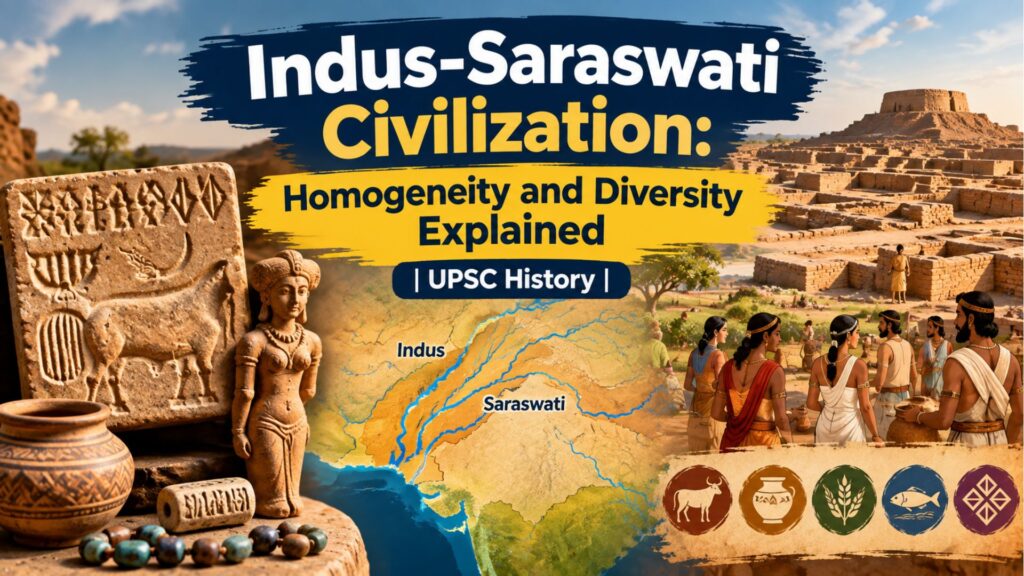
The Indus-Saraswati Civilization, more commonly called the Indus or Harappan Civilization, represents one of the earliest urban traditions of South Asia. Its Mature Urban Phase is generally dated to around 2600–1900 BCE, although its roots and later regional traditions extend beyond this period. Archaeological evidence shows a civilization spread across a very large geographical area, covering different ecological zones, river systems and resource regions.
For UPSC aspirants, the civilization is important because it demonstrates an interesting combination of cultural uniformity and regional diversity. Standardized bricks, weights, seals, craft traditions and urban planning indicate broad cultural integration. At the same time, differences in settlement layouts, pottery, agriculture, architecture, burial practices and economic activities reveal strong regional characteristics.
Thus, the Harappan Civilization should not be understood as a completely uniform political or cultural system. It is better understood as a large interconnected cultural zone with shared traditions and significant regional variations.
UPSC Core Idea: The Harappan world combined integration with regional diversity.
What Is Meant by Indus-Saraswati or Harappan Civilization?
The term Harappan Civilization derives from Harappa, one of the first major sites excavated and identified in the 1920s. The term Indus Civilization refers to its extensive distribution around the Indus river system and adjoining regions.
The expression Indus-Saraswati Civilization is also used in some Indian historical and archaeological discussions because numerous Harappan sites occur along the Ghaggar-Hakra palaeochannel system, which some scholars associate with the ancient Saraswati mentioned in Vedic literature.
However, the identification of the Ghaggar-Hakra with the Vedic Saraswati remains a matter of scholarly debate. Therefore, UPSC answers should avoid presenting this identification as an established fact.
Broad Chronology
| Phase | Approximate Period | Major Features |
|---|---|---|
| Early food-producing traditions | Before c. 3500 BCE | Farming, animal domestication and village settlements |
| Early Harappan | c. 3500–2600 BCE | Regional cultures and increasing settlement complexity |
| Mature Harappan | c. 2600–1900 BCE | Urbanisation, standardized material culture and long-distance exchange |
| Late Harappan | After c. 1900 BCE | Regionalisation, transformation of urban centres and continuation of local traditions |
Modern archaeological research often describes the period before 2600 BCE as one of regionalisation, followed by an integration phase during the Mature Harappan period and a later phase of localisation.
Homogeneity in the Harappan Civilization
Homogeneity refers to the presence of shared cultural features across a large geographical region.
1. Standardised Brick Sizes
One of the striking features of Harappan settlements is the widespread use of standardized brick proportions.
Baked bricks were particularly important in major urban centres. Their regular dimensions suggest shared construction practices and technical knowledge.
This does not necessarily prove the existence of a single centralized empire. Instead, it indicates a considerable degree of cultural and technological standardisation.
2. Standardised Weights and Measures
Harappan sites have produced carefully manufactured stone weights, often following standardized systems.
Such standardisation would have helped facilitate:
- Trade
- Craft production
- Exchange of commodities
- Economic transactions
- Long-distance commercial networks
This is important evidence for economic integration across different regions.
3. Common Writing System
Harappan inscriptions occur on seals, pottery, tablets and other objects.
The signs show considerable similarity across the civilization. However, the Harappan script remains undeciphered.
Therefore, historians cannot yet reconstruct the political institutions, religious beliefs or social structure of the civilization through written texts in the way they can for later periods.
This makes archaeology the primary source of evidence for understanding Harappan society.
4. Similar Seals and Symbolic Traditions
Seals are found across many Harappan sites.
The famous unicorn motif, animals and standardized forms of seal production indicate shared artistic and symbolic traditions.
Seals may have played roles in:
- Identification
- Trade
- Administration
- Ownership
- Religious or symbolic activities
Their exact functions, however, cannot always be established with certainty.
5. Similar Urban Planning Principles
Major settlements demonstrate several common features:
- Planned streets
- Drainage systems
- Brick architecture
- Residential areas
- Craft areas
- Storage facilities
- Wells
- Public structures
The degree of planning varied from settlement to settlement, but the broader principles show substantial interaction between communities.
6. Shared Craft Traditions
Harappan communities produced sophisticated:
- Beads
- Pottery
- Copper and bronze objects
- Faience
- Shell ornaments
- Terracotta objects
- Stone tools
- Jewellery
NCERT archaeological material highlights beads, weights, blades, seals and objects made from stone, shell, copper, bronze, gold and silver as important sources for understanding Harappan material culture.
Diversity Within the Harappan Civilization
Despite these similarities, the civilization was far from completely uniform.
Its enormous geographical spread exposed communities to different environments, resources and cultural influences.
1. Regional Differences in Settlement Patterns
Harappan settlements were found across:
- Indus plains
- Punjab
- Haryana
- Rajasthan
- Gujarat
- Sindh
- Baluchistan
- Jammu region
- Western Uttar Pradesh and adjoining areas
The geographical environment differed significantly between these regions.
Consequently, settlements developed different economic strategies.
2. Dholavira: A Distinctive Regional Expression
Dholavira is an important example of regional diversity.
Unlike many Harappan cities, Dholavira was divided into three major sections, each enclosed by substantial walls.
It also had sophisticated water-management arrangements.
Its architecture reflects adaptation to the relatively dry environment of Kutch.
NCERT notes that Dholavira had three major divisions and substantial stone architecture, while large inscriptions are among its distinctive discoveries.
UPSC significance: Dholavira demonstrates that Harappan urbanism was not based on one rigid architectural model.
3. Lothal and Maritime Trade
Lothal provides evidence for the importance of coastal and maritime networks.
Its location near the Gulf of Khambhat gave it access to coastal exchange.
Archaeological discoveries include:
- Beads
- Seals
- Storage structures
- Craft-production evidence
- A structure traditionally interpreted as a dockyard
NCERT identifies Lothal as an important centre for craft production and overseas trade, based partly on its location and archaeological remains.
Thus, the economic orientation of Lothal differed from that of settlements located deep within the Indus plains.
4. Agricultural Diversity
Harappan agriculture varied according to local environmental conditions.
Communities cultivated different crops depending on:
- Rainfall
- River availability
- Soil
- Temperature
- Irrigation possibilities
- Local ecological conditions
Archaeobotanical evidence also indicates changes in crop choices through time. Research at Harappan sites has documented shifts in agricultural strategies in response to environmental and climatic conditions.
This shows that Harappan society was not economically dependent on one uniform agricultural system.
Homogeneity and Diversity: A Comparison
| Aspect | Evidence of Homogeneity | Evidence of Diversity |
|---|---|---|
| Architecture | Common planning principles | Different settlement layouts |
| Bricks | Standardised proportions | Local building materials varied |
| Weights | Standardised systems | Regional economic activities differed |
| Pottery | Shared Harappan styles | Distinct regional ceramic traditions |
| Seals | Similar motifs and techniques | Local variations existed |
| Economy | Long-distance exchange networks | Agriculture and crafts varied |
| Urbanism | Planned settlements | Different city designs |
| Water management | Importance of water control | Different techniques according to environment |
| Religion/symbolism | Shared motifs | Local practices remain possible |
| Settlement size | Large urban centres and smaller settlements | Hierarchical and functional differences |
The evidence therefore supports a more nuanced interpretation: integration did not eliminate regional identity.
Important Sites and Their Regional Features
| Site | Present Location | Important Features |
|---|---|---|
| Harappa | Punjab, Pakistan | Major urban centre; cemetery and craft evidence |
| Mohenjo-daro | Sindh, Pakistan | Planned city; drainage; Great Bath |
| Dholavira | Gujarat | Three-part settlement, reservoirs and distinctive architecture |
| Lothal | Gujarat | Craft production and maritime connections |
| Kalibangan | Rajasthan | Settlement planning and agricultural evidence |
| Rakhigarhi | Haryana | One of the largest known Harappan settlement complexes |
| Banawali | Haryana | Settlement and craft evidence |
| Surkotada | Gujarat | Fortified settlement and regional Harappan characteristics |
The large geographical distribution of Mature Harappan sites demonstrates that the civilization was not confined to the Indus Valley in a narrow geographical sense. Research places its urban phase across a broad region of present-day Pakistan and northwestern India.
Why Did Homogeneity Develop?
Several factors probably encouraged cultural integration.
1. Trade Networks
Exchange of raw materials and finished products connected distant communities.
Important materials included:
- Carnelian
- Shell
- Copper
- Timber
- Semi-precious stones
- Metals
Trade created incentives for common standards of measurement, production and exchange.
2. Movement of Craftspeople and Ideas
Craft technologies could spread through mobility and interaction.
Bead-making, metallurgy, pottery traditions and other technical practices show evidence of knowledge transmission between regions.
3. Shared Cultural Institutions
The repeated use of particular symbols, weights, seals and construction techniques suggests networks of shared cultural practices.
4. Urban-Rural Interaction
Large cities depended on surrounding rural communities for agricultural products and raw materials.
Therefore, Harappan urbanism was supported by an extensive urban-rural economic network.
Why Did Diversity Continue?
The Harappan Civilization covered an enormous geographical area.
Environmental conditions differed greatly between the Indus plains, Gujarat, Rajasthan and the northwestern regions.
Therefore, communities adapted to their local surroundings.
For example:
Dry region → water conservation became particularly important.
Coastal region → maritime exchange gained importance.
Agricultural plains → farming and river-based settlement were central.
Resource-rich areas → craft production could become significant.
This relationship between environment and human adaptation is one of the strongest explanations for regional variation.
Did the Harappan Civilization Have One Centralised Empire?
This question requires caution.
The widespread similarities in bricks, weights, seals and urban planning demonstrate significant integration.
However, archaeology has not established a single ruler, imperial capital or clearly identifiable centralized state comparable to later empires.
The Harappan script remains undeciphered, and the political structure is therefore difficult to reconstruct.
Hence, the safest UPSC formulation is:
The Harappan Civilization shows strong cultural and economic integration, but the precise nature of its political organisation remains uncertain.
This distinction is important because cultural uniformity does not automatically mean political unity.
Indus-Saraswati Civilization and the Question of the Saraswati
The Ghaggar-Hakra palaeochannel system contains numerous archaeological sites associated with the broader Harappan tradition.
Some scholars have connected this ancient river system with the Saraswati mentioned in Vedic texts.
However, the identification of the Ghaggar-Hakra with the Vedic Saraswati is debated.
UPSC aspirants should therefore distinguish between:
- Archaeological evidence for Harappan settlements along palaeochannels
- Geological evidence concerning ancient river courses
- Literary references to Saraswati in Vedic texts
- Interpretations connecting these different bodies of evidence
A balanced answer should not present a debated identification as an established historical fact.
Was the Harappan Civilization Truly Homogeneous?
No.
It is more accurate to describe it as a civilization characterised by shared cultural norms alongside regional variation.
The Mature Harappan period represents a remarkable phase of integration. Archaeologists identify common material traditions across a vast region, but regional communities retained distinctive settlement forms, pottery, economic practices and adaptations.
Recent archaeological scholarship also stresses that there was no single trajectory of change across all Harappan regions. After about 1900 BCE, different areas experienced different transformations rather than one uniform collapse.
This is particularly important when discussing the so-called decline of the Harappan Civilization.
Instead of assuming that an entire civilization suddenly disappeared, it is better to discuss urban decline, regionalisation and continuity.
Why This Topic Matters for UPSC
This topic is important for both UPSC Prelims and Mains.
For Prelims
Focus on:
- Harappa
- Mohenjo-daro
- Dholavira
- Lothal
- Rakhigarhi
- Kalibangan
- Major archaeological features
- Mature Harappan chronology
- Standardised weights
- Harappan script
- Drainage systems
- Craft production
- Trade networks
- Regional cultures
For Mains
The major analytical themes are:
- Unity versus diversity
- Urbanisation
- Environmental adaptation
- Regional cultures
- Trade and economic integration
- Political organisation
- Archaeological interpretation
- Continuity and transformation after 1900 BCE
A strong Mains answer should avoid simply listing Harappan features. It should connect evidence with interpretation.
UPSC Mains Answer Writing Approach
For a 10-Mark Answer
Use a simple structure:
Introduction
Define the Harappan Civilization and mention its Mature Urban Phase.
Body
Explain:
- Standardised bricks
- Weights
- Seals
- Urban planning
- Shared craft traditions
Then contrast them with:
- Regional pottery
- Different settlement designs
- Environmental adaptations
- Economic variations
Conclusion
State that Harappan culture combined integration with regional diversity.
For a 15-Mark Answer
Use the following framework:
Introduction:
Briefly define the civilization and chronology.
Body Part 1 – Homogeneity:
- Urban planning
- Bricks
- Weights
- Seals
- Script
- Craft traditions
Body Part 2 – Diversity:
- Dholavira
- Lothal
- Regional pottery
- Agricultural variation
- Environmental adaptation
Body Part 3 – Analysis:
Explain how trade, technology and cultural interaction encouraged integration, while geography and ecological conditions encouraged regional differentiation.
Conclusion:
Present the Harappan Civilization as an integrated cultural system rather than a completely uniform society.
For a 20-Mark Answer
A high-quality 20-mark answer can use a thesis–evidence–analysis–synthesis structure.
Suggested framework
Introduction
Give chronology and geographical extent.
Argument 1: Evidence of Homogeneity
Use:
- Standardised weights
- Brick proportions
- Seals
- Script
- Urban planning
- Craft traditions
Argument 2: Evidence of Diversity
Use:
- Dholavira’s distinctive architecture
- Lothal’s maritime orientation
- Regional pottery
- Agricultural differences
- Local settlement patterns
Argument 3: Explain the Relationship
Do not treat homogeneity and diversity as opposites.
Instead, argue that:
Trade + cultural interaction → integration
while
Geography + resources + ecology → regional adaptation
Critical Dimension
Mention that cultural standardisation does not necessarily prove political centralisation.
Conclusion
Conclude that the Harappan Civilization represents unity through shared cultural and economic practices alongside diversity through regional adaptation.
5 Likely UPSC-Style Questions
1. Mains – 10 Marks
“The Harappan Civilization displayed considerable cultural uniformity despite its vast geographical extent.” Explain with suitable examples.
2. Mains – 15 Marks
“Homogeneity and diversity were complementary features of the Harappan Civilization.” Discuss.
3. Mains – 15 Marks
Examine how geography and environmental conditions contributed to regional variations within the Harappan Civilization.
4. Mains – 20 Marks
The standardisation of Harappan material culture indicates integration, but does not necessarily establish political centralisation. Critically examine.
5. Prelims-Oriented Question
Consider the following features:
- Standardised weights
- Harappan seals
- Planned drainage systems
- Regional variations in settlement architecture
Which of the above illustrate the character of the Harappan Civilization?
Answer: 1, 2, 3 and 4.
5 Frequently Asked Questions
1. What is meant by the Indus-Saraswati Civilization?
The term is used by some scholars and writers for the broader Harappan cultural tradition, particularly because many archaeological sites occur along the Ghaggar-Hakra palaeochannel system. The identification of this system with the Vedic Saraswati remains debated.
2. What is the main evidence for homogeneity in the Harappan Civilization?
Standardised weights, brick proportions, seals, script signs, craft traditions and broad urban-planning principles provide evidence for cultural integration.
3. What are the major examples of diversity in Harappan culture?
Dholavira’s distinctive architecture, Lothal’s maritime orientation, regional pottery traditions, differences in agriculture and variations in settlement patterns demonstrate regional diversity.
4. Did the Harappans have a centralised empire?
There is insufficient evidence to establish a single centralised empire with certainty. The civilization shows strong cultural and economic integration, but its exact political organisation remains uncertain.
5. Why did the Harappan Civilization decline after 1900 BCE?
The transformation after about 1900 BCE was regionally varied. Changes in river systems, climate, agricultural strategies, trade networks and settlement patterns have all been discussed by researchers. Current scholarship increasingly emphasises transformation and regionalisation rather than a single sudden collapse.
Conclusion
The Harappan Civilization cannot be accurately described as either completely homogeneous or completely fragmented.
Its standardised weights, seals, brick traditions, craft technologies and urban practices demonstrate a remarkable degree of cultural integration across a vast region. At the same time, regional architecture, pottery, agriculture, settlement patterns and economic strategies reveal substantial diversity.
The most balanced interpretation is therefore that the Harappan world represented a shared cultural tradition adapted to different regional environments.
For UPSC, the key analytical insight is simple:
Harappan unity was expressed through shared material and economic traditions, while its diversity emerged through regional ecological and cultural adaptation.
This approach helps move beyond factual listing and demonstrates the analytical reasoning expected in UPSC History answers.