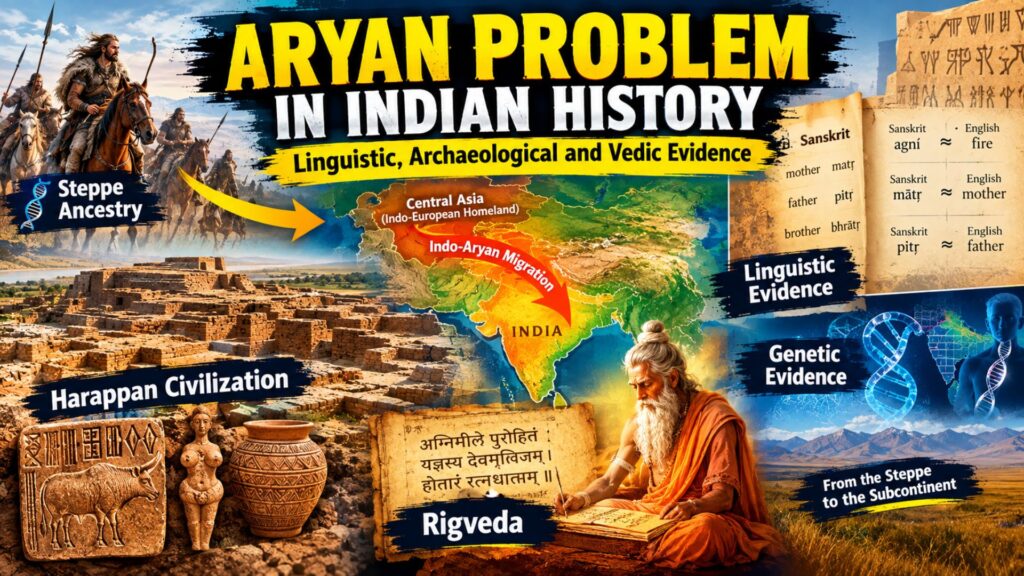
Introduction: Why Is the Aryan Problem Important for UPSC?
The Aryan Problem in Indian history concerns one of the most debated questions in ancient Indian history: how did Indo-Aryan languages and Vedic culture become established in the Indian subcontinent?
The debate involves several disciplines. Linguists study the relationship between Sanskrit and other Indo-European languages. Archaeologists examine material cultures before and after the decline of the Indus or Harappan Civilization. Historians analyse the Vedic texts. More recently, ancient DNA has added evidence about prehistoric population movements.
For UPSC aspirants, the important point is that these sources do not answer exactly the same question. Language, culture, archaeology and ancestry are different categories of evidence. Therefore, the Aryan question should not be reduced to a simple story of either a violent invasion or complete cultural continuity.
The modern discussion increasingly focuses on migration, interaction, cultural transformation and population admixture rather than a single military event.
What Does the Term “Aryan” Mean?
The word Arya occurs in ancient Indo-Iranian traditions. In historical scholarship, however, “Aryan” should not be treated as a biological race.
The more precise term is Indo-Aryan, which refers primarily to a branch of the Indo-European language family. Sanskrit belongs to the Indo-Aryan branch.
This distinction is essential because nineteenth-century racial interpretations of the word “Aryan” created a misleading association between language and biological race.
Language Is Not the Same as Race
A population can adopt a language without being replaced biologically. Similarly, population movement can occur without destroying existing cultures.
Therefore:
Indo-Aryan = linguistic and cultural category, not a racial category.
This distinction is important in UPSC answers because it prevents the use of outdated racial terminology.
The Aryan Debate: Invasion, Migration or Cultural Interaction?
Earlier scholarship frequently used the term Aryan Invasion Theory (AIT). The theory was often presented as an invasion of India by Aryans from outside the subcontinent.
However, the idea of a single large-scale military invasion has lost explanatory power because archaeological evidence does not provide clear evidence for one massive destruction horizon corresponding to such an invasion.
The debate subsequently shifted towards the Aryan Migration Theory, which proposes movements of Indo-Aryan-speaking populations into South Asia over a period of time.
The migration model does not require a single invasion, one army or one decisive battle.
It can involve:
- movement of pastoralist communities;
- gradual settlement;
- interaction with existing populations;
- language shift;
- intermarriage;
- cultural exchange; and
- regional variation.
Thus, migration and cultural interaction provide a more flexible framework for understanding the available evidence.
Linguistic Evidence for the Indo-Aryan Question
Linguistics provides some of the earliest evidence used in discussions about Indo-Aryan origins.
Sanskrit and the Indo-European Language Family
Vedic Sanskrit has structural and vocabulary similarities with several ancient Indo-European languages.
For example, Sanskrit can be compared with:
- Avestan
- Greek
- Latin
- Old Iranian languages
- Germanic languages
- Slavic languages
These similarities indicate a common linguistic ancestry.
The relationship is especially significant between Indo-Iranian languages and other Indo-European branches.
What Does Linguistics Tell Us?
Linguistic evidence suggests that Indo-Aryan developed within a wider Indo-European linguistic history.
It can help reconstruct:
- relationships between languages;
- older vocabulary;
- sound changes;
- linguistic contacts;
- movement of languages and speakers.
However, linguistics alone cannot provide an exact migration date or prove the identity of a particular archaeological culture.
This is a crucial limitation for UPSC answers.
Linguistic Evidence: Strengths and Limitations
| Evidence | What it can indicate | Limitation |
|---|---|---|
| Sanskrit–Avestan similarities | Indo-Iranian relationship | Does not by itself establish migration route |
| Sanskrit–Greek/Latin similarities | Indo-European relationship | Cannot identify a specific archaeological culture |
| Loanwords | Contact between languages | Direction and chronology may be debated |
| Dravidian influence on Indo-Aryan | Language contact in South Asia | Does not by itself establish population replacement |
| Linguistic geography | Possible historical movements | Exact dates remain difficult |
Historical linguists therefore caution against converting linguistic relationships directly into racial or political histories.
Archaeological Evidence and the Harappan Civilization
The Indus or Harappan Civilization reached a high level of urban development during the third millennium BCE.
Major sites include:
- Harappa
- Mohenjo-daro
- Dholavira
- Rakhigarhi
- Kalibangan
- Lothal
After approximately 1900 BCE, the urban system underwent major transformations.
These included:
- decline of large urban centres;
- regionalisation of material culture;
- changes in settlement patterns;
- changes in craft production;
- movement towards smaller settlements.
Importantly, the decline of urban Harappan civilization cannot automatically be equated with the arrival of Indo-Aryan speakers.
Environmental changes, weakening of long-distance trade and regional transformations are among the factors discussed by historians and archaeologists.
Did Aryans Destroy the Harappan Civilization?
There is no convincing archaeological evidence for a single invasion that destroyed the entire Harappan Civilization.
The chronological relationship is also important.
The major phase of urban Harappan decline preceded the period in which the earliest Vedic literature is generally placed.
Therefore, a UPSC answer should avoid writing:
“Aryans invaded India and destroyed the Harappan Civilization.”
A more defensible formulation is:
The decline of the urban Harappan system and the subsequent emergence and spread of Indo-Aryan-speaking traditions should be studied as connected but not necessarily identical processes.
Vedic Evidence: What Does the Rigveda Tell Us?
The Rigveda is the earliest surviving Vedic text and an important source for understanding early Vedic society.
It contains information about:
- tribes and chiefs;
- cattle wealth;
- warfare;
- rivers;
- rituals;
- gods;
- social relationships;
- chariots and horses;
- pastoral and agricultural activities.
The geography of the Rigveda is particularly important.
The text frequently refers to the northwestern part of the Indian subcontinent and the Sapta Sindhu region.
The rivers mentioned in Vedic literature provide clues about the geographical setting of early Vedic communities.
However, the Rigveda is a religious-poetic text rather than a chronological historical record.
Its evidence must therefore be interpreted carefully.
Horses and Chariots in Vedic Evidence
The horse and chariot have attracted considerable attention in the Aryan debate.
The Rigveda contains numerous references to horses and chariots. These became important because horse-drawn chariot warfare was prominent among several Bronze Age societies of Eurasia.
However, the presence of horses or chariot technology cannot by itself prove the arrival of an entire ethnic population.
Material evidence must be examined together with:
- chronology;
- settlement patterns;
- technology;
- genetics;
- linguistic evidence;
- textual evidence.
This is a classic example of why multi-disciplinary history is essential.
Archaeology and the Problem of “Vedic Culture”
One major difficulty is identifying a specific archaeological culture as “Vedic.”
Archaeological remains consist of:
- pottery;
- buildings;
- tools;
- weapons;
- burials;
- animal remains;
- agricultural evidence.
These objects rarely identify the language spoken by their users.
A particular pottery tradition cannot automatically be called “Vedic” merely because it belongs to the approximate chronological period.
This limitation should be explicitly mentioned in UPSC Mains answers.
Genetic Evidence and the Steppe Connection
Ancient DNA has significantly changed the discussion.
A major 2019 study published in Science analysed ancient genomes from South and Central Asia and found evidence for ancestry related to Steppe pastoralist populations entering South Asia after the decline of the Indus Civilization. The researchers linked this population history with the spread of Indo-Iranian languages.
Earlier genetic research had already demonstrated that present-day South Asian populations have complex ancestry resulting from multiple ancient population formations and mixtures.
This does not mean that every Indian with an Indo-Aryan language descends directly from a single migrating group.
Rather, the evidence points towards population mixture over long periods.
Why Is Ancient DNA Important?
Genetics provides a type of evidence that archaeology and linguistics cannot provide directly.
| Evidence | Main contribution |
|---|---|
| Linguistics | History and relationships of languages |
| Archaeology | Material culture and settlement change |
| Vedic literature | Textual and cultural information |
| Ancient DNA | Population movements and admixture |
| Historical analysis | Integration and interpretation of evidence |
The strongest historical reconstruction emerges when these sources are considered together.
Aryan Invasion Theory vs Aryan Migration Perspective
| Feature | Invasion Model | Migration Model |
|---|---|---|
| Nature of movement | Large military invasion | Gradual population movement |
| Main mechanism | Conquest | Migration, settlement and interaction |
| Archaeological expectation | Major destruction horizon | Regional cultural changes |
| Population replacement | Often implied | Not necessarily |
| Current relevance | Historically important | More compatible with several lines of modern evidence |
| Main limitation | Does not adequately explain archaeological complexity | Exact routes, dates and social mechanisms remain debated |
The table should not be interpreted as saying that every aspect of migration is settled. The chronology, routes, scale and social mechanisms remain subjects of research.
A Chronological Framework for UPSC
| Period | Major development |
|---|---|
| c. 2600–1900 BCE | Mature Harappan urban phase |
| After c. 1900 BCE | Transformation and regionalisation of Harappan traditions |
| 2nd millennium BCE | Increasing evidence for Steppe-related ancestry entering South Asia |
| 2nd millennium BCE | Development and transmission of early Vedic traditions |
| Later Vedic period | Expansion towards the western Ganga-Yamuna region |
| 1st millennium BCE | Formation of larger territorial societies and expanding agricultural settlements |
Dates associated with the earliest Vedic compositions remain debated, so aspirants should avoid presenting a single date as absolutely established.
Why This Topic Matters for UPSC
The Aryan problem is important because it connects several major UPSC themes.
For Prelims
Remember:
- Indo-European language family
- Indo-Iranian and Indo-Aryan branches
- Rigveda
- Sapta Sindhu
- Harappan Civilization
- Steppe ancestry
- Vedic literature
- archaeological cultures of the post-Harappan period
For Mains
The topic tests the ability to:
- compare different kinds of historical evidence;
- distinguish migration from invasion;
- explain continuity and change;
- evaluate limitations of sources;
- connect archaeology with linguistics and genetics.
The best answers are analytical rather than ideological.
UPSC Mains Answer Writing Approach
For a 10-Mark Answer
Use a simple structure:
Introduction: Define the Aryan problem and explain why the term “Aryan” should not be treated as a racial category.
Body:
- Linguistic evidence
- Vedic evidence
- Archaeological evidence
- Brief reference to genetic evidence
Conclusion: State that current scholarship favours a complex process involving migration, interaction and admixture rather than a simplistic invasion narrative.
For a 15-Mark Answer
Use three evidence categories:
1. Linguistic Evidence
Explain Indo-European and Indo-Iranian relationships.
2. Archaeological and Vedic Evidence
Discuss Harappan transformation, Rigvedic geography, horses and chariots, and the difficulty of identifying a specific “Vedic” archaeological culture.
3. Genetic Evidence
Explain Steppe-related ancestry and population admixture.
Finish by stressing the need for multi-disciplinary reconstruction.
For a 20-Mark Answer
A high-quality answer can follow this framework:
Introduction
Define the Aryan problem and clarify the distinction between language and race.
Historical Background
Briefly discuss the nineteenth-century Aryan invasion framework and its later revision.
Linguistic Evidence
Explain Indo-European and Indo-Iranian relationships.
Archaeological Evidence
Discuss the Harappan decline, regionalisation and post-Harappan cultures.
Vedic Evidence
Analyse Rigvedic geography, society, horses, chariots and rivers.
Genetic Evidence
Discuss Steppe-related ancestry and admixture.
Critical Evaluation
Explain why no single source can independently prove the complete historical process.
Conclusion
Emphasise migration, interaction, cultural transformation and population mixture as a more nuanced framework.
5 Likely UPSC-Style Questions
1.
“The Aryan problem is no longer simply a debate between invasion and indigenous continuity.” Discuss with reference to linguistic, archaeological and genetic evidence.
2.
Examine the contribution and limitations of linguistic evidence in understanding the origins of Indo-Aryan languages in South Asia.
3.
How far does archaeological evidence support the theory of Aryan migration into the Indian subcontinent? Discuss.
4.
Discuss the importance of the Rigveda as a source for reconstructing the geography and society of early Vedic India.
5.
Ancient DNA has added a new dimension to the Aryan debate. Explain its significance and limitations.
5 Frequently Asked Questions
1. What is the Aryan problem in Indian history?
The Aryan problem refers to debates concerning the origins, movements and establishment of Indo-Aryan languages and Vedic traditions in South Asia.
2. Was there an Aryan invasion of India?
There is no strong archaeological evidence for a single large-scale military invasion that destroyed the Harappan Civilization. Modern scholarship increasingly examines migration, interaction and population admixture.
3. What is the Aryan Migration Theory?
It proposes that Indo-Aryan-speaking populations moved into South Asia from regions connected with the Eurasian Steppe and Central Asia during the second millennium BCE, followed by interaction and admixture with existing populations.
4. Does the Rigveda prove Aryan migration?
The Rigveda provides important linguistic, geographical and cultural evidence, but it does not directly describe a historical migration event. Its evidence must be combined with archaeology, linguistics and other sources.
5. What does DNA evidence say about the Aryan question?
Ancient genomic studies identify Steppe-related ancestry in later South Asian populations and support population movements into South Asia after the decline of the Indus Civilization. This evidence concerns population history and does not by itself identify language or culture.
Conclusion
The Aryan Problem in Indian History cannot be adequately explained through a single source or a simple invasion narrative.
Linguistics demonstrates relationships between Indo-Aryan, Indo-Iranian and other Indo-European languages. Vedic literature provides valuable information about the geography and society of early Vedic communities. Archaeology reveals major transformations after the decline of the urban Harappan system. Ancient DNA provides evidence for population movements and admixture involving Steppe-related groups.
Taken together, these sources point towards a complex historical process involving migration, interaction, cultural transmission and population mixture.
For UPSC preparation, the key lesson is methodological: history becomes stronger when different forms of evidence are compared, their limitations are recognised, and conclusions are kept proportional to the evidence.