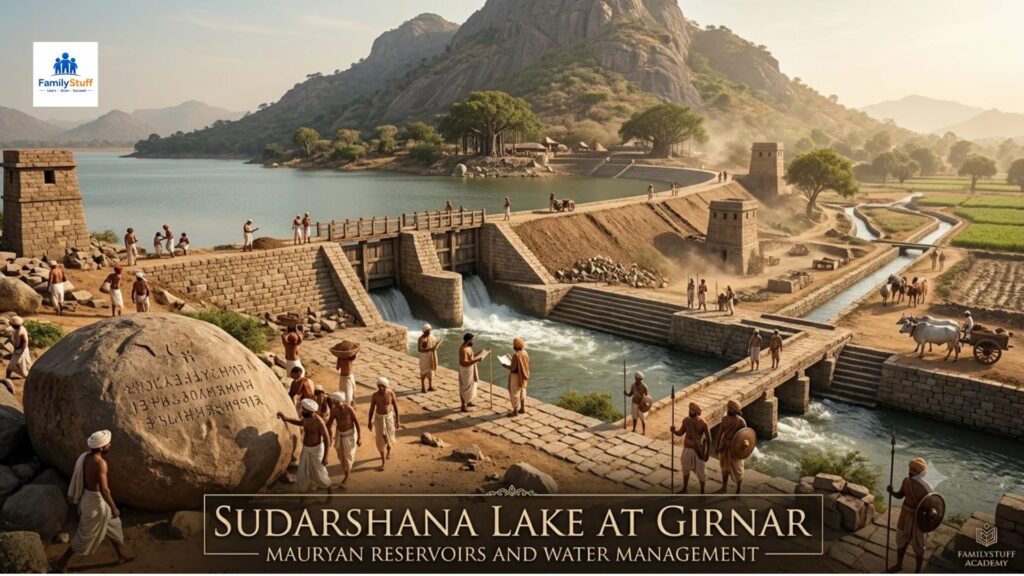
Water management was an important component of the Mauryan Empire’s agricultural economy, administration and regional development. The Mauryan rulers recognised that reliable water supplies supported agriculture, encouraged settlement and strengthened the economic foundations of the state.
One of the most significant examples of Mauryan hydraulic engineering was Sudarshana Lake at Girnar in present-day Gujarat. Its history is recorded in the famous Junagadh rock inscription of the Western Kshatrapa ruler Rudradaman I (c. 150 CE). The inscription traces the lake’s construction to Chandragupta Maurya’s administration and its subsequent improvement under Ashoka.
The Mauryan approach to water management also finds support in the Arthashastra, archaeological discoveries and Ashoka’s inscriptions.
For UPSC Civil Services aspirants, this topic connects several important themes: Mauryan administration, agricultural taxation, public works, ancient engineering, epigraphy and the relationship between the state and the economy.
1. Historical Background of Mauryan Water Management
The Mauryan Empire (c. 322–185 BCE) established an extensive administrative structure across much of the Indian subcontinent.
Agriculture formed the foundation of its economy. However, agricultural productivity depended on rainfall, rivers, irrigation facilities and seasonal water availability.
The state therefore had several reasons to support water management:
To improve agricultural productivity and revenue collection.
To encourage cultivation in areas with limited rainfall.
To support growing settlements and urban centres.
To reduce the impact of seasonal water shortages.
To strengthen regional administration through public infrastructure.
Water management was not necessarily controlled entirely by the central government. Local communities, provincial officials and private individuals also had roles in constructing and maintaining irrigation facilities.
2. Sudarshana Lake: The Most Important Mauryan Reservoir
Sudarshana Lake, located near Girnar (ancient Girinagara) in present-day Junagadh, Gujarat, is the best-documented example of a reservoir associated with the Mauryan administration.
Its historical importance comes from the Junagadh rock inscription of Rudradaman I, dated approximately 150 CE.
Although the inscription was issued several centuries after the Mauryan period, it provides valuable information about the lake’s earlier history.
Construction under Chandragupta Maurya
According to Rudradaman’s inscription:
Pushyagupta, a provincial governor under Chandragupta Maurya, initiated the construction of Sudarshana Lake.
The reservoir collected water from streams originating in the Girnar hills.
The project demonstrated the importance of water storage in the semi-arid Saurashtra region.
Pushyagupta is associated with the administration of the western province under Chandragupta.
Improvements under Ashoka
During Ashoka’s reign, the reservoir received further improvements.
The inscription mentions Tushaspha, a Yavana (Greek or foreign-origin) governor associated with Ashoka’s administration, who provided conduits and other water-management facilities.
This indicates continuity in public infrastructure projects across successive Mauryan reigns.
Repairs under Rudradaman I
Around 150 CE, the reservoir suffered damage following heavy rainfall and a severe storm.
Rudradaman’s governor Suvisakha supervised its restoration.
The inscription describes the reconstruction of the embankment and associated water-control structures.
The repair was reportedly financed by the royal treasury without imposing additional taxes or forced labour on the population.
This episode demonstrates the long-term importance of the reservoir and its continued use beyond the Mauryan Empire.
3. Junagadh Rock Inscription: Historical Evidence
The Junagadh inscription is particularly valuable because the same rock surface contains inscriptions from different historical periods.
Inscription | Ruler / Period | Historical significance |
|---|---|---|
Ashokan Rock Edicts | Ashoka, 3rd century BCE | Mauryan administrative and ethical policies |
Junagadh inscription | Rudradaman I, c. 150 CE | History and restoration of Sudarshana Lake |
Junagadh inscription | Skandagupta, 5th century CE | Later restoration of the reservoir |
Why is this inscription important?
It provides evidence of:
Chandragupta Maurya’s authority in the Saurashtra region.
The role of provincial governors in infrastructure development.
Continuity of public water-management projects.
Advanced knowledge of embankments, channels and water distribution.
The importance of irrigation infrastructure across different dynasties.
UPSC fact: Rudradaman’s Junagadh inscription is an important Sanskrit inscription and a major source for understanding the history of Sudarshana Lake.
4. Water Management in the Arthashastra
The Arthashastra, traditionally attributed to Kautilya, provides detailed information about economic administration and irrigation management.
It discusses the construction, maintenance and regulation of reservoirs, known as setu.
State responsibility for reservoirs
The text describes the king’s responsibility to construct reservoirs and encourage individuals to build them.
The state could provide necessary facilities, including land, access routes and timber, to those undertaking reservoir construction.
This indicates that irrigation development involved both public initiative and private participation.
Irrigation taxation
The Arthashastra also discusses water charges, known as udakabhaga.
The rate varied according to the method used to obtain irrigation water.
Irrigation method | Water charge mentioned in the Arthashastra |
|---|---|
Manual labour | One-fifth of produce |
Carrying water on shoulders | One-fourth of produce |
Using water-lifting devices | One-third of produce |
Drawing water from rivers, lakes, tanks and wells | One-third or one-fourth of produce |
These differentiated rates indicate that the Mauryan-era administrative tradition recognised the costs and labour involved in irrigation.
Regulation and maintenance
The Arthashastra also discusses penalties for damaging reservoirs and irrigation structures.
It emphasises the responsibility of cultivators and users to maintain water facilities.
These provisions suggest that water management was treated as an economic and administrative responsibility rather than merely a technical activity.
5. Important Archaeological Sites and Water Management
Sudarshana Lake is the strongest direct example of a reservoir linked to the Mauryan administration. Other archaeological sites provide useful comparative evidence, but their chronology must be distinguished carefully.
A. Sringaverapura – Uttar Pradesh
Sringaverapura, situated near the Ganga in present-day Uttar Pradesh, is an important archaeological site for studying ancient water management.
Excavations revealed terracotta ring wells and evidence of settlement during the Mauryan period.
However, the famous large brick tank and its elaborate water-channel system belong to a later early historic phase, generally associated with the Shunga period and subsequent developments.
Its significance lies in demonstrating the development of water storage, filtration and floodwater management in ancient urban settlements.
UPSC distinction: Do not incorrectly identify the famous large brick reservoir at Sringaverapura as a confirmed Mauryan construction.
B. Pataliputra – Bihar
Pataliputra, the Mauryan imperial capital, developed near the Ganga and Son river systems.
Archaeological investigations near Patna have identified a large canal considered possibly Mauryan in date.
The canal may have served irrigation and navigation purposes.
However, its precise chronology and functions should be treated cautiously.
The location of Pataliputra itself demonstrates the importance of river networks in ancient political, economic and urban development.
C. Dholavira – Gujarat
Dholavira is an important comparative example of ancient Indian hydraulic engineering.
Located in the Rann of Kutch, it belonged to the Indus Valley Civilisation, much earlier than the Mauryan Empire.
Its inhabitants developed an impressive system of reservoirs, channels and water-storage structures to manage limited water resources.
Dholavira should not be classified as a Mauryan site. It is useful for comparing the evolution of water conservation techniques in ancient India.
6. Ashoka's Contribution to Public Water Facilities
Ashoka’s inscriptions provide additional evidence of state interest in public welfare.
His Second Major Rock Edict refers to medical arrangements for humans and animals in his territories and neighbouring regions.
It also mentions the provision of medicinal plants, roots and fruits.
The Seventh Pillar Edict refers to the planting of trees and the digging of wells along roads for the benefit of people and animals.
These measures reflect the relationship between public infrastructure, welfare and imperial governance.
However, roadside wells should be distinguished from large irrigation reservoirs. They served different purposes within the broader system of public water provision.
7. Chronology of Important Water Management Developments
Period | Site / Development | Significance |
|---|---|---|
3rd millennium BCE | Dholavira | Harappan reservoirs and water conservation |
Chandragupta Maurya | Sudarshana Lake, Girnar | Construction under Pushyagupta |
Ashoka | Sudarshana Lake | Improvements under Tushaspha |
Mauryan period | Pataliputra region | Possible canal infrastructure |
Later early historic period | Sringaverapura | Development of large brick tank and channels |
c. 150 CE | Junagadh | Rudradaman’s restoration of Sudarshana Lake |
5th century CE | Junagadh | Restoration under Skandagupta |
8. Features of Mauryan Water Management
The Mauryan approach can be understood through five important dimensions.
1. Infrastructure development: Reservoirs, embankments, channels and wells supported water storage and distribution.
2. Agricultural development: Irrigation improved the possibility of cultivation beyond areas dependent entirely on seasonal rainfall.
3. Administrative supervision: Provincial officials and specialised administrators contributed to the implementation of public works.
4. Economic regulation: Water charges and penalties encouraged regulated use and maintenance.
5. Public welfare: Wells and roadside facilities supported travellers, people and animals.
Was the Mauryan Empire a Hydraulic State?
The historian Karl August Wittfogel developed the concept of the hydraulic state, in which large-scale water management and irrigation systems support centralised political authority.
Some scholars have applied this framework to the Mauryan Empire because of its administrative structure and irrigation policies.
However, the evidence does not establish that all water management was centrally controlled.
Regional conditions, local participation and private initiatives also influenced irrigation development.
Therefore, the Mauryan Empire is better understood as a state that actively supported and regulated water management rather than as a system in which every water project was centrally operated.
9. Why This Topic Matters for UPSC
This topic has relevance across both Prelims and Mains.
UPSC Prelims relevance
Focus on the following facts:
Sudarshana Lake was constructed under Chandragupta Maurya.
Pushyagupta was the provincial governor associated with its construction.
Tushaspha improved the reservoir during Ashoka’s reign.
Rudradaman I repaired the reservoir around 150 CE.
Suvisakha supervised the restoration under Rudradaman.
The Junagadh inscription is an important source for Mauryan history.
Dholavira belongs to the Harappan Civilisation, not the Mauryan period.
UPSC Mains relevance
The topic connects with:
GS Paper I: Ancient Indian history and Mauryan administration.
GS Paper I: Science and technology in ancient India.
GS Paper III: Agriculture, irrigation and water resource management.
Historical themes: State formation, economic development and public welfare.
It can also support answers on the relationship between environmental conditions, state capacity and economic growth.
10. UPSC Mains Answer Writing Approach
Aspirants should structure their answers according to the marks and expected depth of analysis.
Model framework for a 10-mark question
Question: Examine the importance of Sudarshana Lake during the Mauryan period.
Suggested structure:
Introduction: Explain the importance of irrigation in the Mauryan economy.
Main body:
Construction by Pushyagupta under Chandragupta Maurya.
Improvements by Tushaspha under Ashoka.
Water storage and irrigation significance.
Evidence from Rudradaman’s Junagadh inscription.
Conclusion: Explain its importance as evidence of Mauryan public infrastructure.
Model framework for a 15-mark question
Question: Discuss the role of the Mauryan state in irrigation and water management.
Suggested structure:
Introduction: Agricultural dependence on water resources.
Administrative framework: State supervision and provincial officials.
Infrastructure: Reservoirs, wells, embankments and canals.
Literary evidence: Arthashastra and irrigation taxation.
Epigraphic evidence: Sudarshana Lake and Junagadh inscription.
Public welfare: Ashoka’s wells and roadside facilities.
Critical assessment: State participation alongside local initiatives.
Conclusion: Water management as an instrument of economic and administrative development.
Model framework for a 20-mark question
Question: Evaluate the contribution of the Mauryan Empire to the development of water management systems in ancient India.
Suggested structure:
Section | Points to cover |
|---|---|
Introduction | Importance of irrigation in ancient India |
Historical context | Mauryan expansion and agricultural economy |
Infrastructure | Sudarshana Lake, wells, canals and reservoirs |
Administration | Provincial officials and irrigation supervision |
Economic aspects | Water charges and agricultural taxation |
Evidence | Arthashastra, Junagadh inscription and archaeology |
Comparative analysis | Dholavira and later early historic systems |
Critical evaluation | Limits of centralised control and regional variation |
Conclusion | Long-term importance of water infrastructure |
Answer-writing tip: Use the example of Sudarshana Lake as your central historical evidence. Support it with the Arthashastra and Ashokan inscriptions. Avoid presenting later archaeological structures as Mauryan achievements without chronological evidence.
11. Five Likely UPSC-Style Questions
Prelims-oriented questions
1. Consider the following statements about Sudarshana Lake:
It was constructed during the reign of Chandragupta Maurya.
Pushyagupta was associated with its construction.
Rudradaman I repaired it during the Gupta period.
Which of the statements given above is/are correct?
(a) 1 and 2 only
(b) 2 and 3 only
(c) 1 and 3 only
(d) 1, 2 and 3
Answer: (a) 1 and 2 only.
2. With reference to the Junagadh inscription of Rudradaman I, consider the following statements:
It provides information about Sudarshana Lake.
It mentions Tushaspha’s contribution during Ashoka’s reign.
It was originally issued by Chandragupta Maurya.
Which of the statements given above is/are correct?
(a) 1 only
(b) 1 and 2 only
(c) 2 and 3 only
(d) 1, 2 and 3
Answer: (b) 1 and 2 only.
Mains-oriented questions
3. (10 Marks) Explain the historical significance of Sudarshana Lake in understanding Mauryan administration.
4. (15 Marks) Discuss the contribution of the Mauryan state to agricultural development through irrigation and water management.
5. (20 Marks) Evaluate the role of ancient Indian rulers in developing sustainable water management systems, with special reference to the Mauryan period.
12. Frequently Asked Questions (FAQs)
1. Who constructed Sudarshana Lake?
Sudarshana Lake was constructed under Chandragupta Maurya by his provincial governor Pushyagupta in the Girnar region of present-day Gujarat.
2. Who improved Sudarshana Lake during Ashoka’s reign?
Tushaspha, a Yavana governor associated with Ashoka’s administration, improved the reservoir by providing water conduits and related facilities.
3. Which inscription provides information about Sudarshana Lake?
The Junagadh rock inscription of Rudradaman I, dated approximately 150 CE, provides information about the construction, improvements and later restoration of Sudarshana Lake.
4. What was the role of the Arthashastra in Mauryan water management?
The Arthashastra discusses reservoir construction, irrigation taxation, maintenance responsibilities, water regulation and penalties for damaging irrigation infrastructure.
5. Why is Sudarshana Lake important for UPSC?
It is an important example of ancient Indian irrigation engineering, Mauryan provincial administration and continuity of public infrastructure. It is particularly relevant to Ancient Indian History and Mauryan administration.
Conclusion
Mauryan water management demonstrates the relationship between political authority, agricultural development and public infrastructure in ancient India.
Sudarshana Lake provides the strongest inscriptional evidence of Mauryan involvement in reservoir construction and improvement. The Junagadh inscription connects the administrations of Chandragupta Maurya, Ashoka, Rudradaman I and Skandagupta through the history of a single water-management project.
The Arthashastra further reveals the economic and administrative principles associated with irrigation, including water charges, maintenance and regulation.
However, ancient Indian water management was not exclusively a state activity. Local communities and private initiatives also played important roles.
The Mauryan contribution should therefore be understood as an important stage in the development of organised water management in ancient India, combining state supervision, engineering knowledge and agricultural needs.