Important content note: This topic primarily belongs to UPSC Ancient Indian History, rather than Sociology Optional. However, it offers useful sociological connections to economic stratification, social hierarchy, state power, religious patronage, trade and material culture. The article below preserves the historical focus of the topic while connecting it to relevant sociological concepts for interdisciplinary UPSC preparation.
Introduction
The Gupta period, broadly spanning the fourth to sixth centuries CE, is an important phase in ancient Indian history. Gupta rulers issued gold, silver and copper coins that reveal political authority, economic relationships, religious beliefs and royal representation. Archaeological sites and coin hoards provide additional evidence about the society and institutions of this period.
For UPSC aspirants, the Gupta coin hoards and archaeological sites in India are valuable for understanding how historians reconstruct the past through material evidence. Coins reveal royal titles and symbols, while inscriptions and monuments provide information about political organisation, religious patronage and social relationships.
A sociological reading adds another dimension. It asks who controlled wealth, how rulers legitimised power, and how religion and social hierarchy shaped public life. These questions connect historical evidence with concepts such as social stratification, economic power and cultural institutions.
1. What Are Gupta Coin Hoards?
A coin hoard is a collection of coins deposited together, whether deliberately buried, concealed or lost in the past. Archaeologists and historians study the coins, their dates, metal composition, designs and geographical distribution.
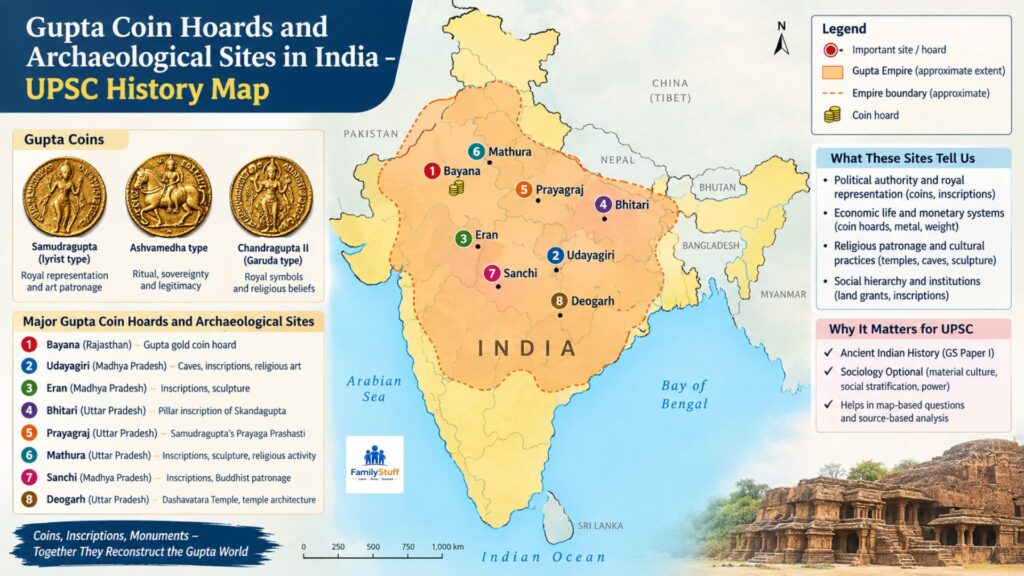
The Bayana coin hoard in Rajasthan is a famous example. It reportedly contained approximately 1,821 Gupta gold coins and is important for the study of Gupta coinage.
Major types of Gupta coins
Gold coins: Often called dinars in historical discussions, these display royal portraits, military achievements, religious symbols and ceremonial activities.
Silver coins: These are particularly useful for studying regional monetary practices, including the influence of Western Kshatrapa coinage.
Copper coins: These provide evidence of another segment of monetary circulation, although their use and distribution varied by region and period.
What do Gupta coins reveal?

Political authority
Royal names, titles and images communicated kingship. Samudragupta’s lyrist-type coins depict him playing a veena, presenting the king as a patron of the arts as well as a ruler.

Ritual and legitimacy
Ashvamedha-type coins connect royal representation with Vedic sacrifice and claims to sovereignty. They show how political authority could draw legitimacy from religious traditions.

Economy and culture
Metal, weight, circulation and coin imagery help researchers investigate monetary systems, exchange networks and royal patronage. However, gold coinage alone cannot establish general prosperity among all social groups.
2. Important Gupta Coin Hoards and Archaeological Sites
The following locations are useful for map-based revision and understanding the archaeological record.
Site or findspot | Present location | Historical significance |
|---|---|---|
Bayana coin hoard | Bharatpur district, Rajasthan | Famous hoard of Gupta gold coins |
Udayagiri Caves | Near Vidisha, Madhya Pradesh | Gupta-era religious art and inscriptions associated with Chandragupta II |
Eran | Madhya Pradesh | Gupta inscriptions, religious sculpture and political evidence |
Bhitari | Uttar Pradesh | Pillar inscription of Skandagupta |
Prayagraj (Allahabad Pillar) | Uttar Pradesh | Samudragupta’s Prayaga Prashasti |
Mathura | Uttar Pradesh | Inscriptions, sculpture and religious activity |
Sanchi | Madhya Pradesh | Inscriptions and evidence of Buddhist patronage |
Deogarh | Lalitpur district, Uttar Pradesh | Dashavatara Temple and developments in temple architecture |
The sites are not all coin-hoard locations. They represent complementary types of evidence—coins, inscriptions, sculpture and architecture.
Why should these sites be studied together?
A coin may identify a ruler or ceremonial event, while an inscription may record a donation, military achievement or religious dedication. Architecture and sculpture reveal patterns of patronage and changing cultural practices.
Cross-checking these sources reduces the risk of treating royal claims as complete descriptions of society.
3. A Sociological Interpretation of Gupta Material Culture
Karl Marx: Wealth and power
Marx’s emphasis on material conditions and control over resources offers a framework for examining the relationship between political authority and economic wealth.
Gupta gold coins demonstrate the importance of royal wealth and the ability to commission valuable objects. Land grants and religious endowments can also be examined in relation to control over resources.
However, coins do not directly reveal how wealth was distributed among peasants, artisans, traders and labourers. A Marxian interpretation must therefore be supported by other historical evidence.
Max Weber: Legitimacy and authority
Weber’s concept of legitimate authority helps explain why kings represented themselves through religious ceremonies, titles and symbols.
Ashvamedha coinage and royal imagery illustrate how political power could be connected with established ritual traditions. Such representations helped communicate a ruler’s status, although they cannot prove that every subject accepted that authority.
Pierre Bourdieu: Symbolic power
Bourdieu’s concept of symbolic power helps explain how objects, rituals and cultural symbols can make authority appear prestigious or legitimate.
Royal coins and monumental religious structures communicated status beyond their immediate economic value. Yet Bourdieu’s framework is an analytical tool developed for social theory, not a direct description of Gupta society.
Comparing the perspectives
Thinker | Main concept | Application to Gupta evidence | Limitation |
|---|---|---|---|
Karl Marx | Economic power | Wealth, resources and social inequality | Coins do not reveal the entire economic structure |
Max Weber | Legitimate authority | Rituals, titles and royal representation | Royal imagery cannot prove popular acceptance |
Pierre Bourdieu | Symbolic power | Prestige and cultural representation | Modern concepts require careful historical adaptation |
These perspectives show how material evidence can support sociological interpretation without replacing historical context.
4. Coins, Social Stratification and Religious Patronage
Social stratification refers to the unequal distribution of wealth, status and power within a society. Gupta coins and archaeological remains provide clues about these relationships, but they must be interpreted alongside inscriptions, literary sources and archaeological contexts.
Economic differentiation
Gold coins indicate that valuable monetary instruments existed within the Gupta economy. However, their presence does not establish that ordinary people regularly used gold coins for everyday purchases.
Differences in access to wealth can be investigated through evidence of trade, landholding, taxation, craft production and donations. The social position of peasants, merchants, artisans and religious institutions requires separate investigation.
Religion and social institutions
Gupta-period material culture includes Hindu, Buddhist and Jain evidence. Udayagiri provides important evidence of Brahmanical religious patronage, while inscriptions and religious objects from other sites demonstrate continuing religious activity across different traditions.
From a sociological perspective, religious institutions could support cultural continuity, patronage networks and social authority. Nevertheless, the surviving evidence varies across regions and does not justify describing Gupta India as uniformly prosperous or religiously homogeneous.
The importance of an Indian sociological perspective
Indian sociologists such as M. N. Srinivas and G. S. Ghurye examined caste, social organisation and cultural processes in Indian society. Their work can help students frame questions about hierarchy and social institutions.
However, their theories were developed primarily through studies of later historical and contemporary settings. Applying them to Gupta India requires independent evidence rather than assuming that social structures remained unchanged over centuries.
5. Limitations of Coins and Archaeological Evidence
Limitation | Why it matters |
|---|---|
Royal bias | Coins often present an idealised image of kingship. |
Uneven survival | Some materials survive better than others, creating an incomplete record. |
Uncertain circulation | A hoard’s location does not necessarily identify where every coin was produced or used. |
Regional variation | Evidence from one area cannot automatically represent the whole empire. |
Interpretive uncertainty | Religious symbols and images may have several meanings. |
A balanced UPSC answer should distinguish between what the evidence directly establishes and what scholars infer from it. For example, a large gold hoard demonstrates the accumulation of gold coins, but it does not independently prove widespread prosperity or a uniformly developed cash economy.
Why This Topic Matters for UPSC Sociology
Although the topic belongs primarily to Ancient Indian History, it offers useful interdisciplinary connections.
Sociology Optional, Paper I: Material culture, social stratification, power, social institutions and the relationship between economic resources and status.
UPSC Mains GS Paper I: Ancient Indian history, art and culture, archaeological evidence and historical interpretation.
Sociological theory: Marx’s economic analysis, Weber’s authority and Bourdieu’s symbolic power.
Contemporary society: Heritage conservation, museum interpretation, the public representation of rulers and debates about access to cultural resources.
For Sociology Optional, use this topic as an illustrative example of how material objects can reflect social relationships. For history questions, prioritise chronology, locations, inscriptions and archaeological evidence.
UPSC Mains Answer Writing Approach
Aspirants should adjust the structure to the wording and marks of the question.
10-mark answer
Approximately 150 words
Define coin hoards and introduce the Gupta period.
Give two examples, such as Bayana and Samudragupta’s gold coins.
Explain their value for studying kingship and economic history.
End with one limitation of numismatic evidence.
15-mark answer
Approximately 250 words
Introduce coin hoards as archaeological sources.
Discuss gold, silver and copper coinage.
Add examples from Bayana, Udayagiri and Prayagraj.
Connect the evidence with economic organisation and religious patronage.
Explain source limitations and conclude.
20-mark answer
Length according to the question and examination context
Establish the historical and conceptual framework.
Analyse coinage, inscriptions, architecture and sculpture.
Compare economic, political and cultural interpretations.
Apply relevant sociological theories where appropriate.
Evaluate regional differences, evidentiary limitations and alternative explanations.
Conclude by stressing the importance of corroborating material evidence.
Answer-writing tip: Add a small map marking Bayana, Udayagiri, Eran, Bhitari, Prayagraj, Mathura and Sanchi for a history-oriented question. In Sociology Optional, use a concise theoretical application rather than allowing historical details to dominate the answer.
Five Likely UPSC-Style Questions
Examine the importance of Gupta coin hoards as sources for reconstructing the economic history of ancient India.
Analyse how Gupta coinage reflected political authority, religious beliefs and royal representation.
Discuss the relationship between material culture and social stratification, with suitable historical examples.
Critically examine the usefulness and limitations of archaeological evidence in understanding ancient Indian society.
Explain how the concepts of economic power and symbolic authority can help interpret Gupta-period material culture.
Frequently Asked Questions
1. What is the Bayana coin hoard famous for?
Bayana, in Rajasthan, is famous for a major hoard of Gupta gold coins, reportedly numbering approximately 1,821. It is an important source for studying Gupta coinage.
2. Which Gupta ruler issued coins depicting a veena?
Samudragupta issued gold coins depicting himself playing a veena. These coins illustrate royal representation and the association of kingship with artistic accomplishment.
3. What do Gupta gold coins reveal about the economy?
They provide evidence of gold coin production, royal wealth and monetary practices. They cannot independently establish the living standards of the entire population.
4. Which archaeological sites are important for Gupta-period studies?
Bayana, Udayagiri, Eran, Bhitari, Prayagraj, Mathura, Sanchi and Deogarh are useful locations to study. Each provides a different combination of archaeological, epigraphic or artistic evidence.
5. Is Gupta coinage relevant to UPSC Sociology Optional?
It is not a core Sociology Optional topic. However, it can illustrate economic inequality, political authority, social stratification and symbolic power when these concepts are relevant to a sociology question.
Conclusion
Gupta coin hoards and archaeological sites provide valuable evidence for reconstructing ancient Indian political, economic and cultural life. Coins reveal royal representation and monetary practices, while inscriptions and monuments add information about institutions, religious patronage and social relationships. A careful analysis must recognise regional variation and the limitations of surviving evidence. Combining historical methods with relevant sociological concepts offers a deeper understanding of how wealth, authority and culture interacted in Gupta-period society.