Introduction
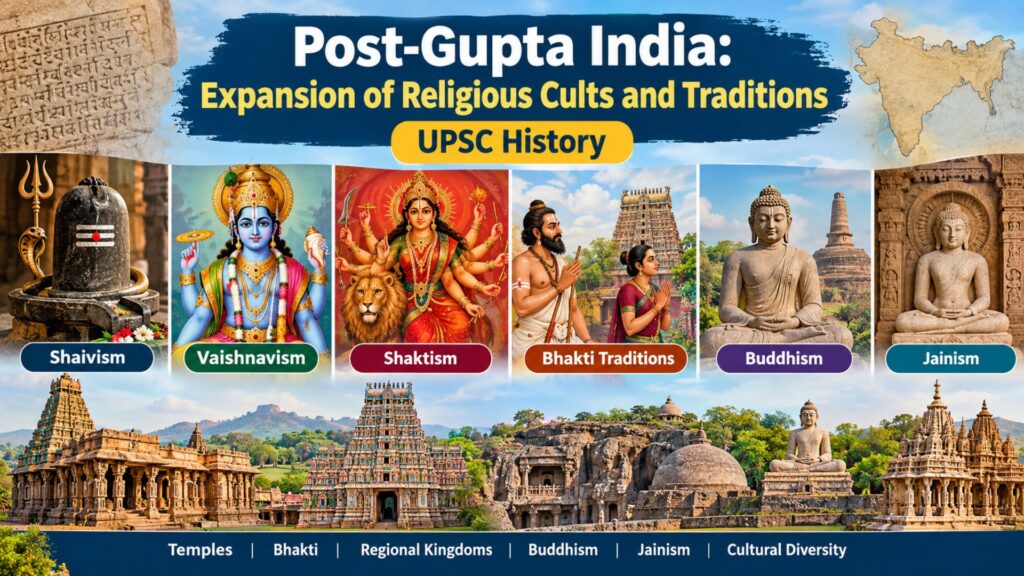
The Post-Gupta period, broadly covering the sixth to twelfth centuries CE, witnessed major changes in the religious life of the Indian subcontinent. The decline of Gupta political authority did not lead to a decline of religious activity. Instead, Hindu, Buddhist and Jain traditions developed new forms, institutions and regional expressions.
This period saw the growing importance of Puranic Hinduism, Shaivism, Vaishnavism, Shaktism, temple worship, devotional traditions, Tantric practices, pilgrimage centres and religious institutions. Buddhism and Jainism also continued to influence different regions, although their political and social positions varied considerably.
For UPSC, the topic is important because it connects religious change with regional kingdoms, temple architecture, land grants, literature, social transformation and the emergence of regional cultures. It also helps explain how religious traditions became deeply connected with political authority and local society.
Historical Context of Post-Gupta India
After the decline of the Gupta Empire, political power became more regionalised. Important kingdoms emerged across northern, central and southern India.
Some important political powers included:
- Pushyabhutis under Harsha
- Chalukyas of Badami
- Pallavas of Kanchipuram
- Rashtrakutas
- Pratiharas
- Palas
- Cholas
- Pandyas and Cheras
The political fragmentation of the period was accompanied by greater regional interaction between royal courts, religious institutions, local communities and economic networks.
Religious traditions therefore developed differently across regions while sharing certain broader trends.
Major Features of Religious Change
1. Expansion of Puranic Hinduism
One of the major developments was the wider spread of Puranic Hinduism.
The Puranas helped popularise stories, genealogies, myths and forms of worship associated with major deities such as:
- Vishnu
- Shiva
- Devi
- Skanda
- Surya
Puranic traditions made religious practices accessible through stories, festivals, pilgrimage and temple worship.
This did not simply replace earlier Vedic traditions. Instead, different religious practices interacted and coexisted.
Why Puranic traditions expanded
Several factors contributed to their growth:
- Expansion of temple-based worship
- Patronage from regional rulers
- Growth of pilgrimage centres
- Composition and circulation of Puranic literature
- Integration of local and regional deities
- Growth of devotional practices
This process also helped connect local religious traditions with wider Hindu traditions.
2. Growth of Shaivism
Shaivism, the worship of Shiva as the supreme deity, became particularly influential in several parts of India.
Shiva was worshipped through different forms, including:
- Shiva linga
- Anthropomorphic images
- Nataraja
- Maheshvara
- Bhairava
The linga became an important symbol of Shaiva worship.
Several Shaiva traditions developed during this period. Some emphasised temple worship, while others developed philosophical, ascetic or Tantric practices.
Shaiva institutions
Mathas, temples and religious teachers helped transmit Shaiva traditions.
The Chalukyas, Pallavas and Cholas made significant contributions to Shaiva temple traditions in southern India.
The later development of the Nayanar devotional tradition further strengthened Shaivism in Tamil regions.
3. Expansion of Vaishnavism
Vaishnavism centred on the worship of Vishnu and his avatars, particularly Rama and Krishna.
The Bhagavata tradition contributed to the growing popularity of Krishna worship.
Important features included:
- Devotion to Vishnu
- Worship of avatars
- Temple rituals
- Devotional literature
- Pilgrimage
- Personal relationship between devotee and deity
The Alvar saints of Tamil Nadu played an important role in the development of devotional Vaishnavism.
Their Tamil hymns helped connect Sanskritic religious ideas with regional language and devotional expression.
4. Rise of Shaktism
Shaktism, centred on the worship of the Goddess or Shakti, became increasingly prominent.
The Goddess could be worshipped in different forms, including:
- Durga
- Kali
- Lakshmi
- Parvati
- Bhagavati
The Devi Mahatmya, incorporated into the Markandeya Purana, was particularly important in the development of Goddess worship.
Shaktism also interacted with Tantric traditions.
Its expansion demonstrates that religious development during the period was not limited to male deities or a single theological tradition.
5. Bhakti and Regional Devotional Traditions
The growth of Bhakti, or personal devotion to a chosen deity, was one of the most significant religious developments.
The Bhakti tradition emphasised a personal relationship between the devotee and God.
In South India, the:
- Nayanars promoted devotion to Shiva.
- Alvars promoted devotion to Vishnu.
They composed devotional hymns in Tamil.
Historical significance
The Bhakti traditions contributed to:
- Growth of vernacular religious literature
- Development of temple-centred communities
- Wider participation in devotional practices
- Strengthening of regional religious identities
- Interaction between religious traditions and local society
However, it is important not to portray Bhakti as a sudden complete rejection of social hierarchy. Its social effects varied across regions, communities and historical periods.
6. Growth of Tantric Traditions
Tantrism became an important component of several religious traditions during the early medieval period.
Tantric practices existed within:
- Shaivism
- Shaktism
- Buddhism
- Vaishnavism
Tantric traditions often emphasised:
- Mantras
- Ritual practices
- Meditation
- Mandalas
- Initiation by a guru
- Special forms of deity worship
Some Tantric traditions also developed esoteric practices that were restricted to initiated practitioners.
Tantrism therefore represents an important example of the diversification of religious practices during the Post-Gupta period.
7. Development of Temple-Centred Religion
The growth of temples was closely connected with the expansion of religious cults.
Temples became more than places of worship. They could function as:
- Religious centres
- Economic institutions
- Landholding institutions
- Centres of education
- Employers of artisans and service groups
- Places connected with festivals and pilgrimage
Royal patronage was important in temple development.
Temple development and political authority
Kings used temple patronage to establish political legitimacy and demonstrate their association with particular religious traditions.
At the same time, temples received land and other resources, which allowed them to become important institutions within local economies.
Thus, the relationship between religion, political power and economy became increasingly significant.
8. Continued Presence of Buddhism
The Post-Gupta period did not mark the immediate disappearance of Buddhism.
Buddhist institutions continued in several regions, particularly under the patronage of certain rulers.
The Pala rulers of eastern India were major patrons of Buddhism.
Institutions such as:
- Nalanda
- Vikramashila
- Odantapuri
became important centres of Buddhist learning.
Nalanda and Buddhist scholarship
Nalanda developed into a major centre of learning and attracted students and scholars from different parts of Asia.
However, Buddhism faced increasing competition from expanding Hindu traditions in some regions.
Its decline was gradual and regionally uneven rather than a single event.
9. Jainism in the Post-Gupta Period
Jainism also continued to have an important presence.
It received patronage from rulers and wealthy merchant communities in different parts of India.
Important Jain centres developed particularly in:
- Karnataka
- Rajasthan
- Gujarat
- Tamil regions
- Deccan
Jain monks, scholars and merchants contributed to the development of literature, education and religious institutions.
Jainism therefore remained an important component of India’s religious diversity.
10. Religious Syncretism and Regional Adaptation
A major characteristic of the period was the interaction between established religious traditions and local beliefs.
Local deities were often incorporated into broader religious frameworks.
For example, regional forms of Goddess worship could become associated with Shaktism, while local traditions could be connected with Shaiva or Vaishnava theology.
This process may be understood as religious integration and regional adaptation.
It helped create diverse forms of Hindu religious practice across the subcontinent.
Comparison of Major Religious Traditions
| Tradition | Main focus | Important developments | Major regions/examples |
|---|
| Shaivism | Shiva | Temple worship, devotional and Tantric traditions | Deccan, Tamil region, North India |
| Vaishnavism | Vishnu and avatars | Bhagavata tradition, Bhakti | North and South India |
| Shaktism | Goddess/Shakti | Devi worship and Tantric traditions | Many regions |
| Buddhism | Buddha and Buddhist teachings | Monastic universities, Mahayana and Vajrayana traditions | Eastern and northern India |
| Jainism | Tirthankaras | Monastic traditions, merchant patronage | Western and southern India |
Religion, Society and Economy
Religious expansion cannot be studied separately from social and economic changes.
The growth of land grants contributed to the development of religious institutions.
Rulers and local elites donated land to temples, Brahmanas and monasteries. These institutions could become important centres of local economic activity.
The temple could therefore connect:
King → Land grant → Temple → Local economy → Artisans and service groups → Religious community
This process contributed to the institutional expansion of religion.
However, land grants and temple economies differed considerably across regions. Their social and economic effects should therefore not be treated as identical throughout India.
Religion and Art
Religious developments stimulated major achievements in architecture and sculpture.
Important examples include:
Pallava architecture
The Pallavas contributed to the development of structural and rock-cut temples at Mahabalipuram and Kanchipuram.
Chalukyan architecture
The Chalukyas developed distinctive temple forms in the Deccan, including monuments at Aihole, Badami and Pattadakal.
Ellora
Ellora demonstrates the coexistence and artistic expression of Buddhist, Hindu and Jain traditions.
Chola temples
The Cholas later developed monumental temple architecture, with the Brihadisvara Temple at Thanjavur representing the scale and sophistication of imperial temple construction.
Thus, religious traditions became major forces in the development of Indian architecture, sculpture and visual culture.
Causes Behind the Expansion of Religious Cults
The expansion of religious traditions resulted from several interconnected factors.
Political patronage
Regional rulers supported temples, monasteries and religious scholars.
Temple institutions
Temples became permanent centres for worship, landholding and community activity.
Vernacular languages
Tamil devotional literature helped communicate religious ideas beyond elite Sanskritic circles.
Pilgrimage
Sacred centres created networks connecting different regions.
Local integration
Regional and tribal deities were incorporated into broader religious traditions.
Religious competition and interaction
Hindu, Buddhist and Jain traditions interacted, debated and adapted to changing social conditions.
Why This Topic Matters for UPSC
This topic is useful for both UPSC Prelims and Mains.
For Prelims
Focus on:
- Nayanars and Alvars
- Shaivism, Vaishnavism and Shaktism
- Puranic traditions
- Tantric traditions
- Pallava, Chalukya and Chola temples
- Nalanda and Vikramashila
- Buddhist and Jain traditions
- Important inscriptions and monuments
For Mains
The topic can be connected with:
- Regionalisation of Indian politics
- Temple economy
- Land grants
- Bhakti traditions
- Vernacular literature
- Art and architecture
- Social change
- State and religion
- Continuity and change in Indian religious traditions
A strong answer should avoid presenting the period simply as the “rise of Hinduism and decline of Buddhism.” Regional variation and continuity are essential.
UPSC Mains Answer Writing Approach
For a 10-mark answer
Question: Discuss the major developments in religious traditions in Post-Gupta India.
Suggested structure
Introduction:
Define the Post-Gupta period and identify its major religious developments.
Body:
- Expansion of Puranic Hinduism
- Growth of Shaivism, Vaishnavism and Shaktism
- Bhakti traditions
- Tantric practices
- Continued Buddhism and Jainism
- Temple-centred religious institutions
Conclusion:
Emphasise religious diversification and regional adaptation.
For a 15-mark answer
Add analysis of:
- Royal patronage
- Land grants
- Temple economy
- Regional kingdoms
- Vernacular devotional literature
- Religious interaction
Use examples such as Pallava temples, Alvar-Nayanar literature, Nalanda and Pala patronage.
For a 20-mark answer
A comprehensive answer can follow this framework:
Introduction → Historical context → Major religious developments → Regional examples → Political-economic factors → Social and cultural effects → Continuity and limitations → Conclusion
A high-quality conclusion can state that Post-Gupta India witnessed not merely religious expansion but the institutionalisation, regionalisation and diversification of religious traditions.
5 Likely UPSC-Style Questions
- Discuss the major factors responsible for the expansion of religious cults and traditions in Post-Gupta India.
- How did temple institutions influence the religious, economic and social life of early medieval India?
- Examine the contribution of the Alvars and Nayanars to the development of Bhakti traditions in South India.
- “The Post-Gupta period witnessed both religious diversification and institutional consolidation.” Discuss.
- Analyse the relationship between political patronage, temple architecture and the expansion of religious traditions in early medieval India.
Frequently Asked Questions
1. What were the major religious developments in Post-Gupta India?
The period witnessed the expansion of Puranic Hinduism, Shaivism, Vaishnavism, Shaktism, Bhakti and Tantric traditions. Buddhism and Jainism also continued in several regions.
2. What was the role of the Alvars and Nayanars?
The Alvars were Tamil Vaishnava devotees, while the Nayanars were Tamil Shaiva devotees. Their devotional hymns contributed significantly to the growth of regional Bhakti traditions.
3. Did Buddhism disappear after the Gupta period?
No. Buddhism continued for several centuries. Institutions such as Nalanda and Vikramashila remained important centres, particularly under the patronage of the Pala rulers.
4. Why did temples become important in early medieval India?
Temples served religious, economic and social functions. They could receive land grants, employ artisans and service groups, support festivals and become centres of local economic activity.
5. How did religion influence art and architecture?
Religious patronage encouraged the construction of temples, monasteries and monuments. Pallava, Chalukya and later Chola architecture demonstrate the close relationship between religious traditions, political authority and artistic production.
Conclusion
Post-Gupta India witnessed a major transformation in the organisation and expression of religious life. Shaivism, Vaishnavism, Shaktism, Bhakti and Tantric traditions expanded alongside continuing Buddhist and Jain traditions.
The period was characterised by the growth of temples, pilgrimage networks, religious institutions and vernacular devotional literature. Political patronage and land grants strengthened many religious institutions, while local traditions were integrated into broader religious frameworks.
Therefore, the Post-Gupta period should be understood not simply as an age of religious dominance by one tradition, but as a period of religious diversification, regionalisation, institutional growth and cultural interaction.