Introduction
Human beings constantly observe society and form explanations about social behaviour. People develop opinions about why poverty exists, why families change, why some communities have greater social status, or why people behave differently in public and private settings. These everyday understandings are commonly described as common sense.
Sociology also begins with observations about society, but social research goes beyond common sense through systematic concepts, evidence, methods and critical analysis. This distinction is fundamental to understanding the sociological method.
For UPSC Sociology Optional, the relationship between common sense and social research is important because it highlights the difference between everyday knowledge and scientific sociological knowledge. Thinkers such as Émile Durkheim, Max Weber and Pierre Bourdieu provide useful ways of understanding this distinction.
What is Common Sense?
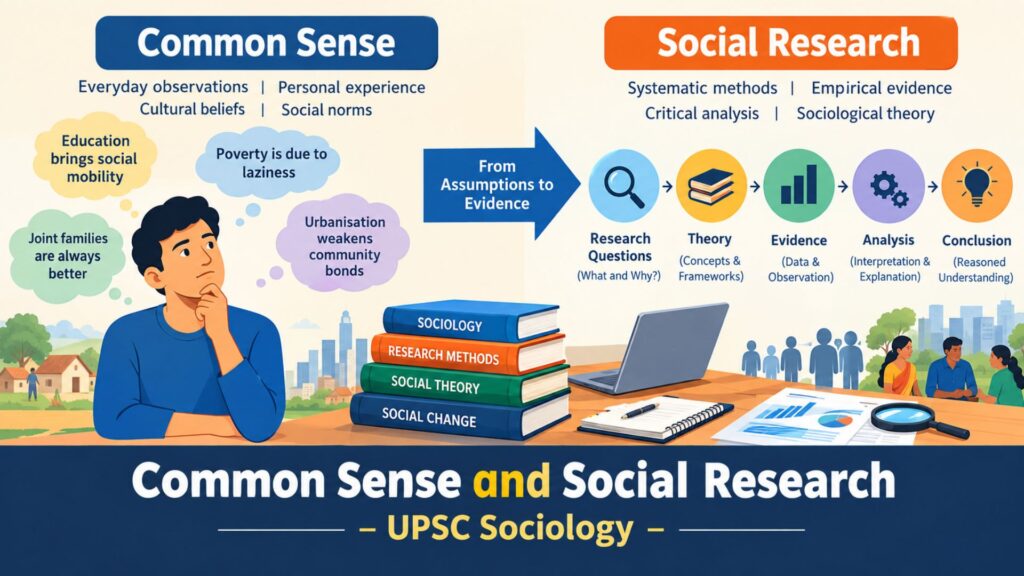
Common sense refers to knowledge and assumptions developed through everyday experience, socialisation, observation and cultural learning.
It helps individuals navigate ordinary social life. For example, people may believe that:
- education automatically produces social mobility;
- poverty results mainly from individual laziness;
- joint families are always more supportive than nuclear families;
- urbanisation necessarily weakens community relationships.
Such statements may contain elements of truth, but they cannot automatically be treated as sociological explanations.
Common sense is therefore experience-based and culturally influenced, while sociological research requires systematic investigation.
Common Sense and Social Research: Basic Difference
| Dimension | Common Sense | Social Research |
|---|
| Source | Everyday experience | Systematic investigation |
| Evidence | Personal observation and social beliefs | Empirical data and evidence |
| Approach | Often taken for granted | Critical and questioning |
| Method | Informal | Systematic methodology |
| Bias | May remain unrecognised | Researchers attempt to identify and control bias |
| Generalisation | Often anecdotal | Based on clearly defined evidence |
| Purpose | Practical understanding | Explanation, interpretation and theory-building |
Is Common Sense the Starting Point of Sociology?
Common sense can provide the initial questions for sociological inquiry, but sociology cannot stop at common-sense explanations.
A researcher may observe increasing migration from villages to cities and ask:
Why are people leaving rural areas?
Common sense might answer that people migrate simply because cities offer better jobs.
Social research would investigate several factors, including:
- employment opportunities;
- agricultural conditions;
- education;
- caste and social networks;
- gender;
- family strategies;
- regional inequalities;
- government policies;
- aspirations and changing lifestyles.
Thus, common sense may generate a research problem, whereas social research seeks a systematic explanation.
Durkheim: Moving Beyond Common-Sense Explanations
Émile Durkheim made one of the clearest arguments for treating sociology as a systematic discipline.
In The Rules of Sociological Method, he argued that sociologists should study social facts as objective realities rather than simply accepting popular explanations.
His study of suicide illustrates this approach.
Suicide appears, at first, to be an intensely individual act. A common-sense explanation may therefore focus on personal problems or psychological conditions.
Durkheim instead examined suicide rates in relation to social integration and regulation. His analysis demonstrated how apparently individual behaviour can have social causes.
This represents an important sociological shift:
Individual experience → Sociological questioning → Empirical investigation → Social explanation
Weber: Understanding Meaning Behind Social Action
Max Weber introduced another important dimension.
For Weber, sociology must understand social action, particularly the meanings actors attach to their behaviour.
Common sense may observe that a person works long hours and conclude that the person is simply ambitious.
A Weberian researcher would ask:
- What meaning does work have for the individual?
- Is the behaviour connected with religious beliefs?
- Is it motivated by economic necessity?
- Does the person’s social environment influence the behaviour?
Weber’s concept of Verstehen, or interpretive understanding, therefore shows that social research cannot rely only on external observation. It must also examine subjective meanings.
Bourdieu: Common Sense and the "Taken-for-Granted"
Pierre Bourdieu provides another useful perspective through concepts such as habitus, cultural capital and doxa.
Doxa refers broadly to aspects of social reality that become taken for granted and appear self-evident.
For example, particular forms of language, dress, manners or educational behaviour may appear naturally superior. Sociological analysis can ask how these preferences are connected with class, cultural capital and socialisation.
Bourdieu therefore helps sociology question assumptions that appear natural but may actually reflect historically developed social structures.
Advantages of Common Sense in Social Research
Common sense should not be dismissed completely. It has several useful functions.
1. Generates Research Questions
Everyday observations can identify important social problems.
For example, widespread observations about changing marriage patterns can lead researchers to investigate:
- age at marriage;
- inter-caste marriage;
- women’s education;
- urbanisation;
- changing family structures.
2. Provides Initial Social Understanding
Researchers are members of society themselves. Their everyday experiences can help them recognise social issues and formulate preliminary questions.
3. Helps Identify Relevant Context
Local knowledge can be valuable in understanding communities, institutions and social practices.
For instance, researchers studying caste relations in rural India may benefit from understanding local terminology, customs and social relationships before designing a research study.
4. Connects Research with Everyday Life
Research becomes socially meaningful when it addresses problems experienced by ordinary people.
Limitations of Common Sense
Despite these advantages, common sense has serious limitations as a basis for sociological explanation.
1. It Can Be Anecdotal
One person’s experience cannot establish a general social relationship.
A student may observe that a relative obtained a government job through education. This does not prove that education always guarantees upward mobility.
2. It May Contain Bias
Common-sense beliefs are shaped by caste, class, gender, religion, region, generation and cultural background.
Consequently, what appears obvious to one social group may not appear obvious to another.
3. It Can Naturalise Social Inequality
Some social inequalities may be treated as natural rather than historically produced.
Sociology questions such assumptions by examining institutions, power and social structures.
4. It May Confuse Correlation and Causation
People often assume that because two things occur together, one causes the other.
Social research requires more careful examination of causal relationships.
5. It Is Often Difficult to Falsify
Common-sense explanations may be flexible enough to explain almost anything after it happens. Scientific research requires claims that can be examined against evidence.
Common Sense, Theory and Social Research
The relationship can be understood as follows:
| Element | Main Function |
|---|---|
| Common sense | Provides everyday observations and possible questions |
| Theory | Provides concepts and relationships for explanation |
| Research methodology | Provides systematic procedures for investigation |
| Empirical data | Provides evidence |
| Sociological analysis | Connects evidence with concepts and theory |
| Conclusion | Provides a reasoned explanation |
Thus, sociology does not simply replace common sense with facts. It combines conceptual reasoning, empirical evidence and critical interpretation.
Indian Sociological Perspective
Indian sociology demonstrates why everyday assumptions require systematic investigation.
M.N. Srinivas
M.N. Srinivas examined Indian social change through concepts such as Sanskritization, Westernization and dominant caste.
These concepts moved beyond simplistic assumptions about caste and social mobility. For example, caste change cannot be understood only by asking whether traditional caste practices are disappearing. Researchers must examine political power, land ownership, education, economic mobility and cultural processes.
G.S. Ghurye
G.S. Ghurye’s work on caste, tribes and Indian social institutions also demonstrates the importance of systematic sociological analysis of Indian society.
Andre Béteille
Andre Béteille’s work on caste, class and power shows how social stratification cannot be understood solely through popular descriptions of caste. Different dimensions of inequality can overlap and change over time.
These Indian sociologists illustrate how sociology transforms everyday observations into more systematic concepts and explanations.
Classical and Contemporary Understanding
The distinction between common sense and sociology remains relevant today.
Social media provides a useful example. People frequently encounter claims about youth behaviour, political participation, family relationships or changing values through online posts.
A common-sense approach may generalise from visible online behaviour.
Social research would instead ask:
- Who produced the data?
- What population was studied?
- How was the sample selected?
- What variables were measured?
- Are alternative explanations possible?
- Can the findings be generalised?
Therefore, the expansion of digital information has made critical sociological thinking more important, not less.
Why This Topic Matters for UPSC Sociology
This topic is useful for Sociology Optional Paper I, particularly in discussions of sociological research, methodology and the scientific character of sociology.
It also supports UPSC Mains answers involving:
- scientific method;
- objectivity;
- research methodology;
- social facts;
- social action;
- theory and empirical research;
- sociology as a science;
- contemporary social change.
For contemporary society, the distinction is especially relevant because people encounter large amounts of information without always examining its reliability.
UPSC Mains Answer Writing Approach
For a 10-mark answer
Use a compact structure:
- Introduction – Define common sense.
- Concept – Explain how it differs from social research.
- Thinker – Use Durkheim or Weber.
- Example – Give one Indian social example.
- Conclusion – State that common sense may initiate inquiry but cannot replace systematic research.
For a 15/20-mark answer
Use a broader framework:
Introduction → Definition → Common sense as starting point → Durkheim and Weber → Advantages → Limitations → Indian sociological examples → Contemporary relevance → Balanced conclusion
A strong answer should avoid simply saying that common sense is “wrong.” Instead, explain that it can provide questions and contextual knowledge, while sociology subjects those assumptions to systematic investigation.
5 Likely UPSC Sociology Questions
- Discuss the relationship between common sense and sociological knowledge.
- Examine how sociology moves beyond common-sense explanations of social reality.
- Analyze the role of common sense in the formulation of sociological research problems.
- Critically examine the limitations of common sense as a source of sociological knowledge.
- Explain with examples how sociological research challenges taken-for-granted assumptions in society.
FAQs
1. Is common sense useful in sociological research?
Yes. Common sense can help researchers identify social issues and formulate preliminary research questions. However, systematic research is necessary to establish sociological explanations.
2. How is sociology different from common sense?
Common sense generally relies on everyday experience and assumptions. Sociology uses systematic concepts, evidence, research methods and critical analysis.
3. Which sociologist challenged common-sense explanations most clearly?
Émile Durkheim is particularly important because his study of suicide demonstrated how apparently individual behaviour can be examined through social factors and social facts.
4. What is the role of theory in social research?
Theory provides concepts and relationships that help researchers formulate questions, interpret evidence and develop explanations of social phenomena.
5. Why is common sense important for UPSC Sociology?
The distinction between common sense and sociological knowledge helps aspirants understand sociology’s scientific and analytical character and improves answers on research methodology and sociological theory.
Conclusion
Common sense is an important part of everyday social knowledge, but it is not equivalent to sociological knowledge. It can provide observations, experiences and research questions, yet sociological research requires systematic concepts, evidence and critical examination.
Durkheim demonstrated the importance of moving beyond individual explanations through the study of social facts, while Weber showed the significance of understanding meanings attached to social action. Bourdieu further highlighted how taken-for-granted assumptions can reproduce social distinctions.
Therefore, the relationship is not simply common sense versus sociology. Rather, sociology uses questions emerging from everyday life and subjects them to systematic, theoretical and empirical scrutiny. This transformation from taken-for-granted understanding to reasoned sociological explanation lies at the heart of sociological inquiry.