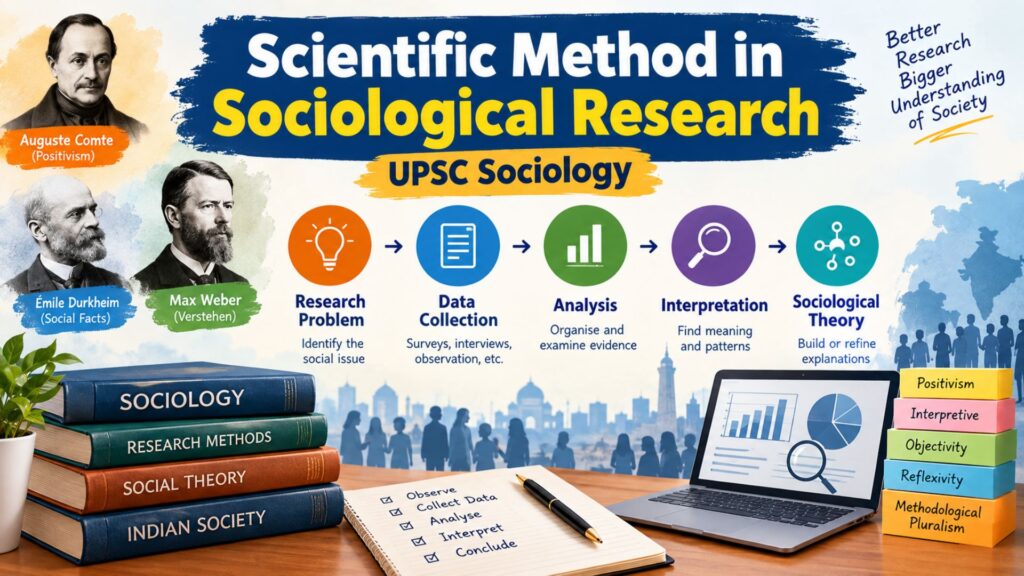
The scientific method in sociological research refers to the systematic use of concepts, observation, evidence, data collection, analysis and logical reasoning to study social reality. Sociology examines human behaviour, institutions, groups and social relationships, but it seeks to study them through systematic inquiry rather than mere common-sense assumptions.
The debate over whether sociology can be a science is central to UPSC Sociology Paper I. Auguste Comte advocated a scientific study of society, while Émile Durkheim demonstrated how social facts could be investigated systematically. However, Max Weber argued that sociology must also understand the meanings attached to social action. This creates an important tension between objectivity and interpretation, making the scientific method a recurring theme in sociological methodology.
What Is the Scientific Method in Sociology?
The scientific method is an organized process through which sociologists formulate questions, collect evidence, test explanations and develop conclusions.
A simplified research process is:
Research problem → Hypothesis → Data collection → Analysis → Interpretation → Conclusion
Scientific research does not mean that every sociological study must use experiments or numerical statistics. Surveys, interviews, observation, comparative studies and qualitative methods can also follow systematic research principles.
Key Features of the Scientific Method
| Feature | Meaning in Sociological Research |
|---|
| Systematic inquiry | Research follows an organized procedure |
| Empiricism | Arguments are supported by observable evidence |
| Objectivity | Researchers attempt to minimize personal bias |
| Verification | Findings can be examined or checked by others |
| Conceptual clarity | Abstract concepts are clearly defined |
| Reliability | Research procedures produce reasonably consistent results |
| Validity | Methods actually measure what they claim to measure |
| Logical analysis | Evidence is connected to conclusions through reasoning |
Scientific Method and the Positivist Tradition
The strongest argument for scientific sociology emerged from positivism.
Auguste Comte
Comte argued that society could be studied through methods comparable to those used in the natural sciences. He believed sociology should identify patterns and laws governing social phenomena.
His approach contributed to the development of positivist sociology, which emphasizes observation, classification and empirical evidence.
Émile Durkheim
Durkheim gave methodological expression to positivism. In The Rules of Sociological Method, he argued that social facts should be studied as realities external to individual consciousness.
His study of suicide demonstrated how apparently individual behaviour could be examined through social variables such as social integration and regulation.
Thus, Durkheim connected:
Empirical data + social facts + comparative analysis → Sociological explanation
Major Steps in Scientific Sociological Research
1. Selection of a Research Problem
The researcher first identifies a sociological problem.
For example:
Why do educational outcomes differ between rural and urban students?
The question can then be converted into specific research objectives.
2. Formulation of Concepts and Hypotheses
Researchers define concepts such as social class, mobility, education or inequality.
Where appropriate, they formulate hypotheses.
For example:
Higher parental educational attainment is associated with greater educational achievement among children.
A hypothesis provides a proposition that can be examined using evidence.
3. Operationalisation
Many sociological concepts are abstract.
For example, social class cannot be directly observed like height or weight. Researchers therefore identify measurable indicators such as occupation, income, education and access to resources.
This process is called operationalisation.
4. Data Collection
Sociologists may use:
- Surveys
- Interviews
- Observation
- Census data
- Official statistics
- Case studies
- Content analysis
- Ethnography
- Historical documents
Both quantitative and qualitative evidence can contribute to systematic sociological research.
5. Analysis and Interpretation
Collected data must be organized and analysed.
Quantitative research may use statistical techniques, while qualitative research may identify themes, meanings, patterns and social processes.
6. Verification and Conclusion
Researchers compare findings with the original research question or hypothesis and identify the scope and limitations of their conclusions.
Weber and the Interpretive Critique
The scientific method becomes more complex when we consider Max Weber’s interpretive sociology.
Weber accepted systematic and causal analysis but argued that sociology cannot simply imitate natural science because human beings attach meanings to their actions.
His concept of Verstehen emphasizes understanding social action from the actor’s point of view.
For example, two individuals may participate in the same religious practice but attach different meanings to it. Statistical data may identify a pattern, but understanding the meaning behind the behaviour may require interviews or observation.
Positivism vs Interpretive Sociology
| Positivist Approach | Interpretive Approach |
|---|---|
| Emphasizes observable evidence | Emphasizes subjective meaning |
| Often uses quantitative methods | Often uses qualitative methods |
| Searches for patterns and relationships | Seeks understanding of social action |
| Associated with Comte and Durkheim | Strongly associated with Weber |
| Greater emphasis on generalisation | Greater emphasis on contextual understanding |
The distinction does not necessarily mean that one approach must completely replace the other. Contemporary sociology frequently combines methods.
Uses of the Scientific Method in Sociology
Understanding Social Patterns
Scientific research helps identify patterns in areas such as:
- Migration
- Family change
- Urbanisation
- Education
- Poverty
- Social mobility
- Gender relations
For example, large-scale demographic data can reveal changing patterns of migration and urban growth in India.
Testing Sociological Explanations
Research allows sociologists to examine whether theoretical propositions are supported by evidence.
For instance, researchers can investigate relationships between education, occupation and social mobility rather than assuming that education automatically produces upward mobility.
Policy and Social Planning
Systematic research can contribute to policy formulation by identifying social needs and evaluating programmes.
Research on sanitation, education, employment or rural development can provide evidence about implementation and social outcomes.
Challenging Common-Sense Assumptions
One important sociological function is to distinguish sociological knowledge from common sense.
A researcher may examine whether apparently individual problems actually have structural causes involving class, caste, gender, institutions or social networks.
Scientific Method in the Indian Sociological Context
Indian sociologists have combined empirical investigation with theoretical analysis.
M.N. Srinivas used fieldwork to study concepts such as Sanskritisation, Westernisation and dominant caste. His village studies demonstrated the value of close observation in understanding Indian social change.
G.S. Ghurye combined textual, historical and empirical sources in studying caste and Indian society.
Andre Béteille used empirical research to examine inequality, class, caste and power, demonstrating how social stratification can be studied through both field research and theoretical interpretation.
These contributions show that sociological research in India need not simply reproduce Western models. Research methods can be adapted to India’s complex social structures and cultural contexts.
Scientific Method: Advantages and Limitations
| Advantages | Limitations |
|---|
| Promotes systematic inquiry | Social behaviour is context-dependent |
| Reduces dependence on speculation | Complete objectivity is difficult |
| Allows evidence-based conclusions | Human meanings may be difficult to quantify |
| Facilitates comparison | Generalisation may overlook local differences |
| Supports theory testing | Researcher values can influence research |
| Helps policy evaluation | Social phenomena can change over time |
The Problem of Objectivity
Complete neutrality is difficult because researchers make choices about:
- What to study
- Which concepts to use
- Which questions to ask
- Which population to investigate
- How to interpret evidence
Weber therefore emphasized value relevance while maintaining the importance of methodological discipline.
Reflexivity
Contemporary sociology increasingly recognizes reflexivity. Researchers should examine how their own social position, assumptions and relationship with participants may influence the research process.
This is particularly important in research involving caste, gender, ethnicity, religion and other socially sensitive subjects.
Foucault and Knowledge
Michel Foucault’s work also complicates the idea that knowledge is completely independent of power. His analysis of power/knowledge highlights how institutions and systems of classification can influence what becomes accepted as legitimate knowledge.
This does not eliminate empirical research, but it encourages researchers to examine the institutional and social conditions under which knowledge is produced.
Theory and Application: An Important Sociological Distinction
The scientific method should not be confused with theory itself.
Theory provides concepts and explanations for understanding social reality.
Method provides systematic procedures for investigating that reality.
For example:
- Marx’s theory of class conflict provides a theoretical framework.
- A survey of occupational inequality can provide empirical evidence.
- Interviews with workers can reveal their experiences and meanings.
Thus, theory guides research, while research can refine, challenge or strengthen theory.
Why This Topic Matters for UPSC Sociology
This topic is highly relevant to UPSC Sociology Optional Paper I, particularly questions concerning research methodology, sociological thinkers, positivism, objectivity and research methods.
It is useful for:
- Sociology Optional: Methodology and research methods
- UPSC Mains: Questions on scientific status of sociology and objectivity
- Paper I: Positivism, interpretive sociology and methodology
- Paper II: Applying research perspectives to Indian social institutions and social change
- Contemporary society: Evidence-based understanding of inequality, migration, education and social transformation
A strong answer should avoid simply stating that sociology is or is not a science. Instead, it should explain the methodological debate.
UPSC Mains Answer Writing Approach
For a 10-mark answer
Use:
Introduction → Definition → 3–4 features → Thinker/example → Limitation → Conclusion
Example:
Define scientific method → mention Durkheim → explain systematic empirical research → introduce Weber’s interpretive critique → conclude with methodological pluralism.
For a 15-mark answer
Use:
Introduction → Positivist approach → Scientific method → Durkheim → Weber’s critique → Indian examples → Limitations → Conclusion
Add a small comparison table where appropriate.
For a 20-mark answer
Use a broader structure:
Introduction → Concept → Historical development → Comte and Durkheim → Weber and Verstehen → Objectivity debate → Quantitative and qualitative approaches → Indian sociologists → Contemporary methodological pluralism → Criticism → Conclusion
The conclusion should recognize both the value and limits of scientific methods in studying social reality.
5 Likely UPSC Sociology Questions
- Discuss the relevance of the scientific method in sociological research.
- Examine the positivist approach to the study of society with reference to Émile Durkheim.
- Critically examine the limitations of applying scientific methods to the study of human society.
- Analyze the differences between positivist and interpretive approaches to sociological research.
- “Sociological research requires both methodological rigour and sensitivity to social meanings.” Explain with suitable examples.
FAQs
1. What is the scientific method in sociology?
It is a systematic approach to studying society through concepts, observation, evidence, data collection, analysis and logical interpretation.
2. Who advocated the scientific study of society?
Auguste Comte strongly advocated a scientific approach to society and is closely associated with the development of positivist sociology.
3. Why is Durkheim important for scientific sociology?
Durkheim developed a systematic methodology for studying social facts and demonstrated its application through empirical research, particularly in his study of suicide.
4. What is Weber’s criticism of positivism?
Weber argued that sociology must understand the subjective meanings attached to social action through Verstehen, rather than treating human behaviour exactly like natural phenomena.
5. Is sociology a science?
Sociology uses systematic empirical methods and logical analysis, but its subject matter involves meanings, values and changing social contexts. Therefore, the nature and limits of its scientific status remain an important methodological debate.
Conclusion
The scientific method has strengthened sociology by encouraging systematic observation, conceptual clarity, empirical evidence and logical explanation. Comte and Durkheim emphasized the possibility of studying society scientifically, while Weber demonstrated that understanding subjective meanings is equally important. Later methodological developments further highlighted issues of power, reflexivity and context.
Therefore, sociological research is best understood not as a simple imitation of the natural sciences, but as a methodologically rigorous and pluralistic inquiry into social reality. Its strength lies in combining empirical evidence with theoretical interpretation while remaining conscious of the limitations of both.