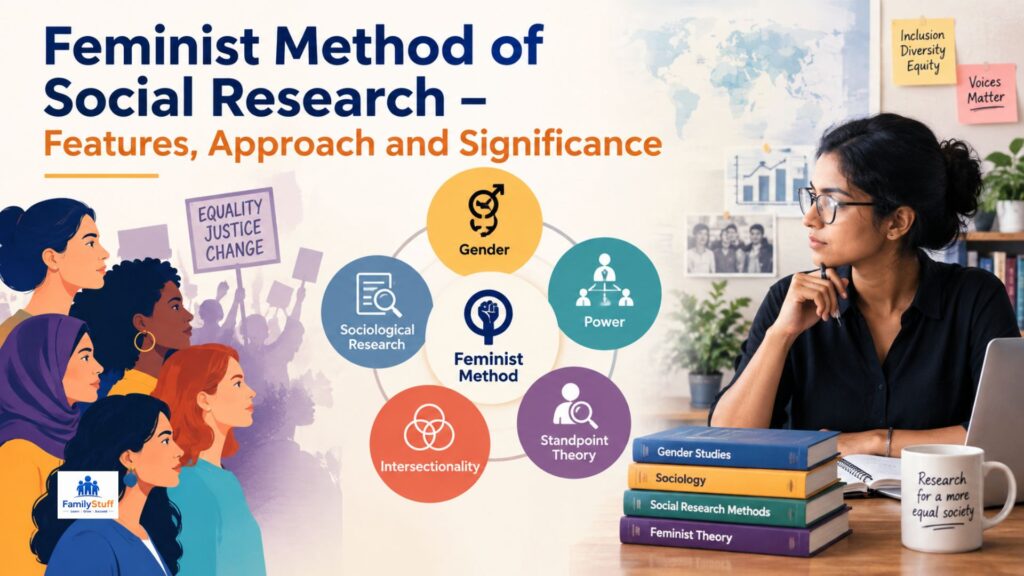
The feminist method of social research emerged as a critical response to conventional approaches that often treated men’s experiences as universal. Feminist scholars argued that social research is not completely neutral when the questions asked, concepts used, researchers involved and voices represented are shaped by existing gender relations.
Feminist methodology therefore examines how gender, power, inequality and social location influence the production of knowledge. It seeks not only to study women but also to question the structures that produce gendered experiences.
For UPSC Sociology Optional, the topic is important because it connects research methodology, feminist sociology, social stratification, power, patriarchy and contemporary debates on knowledge production. It also provides useful perspectives for analysing Indian society.
What Is the Feminist Method of Social Research?
The feminist method is not a single research technique. It is better understood as a methodological and epistemological approach that questions conventional assumptions about objectivity, neutrality and the researcher–respondent relationship.
It asks questions such as:
- Whose experiences are represented in research?
- Whose voices are missing?
- How does power influence knowledge production?
- Can the research process reproduce gender inequality?
- How can marginalized experiences become sources of sociological knowledge?
Thus, feminist research can use qualitative interviews, surveys, ethnography, life histories, participant observation and quantitative data, but applies them with greater attention to gender and power.
Intellectual Foundations of Feminist Research
1. Feminist Epistemology
Feminist epistemology examines how knowledge is produced and whose knowledge receives legitimacy.
Traditional research sometimes presents the researcher as a detached observer. Feminist scholars question this sharp separation between researcher and researched.
They argue that the social position of the researcher can influence:
- research questions
- interpretation
- interaction with participants
- selection of evidence
- representation of findings
2. Standpoint Theory
Thinkers such as Nancy Hartsock and Sandra Harding developed important arguments around feminist standpoint theory.
The central idea is that knowledge can be shaped by one’s social position. Groups experiencing marginalization may perceive structures of power that are less visible from socially dominant positions.
However, feminist standpoint theory does not simply mean that every woman automatically possesses the same standpoint. Class, caste, race, ethnicity and other forms of inequality can produce different experiences.
3. Dorothy Smith and the Sociology of Women’s Everyday Lives
Dorothy E. Smith emphasized beginning sociological inquiry from people’s everyday experiences, particularly the experiences of women.
Her work challenged abstract sociological categories that could obscure the realities of everyday life.
This approach encourages researchers to examine how institutions such as the family, workplace, education system and state organize everyday experiences.
Key Features of Feminist Methodology
| Feature | Meaning | Sociological significance |
|---|---|---|
| Gender sensitivity | Examines gender relations | Reveals gender-based inequalities |
| Reflexivity | Researcher examines their own position | Reduces claims of complete neutrality |
| Voice and experience | Gives importance to lived experiences | Includes marginalized perspectives |
| Power analysis | Studies unequal power relations | Connects knowledge with social structure |
| Participant involvement | Encourages interaction and collaboration | Reduces researcher–respondent distance |
| Intersectionality | Examines overlapping inequalities | Avoids treating women as a homogeneous group |
| Transformative orientation | Research may seek social change | Connects research with emancipation |
Feminist Approach to Research
1. From “Research on Women” to “Research with Women”
Early feminist scholarship highlighted the invisibility of women in conventional social research.
Later approaches increasingly emphasized research with participants rather than simply research on participants.
This can involve greater participation in defining questions, sharing experiences and interpreting findings.
2. Reflexivity
Reflexivity is especially important in feminist methodology.
The researcher asks:
How might my gender, caste, class, education or institutional position influence the research process?
For example, an urban researcher studying rural women’s labour cannot assume that their own understanding of work is identical to that of the respondents.
3. Lived Experience
Feminist researchers frequently use women’s everyday experiences as sociological evidence.
Methods such as:
- life histories
- oral histories
- in-depth interviews
- ethnography
- personal narratives
can reveal dimensions of social reality that large-scale statistics may overlook.
4. Intersectionality
Kimberlé Crenshaw developed the concept of intersectionality in the context of analysing overlapping structures of discrimination.
The concept is highly relevant to Indian sociology.
For example, the experiences of:
- an urban upper-caste professional woman
- a rural Dalit woman
- a tribal woman
- a migrant woman worker
cannot automatically be treated as identical.
Gender interacts with caste, class, ethnicity, region and occupation.
Feminist Research Compared with Conventional Research
| Dimension | Conventional approach | Feminist approach |
|---|---|---|
| Researcher | Often presented as detached | Reflexive about social position |
| Respondent | Subject of research | Participant/knowledge producer |
| Objectivity | Emphasis on neutrality | Critical examination of objectivity |
| Knowledge | Often claims universal validity | Recognizes situated knowledge |
| Power | May receive limited attention | Central analytical concern |
| Experience | May be secondary to formal data | Lived experience is important |
| Purpose | Explanation and understanding | Understanding plus possible transformation |
This comparison should not be interpreted as suggesting that all conventional research lacks reflexivity or that all feminist research follows one uniform method. Feminist research itself contains diverse perspectives.
Feminist Methodology and Indian Society
The Indian context demonstrates why gender cannot be examined independently of other social structures.
Caste and Gender
Uma Chakravarti’s work on the concept of Brahmanical patriarchy is particularly relevant. It highlights the relationship between caste hierarchy, control over women’s sexuality and patriarchal social organization.
A feminist study of marriage, for example, may therefore examine:
caste → endogamy → control over marriage → regulation of women’s sexuality → reproduction of social hierarchy
This provides a deeper analysis than studying gender inequality in isolation.
Women’s Unpaid Labour
Women’s domestic work also demonstrates the importance of feminist research.
Household surveys and time-use studies can reveal the unequal distribution of unpaid care work. Feminist analysis asks why activities such as cooking, childcare and eldercare are often socially undervalued despite their contribution to household reproduction.
Work and Informal Employment
Women constitute a significant presence in many forms of informal and unpaid work. Feminist research can combine statistical evidence with women’s narratives to understand issues such as insecure employment, care responsibilities and workplace discrimination.
Significance of Feminist Methodology
1. Challenges Male-Centred Knowledge
Feminist methodology questions assumptions in which male experiences are treated as representative of humanity.
2. Makes Marginalized Experiences Visible
It brings greater attention to groups whose experiences may be overlooked in mainstream research.
3. Connects Knowledge and Power
Following broader sociological discussions of power, feminist research asks how institutions influence what becomes accepted as legitimate knowledge.
4. Improves Understanding of Social Inequality
Gender becomes connected with class, caste, race, ethnicity and other forms of stratification.
5. Strengthens Policy Research
Research on women’s employment, health, education, violence, unpaid care work and political participation can benefit from gender-sensitive methodologies.
Criticisms and Limitations
A strong UPSC answer should not present feminist methodology as beyond criticism.
1. Question of Objectivity
Critics argue that replacing claims of neutrality with a particular standpoint can itself create questions about objectivity.
Feminist scholars have responded by developing more nuanced ideas such as situated knowledge rather than abandoning standards of evidence.
2. Problem of Representing “Women”
There is no single universal female experience.
Class, caste, race, sexuality, religion, region and age can produce substantial differences.
This criticism contributed to the development of intersectional and postcolonial feminist approaches.
3. Researcher Bias
Feminist researchers are also capable of bringing their own assumptions into research. Reflexivity therefore remains necessary.
4. Methodological Diversity
There is no single feminist method. Feminist researchers may use quantitative, qualitative or mixed methods.
Therefore, feminist methodology is better understood as a perspective on research rather than one fixed research technique.
Classical and Contemporary Perspective
The feminist methodological approach represents an important shift:
Universal claims → situated knowledge
Research on women → research with women
Gender as a variable → gender as a social structure
Single-axis analysis → intersectional analysis
This development also reflects a broader movement in sociology from viewing social reality as purely objective towards recognizing the role of meaning, power, identity and social location.
Why This Topic Matters for UPSC Sociology
Sociology Optional
The topic is directly useful for questions concerning:
- research methodology
- sociological thinkers
- feminist sociology
- gender and society
- social stratification
- power and inequality
UPSC Mains – Paper I
It can be connected with research methods, objectivity, values in sociology and sociological perspectives.
UPSC Mains – Paper II
It is useful while discussing:
- women and society
- patriarchy
- caste and gender
- family
- work
- social movements
- changing gender relations in India
Contemporary Society
Issues such as unpaid care work, workplace inequality, digital gender divides, representation and gender-based violence can be examined more effectively through a feminist sociological lens.
UPSC Mains Answer Writing Approach
For a 10-mark answer
Use this structure:
Introduction: Define feminist methodology.
Core: Explain 3–4 features such as standpoint, reflexivity, lived experience and power.
Example: Add an Indian example involving caste and gender.
Conclusion: Mention its contribution to making sociological knowledge more inclusive.
For a 15/20-mark answer
Follow:
- Introduction – Define feminist methodology.
- Conceptual foundation – Feminist epistemology and standpoint theory.
- Thinkers – Harding, Hartsock, Dorothy Smith, Crenshaw and relevant Indian scholars.
- Features – Reflexivity, experience, participation and power.
- Application – Indian examples involving caste, work and family.
- Criticism – Objectivity, representation and methodological diversity.
- Contemporary relevance – Intersectionality and gender-sensitive research.
- Conclusion – Feminist methodology broadens sociology by questioning whose knowledge counts.
A good answer should distinguish the feminist method from feminist theory: feminist theory explains gendered social relations, while feminist methodology concerns how those social realities are investigated and how knowledge is produced.
5 Likely UPSC Sociology Questions
- Discuss the major features of the feminist method of social research.
- Examine how feminist methodology challenges conventional notions of objectivity in sociology.
- Analyze the significance of standpoint theory in feminist social research.
- Critically examine the role of intersectionality in contemporary feminist research. Illustrate with examples from Indian society.
- “Feminist methodology is concerned not merely with studying women but with questioning power in knowledge production.” Comment.
Frequently Asked Questions
1. What is the feminist method of social research?
It is a research approach that examines gender and power while emphasizing lived experiences, reflexivity, situated knowledge and the inclusion of marginalized voices.
2. Who are the important thinkers associated with feminist methodology?
Important contributors include Dorothy Smith, Sandra Harding, Nancy Hartsock and Kimberlé Crenshaw. Different scholars have contributed to different dimensions such as standpoint theory, situated knowledge and intersectionality.
3. Is feminist methodology only qualitative?
No. Feminist researchers can use qualitative, quantitative and mixed methods. What makes research feminist is not simply the technique but the methodological perspective toward gender, power, knowledge and social relations.
4. What is standpoint theory?
Standpoint theory argues that social location can influence how people experience and understand social structures. Marginalized groups may develop distinctive insights into relations of power.
5. Why is feminist methodology important in Indian sociology?
It helps examine gender together with caste, class, family, work, patriarchy and social institutions. Concepts such as Brahmanical patriarchy and intersectionality help avoid treating Indian women as a homogeneous category.
Conclusion
The feminist method of social research has expanded sociology by questioning whose experiences become knowledge and how power influences research. Its emphasis on reflexivity, lived experience, standpoint, participation and intersectionality provides important tools for studying gendered social relations.
At the same time, feminist methodology is internally diverse and must address questions of objectivity, representation and researcher bias. Its major contribution lies not in replacing every conventional method, but in making sociological research more critically aware of gender, power and social location.
For UPSC Sociology Optional, it is particularly valuable because it connects research methodology with feminist theory, social stratification and contemporary Indian society.