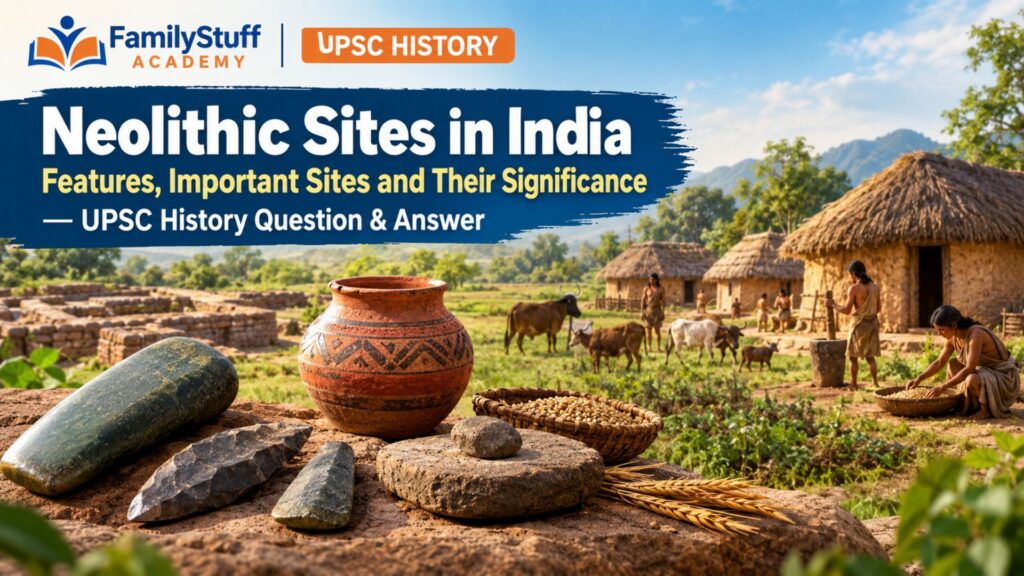
The Neolithic period, or New Stone Age, represents an important stage in the development of human societies. In India, the Neolithic phase is generally associated with the emergence of food production, settled life, domestication of animals, polished stone tools and improved pottery traditions.
Unlike the Paleolithic period, when people mainly depended on hunting and gathering, Neolithic communities increasingly produced food through agriculture and animal husbandry. However, the transition was not uniform across India. Different regions adopted agriculture, domestication and settled life at different times and developed distinctive cultural traditions.
Important Neolithic sites such as Mehrgarh, Burzahom, Gufkral, Chirand, Koldihwa, Mahagara, Daojali Hading, Hallur and Paiyampalli provide valuable evidence for understanding this transformation.
Major Features of the Neolithic Period
1. Beginning of Agriculture
One of the most significant changes during the Neolithic period was the development of food production.
Communities began cultivating crops instead of depending entirely on wild plants. Evidence from different parts of the Indian subcontinent indicates the cultivation of crops such as:
- Wheat
- Barley
- Rice
- Millets
- Pulses
The nature and timing of agriculture varied considerably between regions.
Mehrgarh in present-day Balochistan provides some of the earliest evidence of farming and animal domestication in the northwestern part of the subcontinent.
In the Ganga valley, sites such as Koldihwa and Mahagara have been associated with early rice cultivation, although the interpretation and dating of the earliest rice evidence remain subjects of archaeological discussion.
2. Domestication of Animals
Neolithic communities increasingly domesticated animals for food, labour and other purposes.
Evidence indicates the domestication or management of animals such as:
- Cattle
- Sheep
- Goat
- Pig
- Dog
Animal domestication reduced dependence on hunting and helped communities develop more stable economic systems.
At some sites, archaeologists have found animal bones showing the importance of pastoral activities alongside agriculture.
3. Polished Stone Tools
Neolithic communities are particularly associated with ground and polished stone tools.
Unlike earlier roughly chipped tools, many Neolithic implements were carefully shaped, ground and polished. Important tools included:
- Axes
- Adzes
- Celts
- Chisels
- Grinding stones
- Querns and mullers
These tools were useful for cutting trees, clearing land, woodworking and processing cereals.
The widespread presence of polished stone axes also indicates the growing importance of forest clearance and agricultural activity.
4. Pottery
Pottery became increasingly important for storing, cooking and processing food.
Neolithic pottery traditions differed from one region to another. Some communities produced handmade pottery, while later traditions show increasing technological development.
Pottery vessels could be used to store:
- Grains
- Water
- Seeds
- Other food products
The development of pottery therefore supported the needs of increasingly settled communities.
5. Permanent and Semi-Permanent Settlements
The development of agriculture encouraged people to remain closer to cultivated fields and domesticated animals.
Neolithic settlements therefore show evidence of:
- Houses
- Storage areas
- Hearths
- Pits
- Working areas
- Community spaces
However, Neolithic life should not always be understood as completely sedentary. Some communities may have combined agriculture with hunting, gathering and seasonal movement.
Important Neolithic Sites in India
1. Mehrgarh
Mehrgarh, located in present-day Balochistan, is one of the most important early farming sites in South Asia.
Archaeological evidence from Mehrgarh indicates early agriculture, animal domestication, mud-brick structures and craft activities.
The site is particularly important because it helps scholars understand the emergence of farming communities before the mature urban phase of the Indus civilisation.
Its evidence includes:
- Wheat and barley cultivation
- Animal domestication
- Mud-brick houses
- Storage facilities
- Burials
- Beads and other craft objects
Mehrgarh therefore demonstrates the gradual development of village-based agricultural society in the northwestern subcontinent.
2. Burzahom
Burzahom, located in Kashmir, is famous for its distinctive pit dwellings.
People constructed houses by digging pits into the ground. Archaeological evidence also includes stone tools, bone implements, pottery and animal remains.
Burzahom is significant because it demonstrates a regional form of Neolithic settlement adapted to the environmental conditions of Kashmir.
The site also provides evidence of changing economic practices and cultural traditions over time.
3. Gufkral
Gufkral, also located in Kashmir, is another important Neolithic site.
The site provides evidence of:
- Agriculture
- Animal domestication
- Stone tools
- Pottery
- Settlement activity
Together, Burzahom and Gufkral help explain the development of Neolithic communities in the Kashmir Valley.
4. Koldihwa and Mahagara
Koldihwa and Mahagara, situated in the Belan Valley of Uttar Pradesh, are important sites for understanding early farming communities in the Ganga region.
They have yielded evidence relating to:
- Agriculture
- Rice
- Animal domestication
- Stone tools
- Pottery
- Settlement activities
These sites are particularly relevant to discussions about the development of rice cultivation in the Ganga valley.
5. Chirand
Chirand, located in Bihar, is an important Neolithic site of eastern India.
The archaeological record includes:
- Bone tools
- Stone tools
- Pottery
- Agricultural evidence
- Animal remains
- Settlement remains
Chirand demonstrates that Neolithic communities developed distinctive regional traditions in the middle Ganga plains.
The site is also useful for understanding the interaction between agricultural production, animal domestication and local environmental conditions.
6. Daojali Hading
Daojali Hading, located in Assam, represents the Neolithic tradition of northeastern India.
The site is particularly known for its polished stone tools and pottery.
Its importance extends beyond agriculture because it provides evidence for cultural connections across parts of northeastern India and neighbouring regions.
The site demonstrates that Neolithic developments were not restricted to the northwestern or Ganga regions.
7. Hallur
Hallur, in Karnataka, is an important Neolithic site of South India.
It provides evidence of agriculture, animal domestication, stone tools and pottery.
South Indian Neolithic communities are particularly associated with ash mounds, which are large accumulations of burnt cattle dung and other material at certain sites.
These ash mounds are important archaeological evidence for cattle-related activities and distinctive Neolithic cultural practices in the Deccan.
8. Paiyampalli
Paiyampalli, located in Tamil Nadu, represents the Neolithic tradition of South India.
The archaeological evidence includes:
- Stone tools
- Pottery
- Agricultural activities
- Animal domestication
- Settlement remains
It helps demonstrate the development of food-producing communities in southern India and the regional diversity of the Indian Neolithic.
Regional Diversity of the Indian Neolithic
A major characteristic of the Indian Neolithic is its regional diversity.
There was no single Neolithic culture covering the entire subcontinent.
| Region | Important Sites | Distinctive Features |
|---|---|---|
| Northwest | Mehrgarh | Early farming and animal domestication |
| Kashmir | Burzahom, Gufkral | Pit dwellings, stone and bone tools |
| Ganga Valley | Koldihwa, Mahagara | Rice cultivation and farming |
| Bihar | Chirand | Agriculture, pottery and bone tools |
| Northeast | Daojali Hading | Polished tools and pottery |
| Deccan | Hallur | Agriculture, cattle and ash-mound tradition |
| Tamil Nadu | Paiyampalli | Farming, pastoralism and stone tools |
This regional variation indicates that the Neolithic transition was influenced by local environments, available resources, technological traditions and interactions between communities.
Significance of Neolithic Developments
The Neolithic period brought fundamental changes to human society.
Economic Transformation
The shift from food gathering to food production created more reliable sources of subsistence and encouraged the development of agriculture and pastoralism.
Settlement Development
Permanent and semi-permanent settlements became increasingly important. This provided the foundation for more complex village communities.
Technological Development
Polished stone tools, pottery and grinding equipment improved agricultural and domestic activities.
Social Changes
Settled life encouraged cooperation, food storage, craft production and the development of more organised communities.
Foundation for Later Civilisations
Neolithic communities contributed to long-term developments that eventually supported more complex societies.
However, the transition from Neolithic villages to urban civilisation was not direct or identical everywhere. Different regions followed different historical trajectories.
Conclusion
The Neolithic period represents a major transformation in the history of the Indian subcontinent. The emergence of agriculture, animal domestication, polished stone tools, pottery and settled communities changed the economic and social organisation of prehistoric societies.
Sites such as Mehrgarh, Burzahom, Gufkral, Koldihwa, Mahagara, Chirand, Daojali Hading, Hallur and Paiyampalli reveal the diverse ways in which communities responded to their local environments.
For UPSC preparation, the Indian Neolithic should therefore be understood not simply as the “age of polished stone tools”, but as a long and regionally varied process of economic, technological and social transformation that laid important foundations for later developments in Indian civilisation.
Frequently Asked Questions (FAQs)
1. What is the Neolithic period?
The Neolithic period, or New Stone Age, was a prehistoric phase marked by agriculture, animal domestication, polished stone tools, pottery and settled communities.
2. Which is an important early Neolithic site in India?
Mehrgarh is one of the most important early farming sites in South Asia. It provides evidence of agriculture, animal domestication and settled village life.
3. What are the major Neolithic sites in India?
Important sites include Mehrgarh, Burzahom, Gufkral, Koldihwa, Mahagara, Chirand, Daojali Hading, Hallur and Paiyampalli.
4. What were the main features of Neolithic culture?
Major features included food production, animal domestication, polished stone tools, pottery, permanent or semi-permanent settlements and food storage.
5. Why are Neolithic sites important for UPSC History?
Neolithic sites help explain the transition from hunting and gathering to agriculture and settled life, providing important evidence for understanding early social, economic and technological development in India.