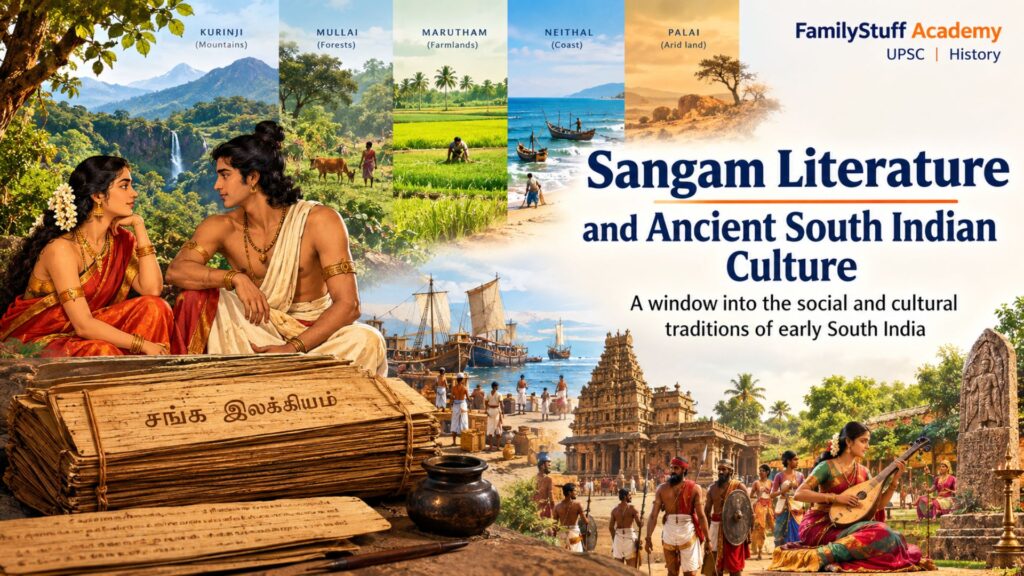
Sangam literature is one of the most important sources for understanding the history of ancient South India. Composed primarily in Tamil, these works provide valuable information about the people, customs, occupations, beliefs, political institutions and cultural traditions of the Tamil region.
The term Sangam literature broadly refers to a body of early Tamil poems and works associated with the Sangam tradition. Important collections include the Ettuthokai (Eight Anthologies) and Pattuppattu (Ten Idylls). Works such as Tolkappiyam, Purananuru, Akananuru, Kuruntokai and Pattinappalai provide glimpses into different aspects of early South Indian society.
However, Sangam literature should not be treated as a complete historical record. It consists largely of poetry, and many poems reflect particular social groups, literary conventions and idealised situations. Therefore, historians use Sangam texts along with archaeology, inscriptions, coins and foreign accounts.
The question is not simply whether Sangam literature provides information about ancient South India, but how far it can act as a window into its social and cultural traditions.
Sangam Literature and Social Life
One of the greatest contributions of Sangam literature is its description of everyday social life.
The poems refer to different groups within society, including rulers, warriors, farmers, merchants, craftsmen, hunters, fishermen, bards and agricultural communities. This suggests that ancient South Indian society was occupationally diverse.
The poems also describe relationships between kings and their subjects. Kings were expected to protect their territories, provide support to their followers and demonstrate generosity. The idea of generosity or patronage appears repeatedly in the poems, particularly in descriptions of rulers rewarding poets and warriors.
Women also occupy an important place in Sangam poetry. Poems of the akam tradition describe love, marriage, separation, waiting and emotional relationships. These poems provide valuable evidence about perceptions of love, family relationships and gender roles.
Women are not represented only as passive figures. Sangam literature includes references to female poets, with Avvaiyar being one of the best-known examples. Such references demonstrate that women participated in the intellectual and literary traditions of the period.
Akam and Puram: Two Windows into Society
Sangam poetry is traditionally divided into two broad themes: akam and puram.
Akam refers to the inner world of personal emotions, particularly love and relationships. It deals with themes such as union, separation, waiting and the social circumstances surrounding relationships.
Puram, in contrast, deals with the external world. It includes war, heroism, kingship, generosity, death and public life.
This division is particularly useful for historians because it provides two different perspectives on society.
Akam poetry gives clues about family life, emotional relationships, marriage customs and social expectations. Puram poetry provides information about warfare, political authority, heroic values and relationships between rulers and poets.
Thus, Sangam literature does not describe society through a single narrative. Different literary themes reveal different dimensions of ancient Tamil life.
The Five Landscapes and Cultural Traditions
One of the most distinctive features of Sangam literature is the concept of Tinai, which connects human life with particular geographical landscapes.
The five major landscapes are:
- Kurinji – mountains and hilly regions
- Mullai – forests and pastoral areas
- Marutham – agricultural plains
- Neithal – coastal regions
- Palai – arid or transformed landscapes
Each landscape is associated with particular occupations, lifestyles, emotions and cultural practices.
For example, Kurinji is associated with mountain communities and hunting, while Neithal reflects coastal life, fishing and maritime activities. Marutham represents fertile agricultural areas and farming communities.
This relationship between geography, occupation and culture is an important feature of early Tamil thought. It shows how closely people understood their social and cultural life in relation to the natural environment.
Economy and Occupations
Sangam literature also provides valuable information about the economy of ancient South India.
Agriculture was an important occupation, especially in fertile river valleys and plains. References to cultivation, agricultural communities and food production indicate the significance of farming.
Fishing and maritime activities were important in coastal regions. Sangam poems refer to fishing communities and coastal settlements, reflecting the economic importance of the sea.
Trade also appears prominently in several texts. The port city of Puhar, or Kaveripattinam, is described in Pattinappalai. The text provides details about merchants, markets, ships and commercial activity.
The evidence from Sangam literature can be connected with archaeological discoveries and Roman coins found in parts of South India. Together, these sources indicate that the Tamil region participated in wider networks of trade during the early historic period.
Political Life and Kingship
Sangam literature is an important source for understanding political traditions in ancient Tamilakam.
The Chera, Chola and Pandya rulers appear frequently in the literary tradition. These dynasties became prominent political powers in the Tamil region.
Kingship was closely associated with warfare, protection, generosity and honour. Poems celebrate victorious rulers and heroic warriors. They also describe battles, cattle raids, territorial conflicts and the rewards given to warriors and poets.
The poems therefore reveal a political culture in which personal reputation, military success and generosity were important components of royal authority.
At the same time, Sangam literature should not be interpreted as providing a complete political history. Literary praise could exaggerate the achievements of rulers. Historians therefore compare these accounts with inscriptions, coins and archaeological evidence.
Religion and Beliefs
Sangam literature provides important clues about religious beliefs and practices.
Different deities and forms of worship are mentioned in the texts. Murugan, particularly associated with the Kurinji landscape, occupies an important position in early Tamil religious traditions. Other deities and religious practices also appear in the literature.
Hero worship is another significant feature. The tradition of erecting hero stones (nadukal) for warriors who died heroically is reflected in early Tamil cultural traditions. Such practices indicate the importance of martial values and collective memory.
The literature also contains references to rituals, festivals, omens and supernatural beliefs. These references help historians understand the religious imagination of ancient Tamil society.
Food, Clothing and Festivals
Sangam poems provide glimpses into everyday cultural practices.
References to food indicate the use of rice, meat, fish, fruits, milk products and other locally available resources. Dietary practices varied according to geography and occupation.
The literature also contains references to ornaments, clothing, music and celebrations. Gold, pearls and other ornaments appear in descriptions of wealthy people and rulers.
Music and performance were important parts of cultural life. Panars, or travelling bards and musicians, are frequently mentioned. Their role demonstrates the connection between literature, music and patronage.
Festivals and celebrations also formed part of community life. These descriptions help reconstruct aspects of the cultural environment that are not always visible through political history alone.
Sangam Literature as a Source of Gender and Family History
Another important contribution is the evidence it provides about women and family relationships.
Akam poems frequently describe women expressing emotions, making decisions within relationships and interacting with friends and family members. The talaivi, or female protagonist, is an important figure in this literary tradition.
The poems also refer to mothers, companions and social expectations surrounding relationships. This allows historians to examine ideas about love, marriage and family.
However, literary representations cannot automatically be treated as descriptions of the lives of every woman. Poetry follows conventions, and many poems represent idealised or stylised situations.
Therefore, Sangam literature is best used as evidence for social values, cultural ideals and literary representations, rather than as a complete demographic record.
Limitations of Sangam Literature
Although Sangam literature is extremely valuable, it has several limitations.
First, it is primarily a literary source rather than a systematic historical record. Poems were composed for particular contexts and audiences.
Second, royal praise may exaggerate the achievements of rulers. Poets often depended on patronage, which could influence the representation of kings and warriors.
Third, the surviving texts do not provide equal information about every social group. Elite warriors, rulers, poets and wealthy communities receive considerable attention, while some ordinary people remain less visible.
Fourth, dating individual poems and establishing their exact historical context can be difficult. The compilation and transmission of the texts occurred over time.
For these reasons, historians compare Sangam literature with other forms of evidence.
Corroboration Through Other Sources
The historical value of Sangam literature becomes stronger when combined with archaeological and epigraphic evidence.
Archaeological sites such as Arikamedu, Keeladi and Kodumanal provide evidence relating to settlement, crafts, trade and material culture. Tamil-Brahmi inscriptions also provide information about early Tamil society.
Roman coins and archaeological evidence of imported goods support the existence of long-distance trade networks involving South India.
Foreign writers and geographers also provide information about the Indian Ocean trade and the Tamil region.
Therefore, Sangam literature should be understood as one part of a wider historical evidence base.
Conclusion
Sangam literature acts as a valuable window into the social and cultural traditions of ancient South India, particularly the Tamil region. It provides insights into social groups, occupations, agriculture, trade, kingship, warfare, religion, gender relations, family life, music and literary culture.
Its greatest strength is that it does not merely describe rulers and political events. It also preserves glimpses of everyday emotions, occupations, landscapes and cultural values.
At the same time, Sangam literature has limitations. It is poetic, selective and sometimes idealised. Therefore, it cannot by itself provide a complete picture of ancient South Indian society.
For UPSC preparation, the best approach is to use Sangam literature as a major literary source and cross-reference it with archaeology, inscriptions, coins and foreign accounts.
In this way, Sangam literature becomes more than a collection of ancient poems. It becomes an important historical window through which we can examine the diverse social and cultural traditions of early South India.
Frequently Asked Questions
1. Why is Sangam literature important for UPSC History?
It provides valuable information about the social, economic, political and cultural life of early historic South India.
2. What are Akam and Puram in Sangam literature?
Akam deals mainly with personal emotions and love, while Puram focuses on public life, warfare, kingship, heroism and generosity.
3. What is Tinai?
Tinai is a system that connects specific landscapes with occupations, lifestyles, emotions and cultural traditions.
4. What are the limitations of Sangam literature?
It is poetic and selective, may idealise rulers and warriors, and does not represent every section of society equally.
5. Which other sources can be used with Sangam literature?
Archaeological evidence, Tamil-Brahmi inscriptions, coins, material remains and foreign accounts can be used to corroborate literary evidence.