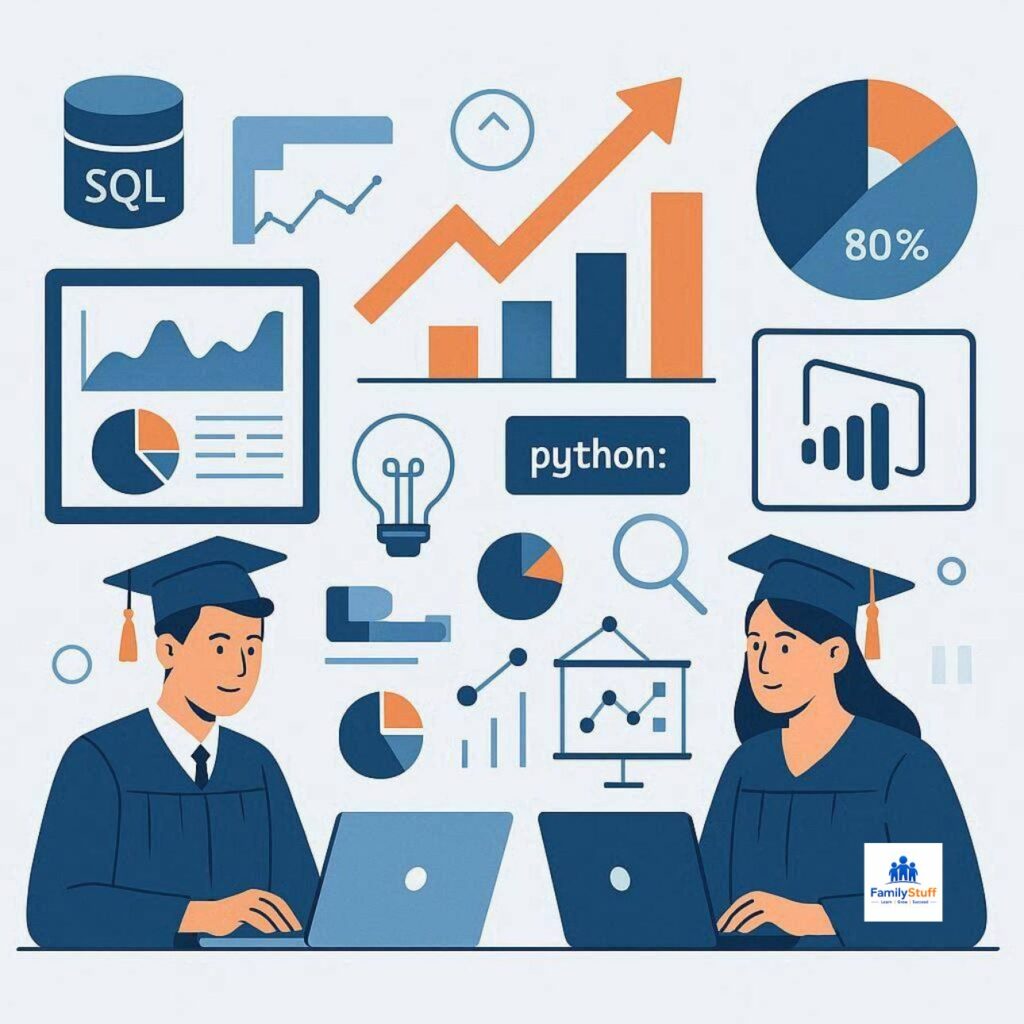
Data has become one of the most valuable assets for businesses worldwide. From startups to multinational corporations, organizations rely on data to make informed decisions, improve customer experiences, increase profits, and stay ahead of competitors. As a result, Data Analytics has emerged as one of the fastest-growing and highest-paying career fields.
If you have recently completed your graduation and are wondering about your next career move, enrolling in a Data Analytics course can be an excellent choice. Whether you come from a commerce, science, arts, engineering, or management background, data analytics offers opportunities for graduates from almost every academic discipline.
In this guide, we will explore the best data analytics courses after graduation, career opportunities, required skills, salary expectations, and how to choose the right course for your goals.
What Is Data Analytics?
Data Analytics is the process of collecting, organizing, analyzing, and interpreting data to identify trends, patterns, and insights that help businesses make better decisions.
Companies use data analytics to:
- Understand customer behavior
- Improve marketing campaigns
- Predict future trends
- Reduce operational costs
- Increase business efficiency
- Enhance product development
- Manage risks effectively
Data analysts transform raw data into meaningful information that organizations can use to grow and succeed.
Why Choose Data Analytics After Graduation?
The demand for skilled data professionals continues to rise across industries. Businesses generate enormous amounts of data every day, creating a need for professionals who can analyze and interpret it effectively.
Benefits of Learning Data Analytics
High Demand
Organizations across sectors are actively hiring data analysts and business intelligence professionals.
Attractive Salaries
Data analytics roles often offer competitive starting salaries and strong long-term growth potential.
Opportunities Across Industries
Data analytics skills are valuable in healthcare, finance, e-commerce, education, technology, marketing, and many other sectors.
Career Flexibility
You can work as a full-time employee, freelancer, consultant, or entrepreneur.
Future-Proof Career
As businesses increasingly rely on data-driven decision-making, analytics professionals remain in high demand.
Top Data Analytics Courses After Graduation
1. Data Analytics Certification Programs
Certification programs are ideal for graduates looking to enter the field quickly. These courses focus on practical skills and industry-relevant tools.
Topics Covered
- Data analysis fundamentals
- Excel for analytics
- SQL databases
- Data visualization
- Reporting techniques
Best For
Fresh graduates and career changers.
Career Roles
- Data Analyst
- Reporting Analyst
- Junior Business Analyst
2. Business Analytics Courses
Business Analytics focuses on using data to solve business problems and improve organizational performance.
Topics Covered
- Business intelligence
- Predictive analytics
- Decision-making models
- Dashboard creation
- KPI analysis
Best For
Commerce, management, and business graduates.
Career Roles
- Business Analyst
- Business Intelligence Analyst
- Strategy Analyst
3. Data Science and Analytics Programs
Data Science courses combine analytics, statistics, machine learning, and programming.
Topics Covered
- Python programming
- Statistics
- Machine learning
- Data visualization
- Predictive modeling
Best For
Graduates interested in advanced analytics careers.
Career Roles
- Data Scientist
- Analytics Specialist
- Machine Learning Associate
4. Google Data Analytics Professional Certificate
This beginner-friendly program is designed for individuals with little or no prior experience in analytics.
Topics Covered
- Data cleaning
- Data transformation
- Data visualization
- Spreadsheet analysis
- SQL fundamentals
Best For
Beginners entering the analytics industry.
Career Roles
- Data Analyst
- Operations Analyst
- Junior Data Specialist
5. Power BI and Data Visualization Courses
Data visualization is a crucial skill in analytics. Power BI is one of the most widely used tools for creating interactive dashboards.
Topics Covered
- Dashboard design
- Data modeling
- Business reporting
- Interactive visualizations
- KPI tracking
Best For
Graduates seeking business intelligence roles.
Career Roles
- Power BI Developer
- Reporting Analyst
- BI Analyst
6. SQL for Data Analytics
SQL is one of the most important skills for data professionals. It helps analysts retrieve and manage data stored in databases.
Topics Covered
- Database management
- SQL queries
- Data extraction
- Data filtering
- Performance optimization
Best For
All aspiring data analysts.
Career Roles
- Database Analyst
- Data Analyst
- Reporting Executive
7. Python for Data Analytics
Python has become the preferred programming language for analytics and data science.
Topics Covered
- Data manipulation
- Data visualization
- Statistical analysis
- Automation
- Predictive analytics
Best For
Graduates interested in technical analytics roles.
Career Roles
- Data Analyst
- Data Scientist
- Analytics Consultant
8. Advanced Analytics and Machine Learning Courses
These courses focus on predictive models and artificial intelligence applications.
Topics Covered
- Machine learning algorithms
- Predictive analytics
- Data modeling
- AI applications
- Pattern recognition
Best For
Professionals aiming for advanced analytics careers.
Career Roles
- Machine Learning Analyst
- AI Analyst
- Predictive Analytics Specialist
Essential Skills Required for Data Analytics
Success in data analytics depends on developing both technical and business skills.
Technical Skills
Microsoft Excel
Excel remains a valuable tool for data analysis and reporting.
SQL
Database querying is a fundamental requirement in most analytics roles.
Power BI
A popular business intelligence and visualization platform.
Tableau
Used for creating advanced visual reports and dashboards.
Python
Widely used for data analysis, automation, and machine learning.
Statistics
Understanding statistical concepts helps analysts interpret data accurately.
Soft Skills
Critical Thinking
Analysts must identify patterns and solve business problems.
Communication
Data insights must be explained clearly to stakeholders.
Attention to Detail
Accurate analysis requires careful review of data.
Problem Solving
Organizations value professionals who can translate data into solutions.
Career Opportunities After Completing Data Analytics Courses
Data analytics opens doors to numerous career paths.
Data Analyst
The most common entry-level role in analytics.
Responsibilities
- Analyze datasets
- Create reports
- Identify trends
- Support business decisions
Business Analyst
Focuses on solving business challenges using data insights.
Responsibilities
- Analyze processes
- Improve efficiency
- Recommend solutions
- Track business performance
Business Intelligence Analyst
Specializes in dashboards, reporting, and business intelligence tools.
Responsibilities
- Build dashboards
- Monitor KPIs
- Generate insights
- Support management decisions
Data Scientist
An advanced role involving predictive analytics and machine learning.
Responsibilities
- Develop predictive models
- Analyze complex datasets
- Build machine learning solutions
Marketing Analyst
Uses data to improve marketing campaigns and customer engagement.
Responsibilities
- Campaign analysis
- Customer segmentation
- ROI tracking
- Market research
Salary Expectations in Data Analytics
Salaries vary based on skills, location, experience, and industry.
Entry-Level Positions
₹4 LPA to ₹8 LPA
Mid-Level Professionals
₹8 LPA to ₹15 LPA
Experienced Analysts
₹15 LPA to ₹25 LPA
Data Scientists and Advanced Specialists
₹20 LPA to ₹40 LPA and beyond
Professionals with expertise in Python, machine learning, cloud analytics, and business intelligence often command higher salaries.
How to Choose the Right Data Analytics Course
Define Your Career Goals
Choose a course aligned with your desired role.
- Data Analyst → Analytics Certification
- Business Analyst → Business Analytics
- Data Scientist → Data Science Program
- BI Analyst → Power BI Certification
Check Course Curriculum
Ensure the course covers:
- Excel
- SQL
- Power BI or Tableau
- Python
- Statistics
- Real-world projects
Look for Practical Training
Employers prefer candidates with hands-on experience and project portfolios.
Evaluate Industry Recognition
Select programs from reputable institutions with strong placement support and positive student outcomes.
Consider Flexibility
Online, hybrid, and self-paced options allow graduates to learn while preparing for interviews or working part-time.
Future Scope of Data Analytics in 2026 and Beyond
Data analytics continues to be one of the most promising career fields globally. Emerging technologies such as Artificial Intelligence, Machine Learning, Big Data, and Cloud Computing are increasing the demand for analytics professionals.
Industries actively hiring data analysts include:
- Banking and Finance
- Healthcare
- Retail
- E-commerce
- Manufacturing
- Education
- Information Technology
- Telecommunications
- Logistics
- Government Organizations
As businesses become more data-driven, professionals who can transform data into actionable insights will remain highly valuable.
Final Thoughts
Data Analytics is one of the best career options after graduation for students from diverse academic backgrounds. With strong demand, attractive salaries, and opportunities across industries, analytics offers excellent long-term career growth.
Whether you choose a certification program, business analytics course, Power BI training, SQL specialization, or a complete data science program, developing analytical skills can significantly improve your employability and earning potential.
The key to success is selecting a course that combines technical knowledge, practical projects, and industry-relevant tools. By investing in data analytics skills today, graduates can build a rewarding and future-ready career in 2026 and beyond.
Familystuff Tip: Start with foundational skills like Excel, SQL, and Power BI before moving into Python, machine learning, and advanced analytics. Building a strong foundation will accelerate your career growth and help you stand out in the competitive job market.